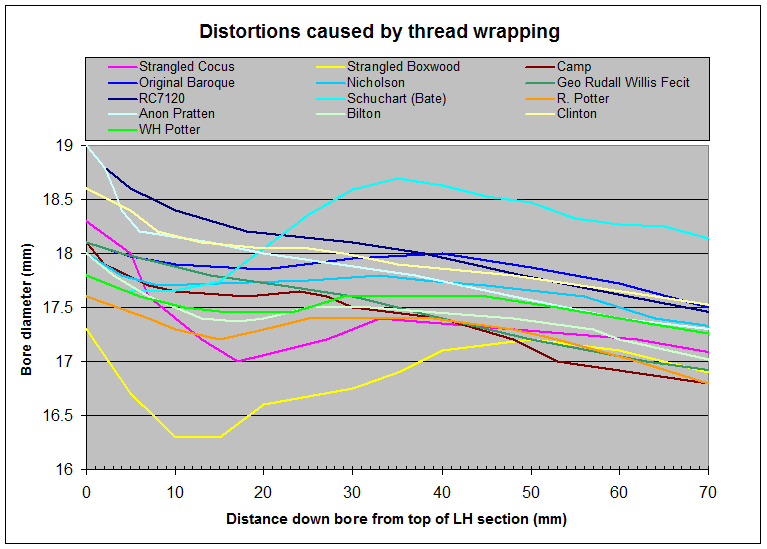
About now, we might be starting to think, OK, I get it, tightly bound thread wrapped around thin tenons particularly in relatively soft and thin timbers is going to end up with cellular collapse and compressed or even strangled bores. But, just in case we’re getting a bit smug, I am aware that that doesn’t appear to be the end of it. As I mentioned above, I haven’t even had time to consider Claire’s work to see if she references the same issue. Later…
Check this set of bore curves, from my “Classical Bores I have known” page.
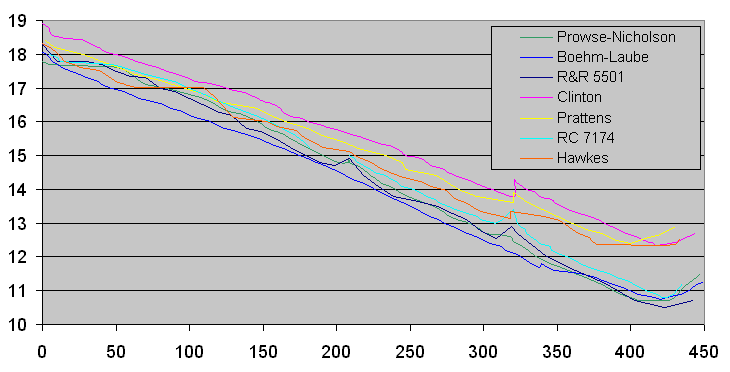
If you look at the bore traces over the first 30mm from the left, you can see signs of tenon compression in most of them. Nothing new there, just confirmation that this is a commonplace issue. The varying shapes of the compression is interesting…
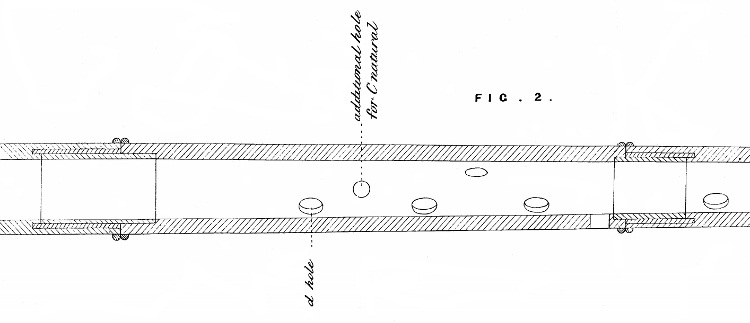
Coincidentally, most of these flutes are of the “long body” type, so there is no LH/RH tenon-socket joint, except for Rudall & Rose 5501 and Rudall Carte 7174 (navy and aqua traces). Their middle joint occurs at around 210mm. Note that there is evidence of tenon compression at the bottom of the LH section on both. But there is also appearance of bore expansion just below the joint. What?
All of the flutes have a separate foot joint, circa 320mm in from left. Again we now expect to see some tenon compression leading up to that, and we often do. But again, we sometimes see what appears to be bore expansion just into the foot bore.
Now, in the light of my and Claire’s work, it’s easy to understand the tenon compressions. The thin wood of the tenon gets wet and tries to expand, the tight bands of thread wrapped around it prevent that. Cells are crushed, and when the moisture evaporates, the wood shrinks to a smaller size than it used to be. This loosens the thread wrap, and the diligent owner compounds the problem by rewrapping the thread tighter. History repeats itself, maybe many times.
But what explains the bore expansions just below the sockets these tenons plug into? If the bands of tight thread are busy stopping the tenons expand, they can’t be also expanding the insides of the sockets, can they? Or are we seeing some kind of general collapse except in the areas that that these bands of tight thread are?
And what is the role of the (usually) metal rings that support these sockets? If a band of tight thread can cause mayhem, surely a metal band has some powers too?
I don’t have answers at this point, only questions. Just alerting you to them, to demonstrate our work here is not yet done…