Climate in India?

We’ve probably all come across 19th century English-made flutes with massive cracks to head and barrel, and sometimes to sockets further down. Such cracking was almost inevitable in the US and Australia, and can be readily explained by the difference in climates. I imagine since central-heating and air-conditioning became common, the same is increasingly happening to 19th century English-made flutes in England.

It puzzles me though why Clinton chose to label his all-metal conical the Flute for India. I’ve not been to India, and I’m hoping we might hear from someone who has, but it’s my impression that while India can be pretty hot, it’s generally not that dry. Indeed, I’m thinking monsoonal. Or am I wrong?

From the price-list pamphlet:

MESSRS. CLINTON & Co have much pleasure in announcing, that they have been honoured with Her Majesty’s Royal Letters Patent for the construction of a new Metal Flute, manufactured expressly for India. This Instrument is particularly recommended to the notice of all flautists who reside in extreme climates. It has long been a subject of regret, and almost an universal complaint, that amateurs of the Flute experience much inconvenience and annoyance from the fact that Wooden Flutes will not stand the climate of India - they so frequently split, and thereby become useless until sent to England to be repaired, incurring much expense in the transit to and fro, and depriving the performer of his instrument for a considerable time.

Here’s the instrument in question:
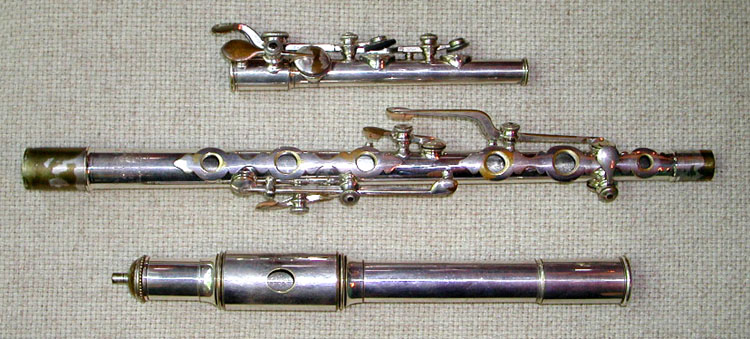
More about it at: http://www.mcgee-flutes.com/clint-India.htm
Depends on where you are. Here’s a climate map:

https://en.wikipedia.org/wiki/File:India_map_of_Köppen_climate_classification.svg

The Indian subcontinent has a lot of variability when it comes to climate, from desert to wet, from hot lowland to cool montane, and everything in between. I’m not surprised that wooden European flutes had a hard time of it. Using metal is practical given India’s highly variable conditions. Metal flutes could be sent anywhere, or be taken from one extreme to the other, and not suffer; a wood flute made in moist England and shipped to the arid Punjab would be on borrowed time at best.

Woah, yes, that tells a tale, doesn’t it. Seventeen different climates in one country. So, depending on where the poor flute ends up, it could be soaking in monsoonal downpours or enduring warm or semi-arid desert conditions, and everything between.

Interesting to swap the word Australia for India in that link. We have 10 climates, covering about the same range, but most of our population lies in the mild groupings. I’m in the Temperate Oceanic Climate, rated Cfb - “Warm temperate, fully humid, warm summer”. Same as Britain? Hmmmm.
Gorgeous day outside (20C, on the third day of winter). Probably not quite like Britain!

Ah, now this is interesting - a whole world climate map. India comes in generally as AW - “Equatorial, Winter Dry” under that system. “Winter Dry” sounds ominous. Just add a nice cosy fireplace…

Check out your climate compared to Britain and it might give some insights into how a 19th c flute would fare chez-vous. (But keep in mind the air-conditioning/central heating complication!)

https://www.weatherbase.com/gr/koppen.png

Personally, I am of the opinion that all wooden flutes and their stock ought to be seasoned and made in desert conditions; that way the flute could be equal to any circumstance. After all, humidity-wise there’s nowhere to go but up. Your outback would be perfect, you know. Fancy a move to the Red Centre?

Urk! Not good for my complexion…

Unfortunately, while starting at dehydrated might seem like a good idea, it has drawbacks too, and I can illustrate at least some of them:

  • wooden heads and barrels will subsequently expand, releasing the metal tuning slides inside.*
  • wooden stopper cores will expand, jamming the stopper tightly inside the head slide.*
  • the sockets will try to expand, but the open end will be restrained by the ring. The socket will end up reverse-tapered, so that the tenon will rock inside, unless…
  • the tenons will expand and will jam in the narrow opening of the socket
  • the key-slots will expand, leaving the keys a bit loose
  • the bore will expand, with possible effects on tuning.

You just can’t win, can you?

  • I came across both of these issues in a Michael Grinter flute I repaired some 6 months or so ago.
    Michael was pretty secretive about how he went about doing things, but I do remember discussing with him the tricky business of preparing flutes for different climates, and him mentioning he used a dehumidifier. I use an environment chamber to achieve the same ends. The technology probably doesn’t matter, but the degree of dehydration, and the safety margins you leave are critical.

It illustrates the folly of treating wood as an engineering material. You can see why Clinton went for the all-metal option!

I’ve often wondered if the reasons flutes didn’t make it much into Appalachian music in the US had to do with climate. But then again fiddles are plentiful, and fiddles are thin wood and objectively much more fragile than flutes.

There were players of wooden fifes in Appalachia, related to the fife and drum tradition. So I don’t think we can blame the climate as the reason why flutes are basically absent in what we think of as “Appalachian music.” I’ve read a lot of discussion about it without any settled opinion, as to why stringed instruments were favored.

As far as climate goes, Chicago has a harsh winter climate, and we have to assume O’Neill and his gang at the Irish Music Club were playing their flutes and Uilleann pipes in heated rooms that were pretty dry. Of course we don’t know how many of them cracked. I can’t remember if he ever mentioned that in his writings.

He never mentions cracking as a problem–in fact he comments on flutes in Ireland as never needing maintenance. But he also doesn’t really take the flute seriously as an instrument–it’s all pipes and fiddle for him. He played the flute, as did others in the Chicago music club, but he never writes about it the way he writes about the pipes and (secondarily) the fiddle

Bamboo/cane flutes do well in India (I lived there for three years, traveled about, played flute). And
the fingering is just like a keyless Irish flute. There are some places that are very dry (e.g. Rajisthan) but most of India is pretty humid. Bamboo flutes are widely played. So I have doubts of the need or point of the Clinton flute. Perhaps the Brits wouldn’t want to be caught playing a native flute.

The following is all conjecture on my part, but some things come (randomly, I’m afraid) to mind: First, I assume that few bansuri/venu players traveled widely outside their home climates - not just out of economic considerations, but more likely because the local traditions they were schooled in kept them in close proximity to their audience who were of like culture and its ensuing expectations. Beyond the recreational novelty, a fluteplayer from Kerala would have little musical reason to go to Rajasthan: it may not be so evident to Western ears, but the Carnatic and Hindustani traditions (south and north, respectively) are fundamentally different, and those traditions have their own myriad variants. There’s more incentive for the traditional Indian musician to stay put rather than range far afield; in that case, a bamboo flute’s physical stability is pretty well assured.

Of course, these days Indian trad travels widely and has occasionally broken out of its parochial nature, but novel combinations and experimentation are more the exception than the rule.

In contrast to my assumption about native players, it is easy to imagine that during the Raj, British fluteplayers would have been more likely to travel to contrasting climates; OTOH, it’s just as easy to imagine that Messrs. Clinton & Co may have taken a mere couple of instances of cracked flutes and wildly overstated the direness of the case in promoting their “solution”. While the practice isn’t universal, the bansuri/venu is commonly bound with thread wrappings, and this would also contribute to stability. Those of us whose Western wood flutes have cracked know all too well that metal ferrules are no bulwark against that.

As to an occupier not wanting to be seen “going native”, who knows; there was enough of it that it was a topic of discussion and varied opinion. The issue to me appears instead to be simply one of carrying on the Western tradition of keyed flutes for Western music.

What I’m curious about is whether, and how much, Clinton’s beast caught on.

Once when I was passing through Bombay I went to see a flute teacher. He was a little brown man in
his fifties. I had a metal Boehm flute and played it for him. He looked at me intently and said: ‘Relax,
Mr. Stone, relax!’

No, I don’t think we can blame climate for the limited use of flutes in Appalachia. Sadly, I just think the music fits better on fiddle. Doesn’t stop me playing a few Old-timey tunes!

And Indian-made flutes had the benefit of being made from just one material. Problem with Western-style flutes was the clash between the immutable metal tuning slides and the shrinking wood around them.

And we shouldn’t forget the rings, which were inclined to come off when the timber shrunk. Lose the ring and the flute was at great risk of splits at the socket. We should note at this point the several little grooves seen under rings on flutes made by Rudall & Rose. I’m assuming they were there to enable you to add thread to re-secure a loose ring.

I suspect, Nano, that “Clinton’s beast” - the Flute for India - didn’t catch on well at all. I’ve seen very few of them. But it’s probably fair to note that change was afoot - Boehm had already introduced his metal flute, Carte, Clinton and Siccama their new models, Pratten his Perfected etc. Cats were generally spending a lot of time among the pigeons.

I don’t think we should underestimate the problem Clinton was trying to address. Remember that other makers had embraced ebonite for the same reason.

Or the size of the potential market. I’ve dug out Kelly White’s thesis on Woodwind Instruments of Boosey & Co - she lists three pages of “Colonial Military” customers - about 120 companies with names like the 21st Madras Native Infantry, who bought instruments on 7 different occasions from 1868 to 1885, or the 3rd Bombay Native Infantry, purchasing 7 times from 1870 to 1898. There’s another list of “Colonies” - about 50 entries, with great names like HH (His Highness) the Nizam of Hydrabad (5 purchases), HH the Rajah of Mendhi, and the Maharajah of Mysore. Sales to India were big.

Has anybody done any systematic experimenting with preventing cracks? It seems like having wood and metal together–both the tuning slide and the rings–is asking for trouble. Can you make tuning adjustable without a metal slide? maybe a material with very low thermal expansion?

The only approach that I’m aware of is my “new improved tuning slide”, which I and some other makers routinely use, and seems to do the trick.

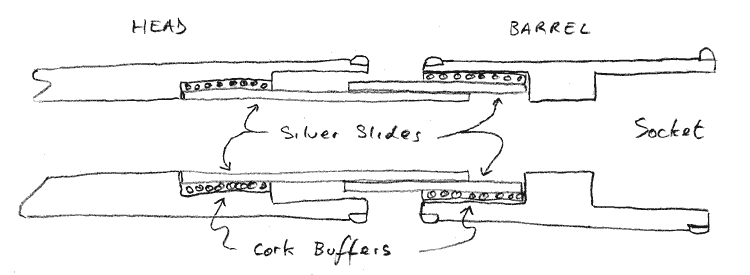
Excuse the rough sketch, but here’s the idea:

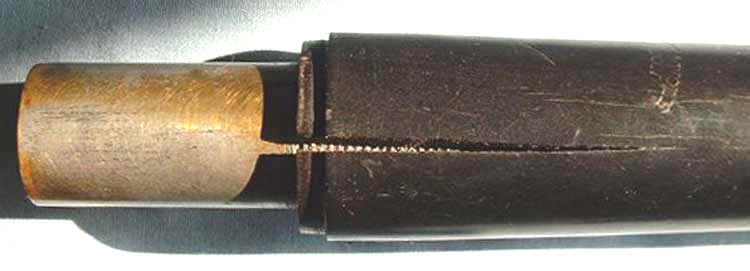
Instead of a full length head slide, I use the bare minimum length. That in itself won’t get you out of trouble, as we see plenty of examples of old French flutes with short tuning slides that crack only at the lined section, e.g:

The tricky bit in my arrangement is that, instead of the slides being firmly mounted inside the head and barrel, they are mounted with cork buffers as shown in the sketch above. This lets the wood move but keeps the slides in place.

Now, I say “as far as I know”. There may be other and indeed better solutions out there. I’d be keen to hear of them.

Oh, and I should point out that it’s not thermal expansion (of the metal or the wood or both) that’s causing the problem. It’s the movement (shrinkage and expansion) in the wood caused by changing humidity. Compounded by the fact that strong dense timbers like we use can withstand enormous pressure (think railway sleepers), but crack very easily under a riving force. Especially in the very thin sections we like on our flutes.

Given that it’s a humidity effect, the worst situation will be when the flute is made in a damp climate and exported to a dry one. 19th century England (think poorly-heated workshops in foggy London) to central India certainly fits the bill. But so did Australia and the US.

Which brings us back to using ebonite, or more recently delrin, instead of wood. We gain on both fronts. These materials are not humidity affected, and, having no grain, they don’t split easily. But it’s hard to kick the wood habit!

More about the “new improved tuning slide” at http://www.mcgee-flutes.com/fluteslide.html

Fiddles are nowhere near as fragile as flutes. I have both, several of each. Fiddles are pretty much indestructible and will only improve with age. Flutes, OTOH, deteriorate from the moment they’re made. (I am completely confident in my statement about fiddles; less so in my statement about flutes.)

i’ve heard it proposed a few times that while fiddles improve with age for a long time, eventually this reaches some sort of plateau and the wood begins to degrade rather than improve. there’s some concern that the oldest old itatlians might reach this point soon. unfortunately the number of old italian fiddles i own (i.e., zero) isn’t enough to investigate if this is actually true…

fiddles aren’t indestructible and they do crack; this is a common repair job for luthiers and (much like flutes) shouldn’t affect the instrument when done well. i know a few people who have needed crack repairs done on their fiddles. but i do have the impression that cracking is much less common on fiddles, and they seem to be generally more tolerant of changes in climate than flutes do. maybe that’s because flutes are solid and round, while fiddles are made of separate parts which are held together with a weak glue that often breaks before the wood? or, maybe it’s something to do with fiddles being held under tension when they’re strung, while flutes aren’t…

that might be true, but maybe it’s more that making a metal keyed flute was easier than trying to retrofit the simple system keywork onto a bamboo flute? (i don’t really know anything about Indian flutes, but i’m assuming they are quite different to play than 8-key simple system flutes.)

Ah, Terry, you have won my heart. :thumbsup:

I think that’s probably true, and also for flutes vs. all the other string instruments. Hey, maybe we’re back to why flutes never made it into Appalachian OldTime music! :slight_smile:

My fiddler S.O. still has the fiddle she learned on as a child, and it looks fine after almost 50 years. I have my grandfather’s fiddle which is much older, and it was able to be repaired into playable shape (although it will never sound great, it’s a cheap fiddle).

Fiddles and flutes can both develop cracks from environmental stress, but both types of cracks can be repaired, so that comes out about even. The profile of wear over time is different though. Flutes wear in places that are more difficult to repair, like strangled or otherwise warped tenons, or warping of the entire barrel (for boxwood?). Apparently if you play as hard and as often as Kevin Crawford, you can even wear out the shape of the embouchure hole! In contrast, most of the playing wear on a fiddle is either peg wear or divots in the fingerboard, which are relatively easy repairs.

One other factor may be the scarcity of repair techs who know how to address issues with a 19th Century wooden flute design, compared to the scads of stringed instrument repair people out there. This may be one reason why wooden flutes are seen as more fragile over time, if there are just so few people who know how to repair them and keep them going through the years.

Heh heh, Nano. Are you a person given to riving, or just an enthusiast for fine old words?

As you may remember, I also work with carillons, and our National Carillon is undergoing a major upgrade to bring it into the modern era. (There’s been some great work on bells, clappers and carillon mechanisms over the last 50 years, some of which I’ve had the honour to be part of.) We’re also adding a large bell, and that’s brought me back into contact with a few great old words.

Bellmakers use a shaped “strickle” to create the smooth inner surface of the mould for the bell. When you use the back of a knife to level off a teaspoon of sugar in cooking, you’re actually using it as a strickle.

And once something is cast or moulded, removing any remaining protruding ragged edges is called fettling. We still see the root used as in “Nano sure appeared in fine fettle today…”

It makes you wonder what flute-making archaisms we could revive to add solemnity and intrigue to our work-a-day endeavours?

Well, they’re not under tension now, since the nice Indian gentleman convinced Jim to relax!