Flute for Research Purposes

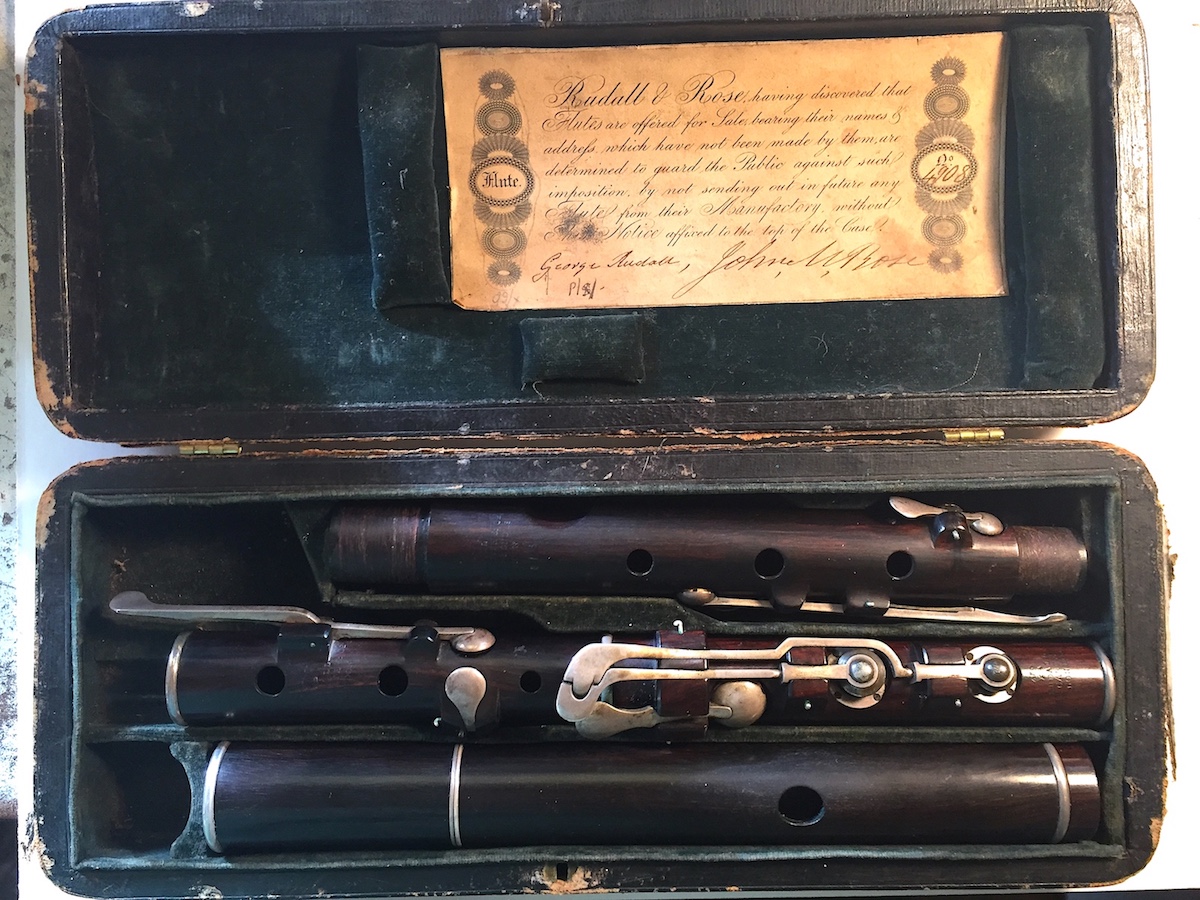
I’ve decided to hang onto this Nicholsonized Rudall, Rose and Carte (#6078) and am purchasing it, instead of trying to sell it for my friend John. Its a lovely specimen with great playing properties and all intact, just needing some minor restoration etc. Eventually I might make copies of this one, blocks and all - though that will take some tooling up and practice3. Its rare that I do something like this!

Casey

Darn, another one off the market.

Have you shown us an image of this beast, Casey? Damn, I’m drooling on the keyboard again…

#6078. So around 1854?

See below, Terry.

I’ve been slowly measuring this flute with an eye towards reamer making. A conversation over breakfast in June with Robert Bigio in Vancouver has me rethinking how I will approach reamer making for copying this. According to him, the Rudall, Rose and Carte flutes and their predecessors were all reamed with several different straight taper reamers in combination, instead of reamers with various bumps and grinds. Robert apparently has in his possession many of the reamers they used along with other tooling.

This one when I tighten up the pads and open the two foot joint keys (these are a little stuck in their mortises and need service) this thing plays like a dream.

You can see in this image the cutout for the left hand forefinger. Not visible is the square of shark skin for the thumb placement on the right hand. These are the “Nicholsonized” features. Also, note that the case, while it fits, is actually for another Rudall and Rose flute. I like the engine-turned illustrations on the label.

I left the image at full size so that you can look at it closely.

Casey

Thank you Casey. I was wondering what this flute looked like. It looks like there is not much that needs to be done for it.

Its a great specimen for sure!

Do you think the carve out was original? I have never seen that on a Rudall before.

left-hand excavations were not unheard of on Rudall&Rose flutes, the distinction of Nicholson flutes of Clementi and some (later) by Prowse.

I have a very very early R&R (no serial number from the 7.Tavistock address) in which there is the left-hand excavation as well as a small indentation for the right thumb, another Nicholson feature.

I have owned several R&R flutes over the years (and have two others in possession) that have this feature as well.

And I had another at one time that Pat Olwell used as the model to make the indentations for my own flute.

So…they do exist in fair numbers.

Woah. “I left the image at full size so that you can look at it closely.” I’ll say. Almost as good as being there, Casey! Good on you!

I wonder if this is as wide as Chiff & Fipple has ever been pushed? I visualise moderators clinging to restraining ropes as Chiff & Fipple tumbles headlong through space and time, leaving Earth orbit, possibly to end up plunging into the sun…

(Sorry, moderators, it’s been a long day…)

“According to [Robert Bigio], the Rudall, Rose and Carte flutes and their predecessors were all reamed with several different straight taper reamers in combination, instead of reamers with various bumps and grinds. Robert apparently has in his possession many of the reamers they used along with other tooling.”

It would be interesting to press Robert on the dimensions of those reamers, and graph them against the measured bore of this flute to look for correlations. I’d expect some constraining at the tenons (because of the thread), and maybe some shrinkage overall, but you would hope to see correlations in the body sections proper.

“this thing plays like a dream”. Gorgeous. Now, from the images, it doesn’t appear to be a large-holed flute. I’m thinking more the dimensions of Chris Norman’s #742, which is similar to what I based my “Rudall Refined” model on. Discussed at http://www.mcgee-flutes.com/RR742.htm Hole 5 around 8mm (5/16"). But, is that a mistaken interpretation?

And, if it is a “small holed Rudall”, of which they seemed to make a lot, it’s later than I thought we see such instruments. Big difference between #742 and #6078 when the top number is somewhere a bit north of #7000! Interesting.

It’s all interesting. One day we may get close to understanding what they were up to back then!

Interesting that the case was intended for Rudall & Rose #4908 (circa 1844), but seems to work pretty well for Rudall, Rose & Carte #6078 (circa 1854). I guess it’s only 10 years, but it was at a time of considerable change.

Now, turning to the Nicholsonian features, Casey, how do you find them, comfort wise? I had a play with some of these way back but wasn’t convinced. But I wouldn’t rule out returning to the topic. Anything we can do to improve player comfort and safety deserves our closest attention.
It’s good to see the detail, but best through linking to the full-res. from a smaller image sized for the forum.

If we’ve had bigger, it wouldn’t be by much. Normally of course it would be a nuisance, but this is different.

Chiff & Fipple: Come for the flutes, stay for the trippiness.

Robert published an article on reaming flutes that discusses these Rudall & Co. reamers:

On Reaming Flutes
Robert Bigio and Michael Wright
The Galpin Society Journal, Vol. 58 (May, 2005), pp. 51-57

By the way - I saved that image to a smaller size, but it appears that the C&F stores the first instance on the page. Oh well - I tried. Enjoy it at its magnified glory!

Casey

… available for download at: http://woodwindshelp.weebly.com/uploads/2/3/7/9/23791000/on_reaming_flutes.pdf

If you look at the graph of bores on page 55, you’ll see some steps in some of the bores at around 180mm and 315mm. The authors attempt to explain these away: “The steps between the sections on flutes 264 and 281 were caused by the maker inserting the reamer further into the wood”, but if that were the case, the bores wouldn’t line up elsewhere!

I think it’s clear that the two flutes with the big steps (#264 and #281) were suffering bore strangulation at the tenons, due to overtight thread wrapping. They are of ivory, whereas #241 (the unbroken trace on the graph) is of lignum vitae, and shows no compression. These are very old flutes that will have had loose thread tightened many times over their lives. The directions of the steps are consistent with tenon bore compression.

Note that there is no sign of tenon compression up at the top of the bore an any of the flutes. That’s because Stanesby put his tenon on the end of the head, and socket at the top of the LH section. I imagine if we examined the head bore of the ivory flutes, we’d find compression there too. Indeed that would be very instructive, as the head bore is normally a simple cylinder.

Note that one of them has limited data given at the top of the bore because of damage. That damage is likely to be a crack in the socket there, leading to an apparent expansion of the bore.

Anyone interested in the topic of bore strangulation by thread wrapping can find my study on the topic starting at:
http://www.mcgee-flutes.com/wrap-survey.htm

Thanks for posting the link to this article! I think it provides convincing evidence that flute bores were produced by using reamers.
This was the author’s claim and I think he proved it quite convincingly. I think we need to be careful not to read too much more into
it than that though.

Regarding the question of whether the reamers were straight or not, the article shows that the bores they produced were not precisely
straight. Even each section of the bore that was claimed to be produced by a separate straight reamer was not precisely straight. There
is an assumption (stated as such) that the maker of the reamer intended it to be straight, but did not have access to precision machining.
But this leaves open the question of whether the resulting flute sounded good because of the error or despite it. Really, it doesn’t matter
for modern makers because we do have access to precision machining and can reproduce the variable bore profile of the nice sounding
flute quite accurately. Hence, we can produce a copy of the instrument that also sounds good, which is the main goal, isn’t it?

Its actually not too difficult to make a reamer that has an irregular profile. However, even if you can produce one you may still choose to
make several smaller reamers instead. Reasons for doing this are that the small reamers are easier to use, cut better, catch less, and
are much less stressful to make, in the sense that a mistake in machining at the late stage of milling the cutting edge does not waste as
much work on a small reamer as it would on a large one. Basically, using multiple small reamers instead of a single large one allows the
reamers to be constructed incrementally, and once each piece is finished, the work you put into making that part is “safe”.

Also, if reamers are hardened to make the cutting edge last longer, there will be much less warping of a short reamer than a long
one. Warping basically ruins a reamer because it prevents it from cutting a bore profile that matches its own dimensions.

On the issue of thread strangulation, I do not agree that the most obvious steps in the graphs are evidence of this. I’m not saying that
bore compression due to thread wrapping does not exist, I’m just claiming that the abrupt steps in the graphs are due to something else
entirely. My take is that these steps simply coincide with the ends of each section, and that the reason there is an abrupt step is because
the bore diameter at the end of one section simply does not precisely match that of its adjacent section. This happens if you insert a reamer
too far, or not far enough in either section. In practice it is difficult to get the insertion exactly right. Note that this problem can occur
regardless of whether the bore of a multi-section flute is reamed using a single reamer or multiple reamers, because with a single reamer
you also have to decide how far to insert it into each section, and if you go too far you enlarge the bore of that section too much causing
a step in bore profile as you go to the adjacent section.

I do see slight evidence of bore compression on the left hand tenon of 264, and the right hand tenon of 281, and that might be due to
thread wrapping, but that is a much more subtle effect than the steps themselves.

I have a number of reasons to be confident we are seeing strangulation:

  • if the three bores were made pushing the reamers in to different degrees, we’d expect to see three parallel graph traces, never meeting. But the three traces are intertwined, and tend to agree in the mid-points between the ends of each section. Those are the points we would expect to see least impact of strangulation. That suggests to me the reamers were inserted to the same degree.

(I don’t think it’s hard to get the degree of penetration of the reamer consistent. As you see in the article, you just make a mark on the reamer and insert it up to that mark.)

  • the deviations are greatest at the tenons and sockets, where we would expect if strangulation were to be involved.

  • the directions are what we expect to find. Tenons are always squashed, sockets are always expanded.

  • we do see some impact of strangulation further into the flute from the tenons or sockets, but it is reduced. Which makes sense. It’s further from the point of strangulation, and the timber there is much thicker than at the tenons.

  • we see a marked difference between the two ivory flutes and the lignum vitae one. The lignum vitae flute does not show signs of strangulation. Its trace sails serenely through the middle of the expansions and squashings shown by the ivory flutes. We know this stuff is legendary - the most dense and strong timber traded. Used for the propeller shaft bearings in submarines. Used by the English police force for its truncheons (ouch!). If any timber could withstand strangulation it would be lignum vitae. It would appear ivory is considerably less strong.

  • finally, note the similarities between the distortions of the Stanesby ivory flutes and the Richard Potter boxwood flute I studied in the second of my series on strangulations:

Not so, Casey; C&F stores nothing, but simply displays the version you uploaded to http://www.caseyburnsflutes.com/RRC6078.jpg.

Oh well - I tried. Enjoy it at its magnified glory!

It’s certainly good to look at!

It occurred to me later that you could also display the full-size image through the ‘img’ tags in an otherwise empty post (or one with very few words) and post your text to a separate reply before or after. That way you’d only have to scroll horizontally for the image and not to read the associated text, which is the most awkward bit.

Terry, I think the graph you posted of your Richard Potter flute does show convincing evidence of
strangulation, but the graph in the paper by Bigio and Wright does not show the same pattern.

None of the three flutes show significant deviations from a straight line in the tenon part of their
left hand sections. The three lines are not identical to each other, but we do not know that precisely
the same reamer was used for all three. They each have small deviations from a straight line along
the left hand section of their bores, but these are similar in scale along the entire length of that
section, unlike your Potter which shows more constriction around the tenons.

In the Bigio paper graph, the right hand sections of 264 and 241 have some constriction of the bore
close to the tenon, but the shape is identical between the two of them and quite different from 281.
I’m not convinced that any of the three show a strangulation pattern here. If 281 was strangled, surely
the constriction would start higher up the bore, and if 241 was strangled, surely there would be a
discontinuity in the bore going from right hand section to foot, but there is none.

Regarding your statement that “if the three bores were made pushing the reamers in to different degrees,
we’d expect to see three parallel graph traces, never meeting”, the main argument of the paper is that
the graphs of all three flutes are in fact similar enough to prove that they were all reamed. So are the lines
similar or not? The obvious places where the lines intersect is at the joints, but this discontinuity is easily
explained by variations in reamer insertion AND by use of distinct reamers for each section which might
not precisely agree with each other. This seems to be the obvious explanation for the discontinuities
given what we know about the way multiple small reamers are used.

The left hand sections of 281 and 264 are almost identical, as are the right hand sections of 241 and 264.
The gradients of the lines for the left and right sections of each flute are more or less parallel to each other,
and in both cases the discontinuity occupies no length and occurs in precisely the same place for 281 and
264. 241, on the other hand does not seem to have any discontinuity in its bore, even though it has a
constricted area like 264.

I think the graph of these three flute bores simply shows that the reamer manufacture and insertion were done
more accurately for 241 than for the other two flutes and that there is little convincing evidence of strangulation
in this graph. The graph for your Potter flute tells quite a different story though.

OK, maybe we’ll just have to disagree on this one, and that’s OK.

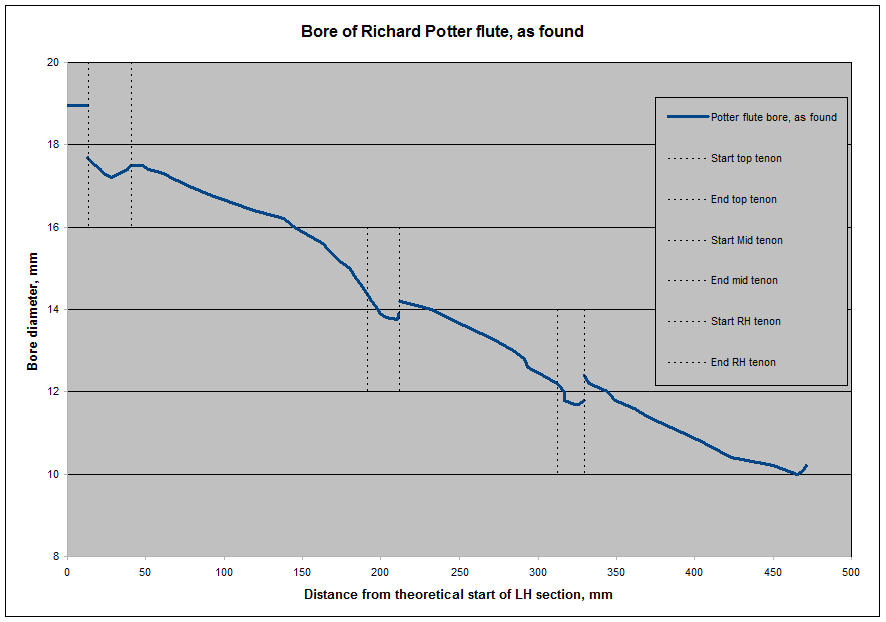
But now, see what you make of this. Look at around 280mm on the Potter Graph, which I’ll reproduce here:

Note the sudden reduction of diameter.

Now look at the graph of the Stanesby bores in the article, at around 265mm. Two of the bores show very similar sharp reductions, but the third bore doesn’t. But the odd thing here is that the Lignum Vitae one is aligning with one of the ivory flutes, not standing out from them as it does in most other disagreements.

So, is that kink movement or intention? If intention, what was the intention? 280mm along the Potter is the middle of the Short F key block, but I’m not sure that’s significant, as only one of the Stanesby flutes (281) has a Short F and it’s the one that doesn’t have the kink.

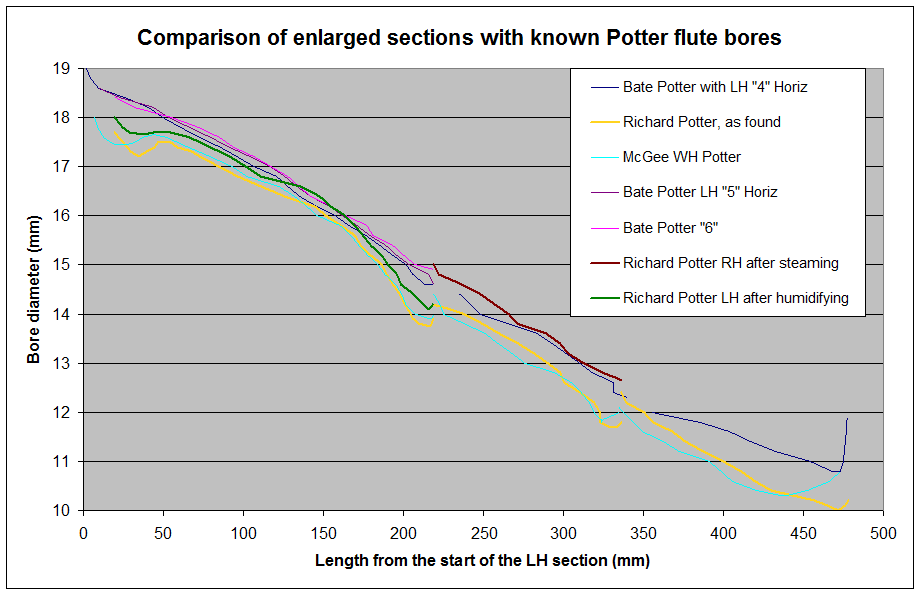
Now look at this latter graph in the Strangulation 2 series. You’ll see the same as-found bore, thick and in yellow, showing the same sudden reduction as seen in the graph above.

But compare it with the RH section bore after steaming trace, shown in brown. Almost gone. And note how much bigger the section has come. That suggests to me the kink was caused by strangulation. But I’m open to other interpretations.

Now look at the graph of the Stanesby bores in the article, at around 265mm. Two of the bores show very similar sharp reductions, but the third bore doesn’t. But the odd thing here is that the Lignum Vitae one is aligning with one of the ivory flutes, not standing out from them as it does in most other disagreements.

I agree that these two flutes have a very similar bore constriction here, as does your Potter. There are many possible explanations for this, and none of them really seems conclusive to me. It might be due to strangulation, but then why does it start so abruptly so far from where the thread resides, and why do only two of the three flutes exhibit it? It might be due to some other kind of movement, but then why does it occur so similarly in two very dissimilar materials (lignum vitae and ivory) and not in a third, almost identical ivory flute? It may have been the maker’s intent, but its not clear what the intent was. Just a wild guess for the sake of argument: maybe it was an attempt to achieve a better balance between a cross fingered F nat and F#, or to reduce the reach for the R3 hole?

Another possibility is that it is not intentional but occurred as a side-effect of a mis-shaped, broken or worn reamer. With long term use the leading (narrow) end of a reamer wears much more than the trailing (wider) end, because it removes much more material. A worn reamer will not cut the narrow part of the bore as well as it will cut the wider part, so this would cause unintentional narrowing of the bore toward the foot end of each section, but not toward the head end. This could also explain the discontinuities in the bore diameters at the joints, even if the reamer was inserted to the intended depth precisely. It could also explain a narrowing of the bore in the location you identified, but it is surprising that the narrowing begins so abruptly. One hypothesis for why this might be so is because attempts to sharpen the blunted narrow end of the reamer were localized. Perhaps the length of the constriction corresponds to the width of the grinder wheel or sharpening stone used on the reamer?

If we assume that the bore constriction is due to movement or strangulation that occurred later in the flute’s life, then it is very difficult to explain why the bore of the right hand and foot sections of 241 continue to align so perfectly. This implies that if the strangulation had not occurred then there would have been a discontinuity between the two in the other direction (the end of the right hand section bore being substantially wider than the start of the foot section), which would be an unusual observation. And even if this was so, I find it hard to believe that the flute suffered strangulation that just happened to precisely fix a hypothetical initial error in the flute’s construction.

I don’t think that any of the possible explanations for the deviations in these three flutes is really proven, but it seems most likely to me that the use, wear and abuse of the reamers themselves contributed heavily to the shapes we observe, in addition to centuries of movement due to the effects of humidity changes in flute sections that have non-uniform shapes, wall thicknesses and hole sizes/locations, and also, in some cases, in addition to the effects of bore constriction caused either by thread wrapping/strangulation, or by the machining of seating areas for the thread.

In contrast to the graphs in this paper, I do find the shapes exhibited in your graphs of Potter flutes to be more convincing evidence for the effects of strangulation on those flutes. In the case of those Potter flutes, it is the location of the constrictions that convinces me, not the discontinuities in bore diameter from one section to the next.

I don’t have any difficulty with seeing the discontinuities as potential signs of strangulation.

Firstly, the open end of a tenon is a point very close to where the compressive force of the wrapping is centred. And, being a thin and open end, it’s pretty weak, compared to say the shoulder above the tenon, which is much thicker and well supported. I think it would be very surprising if the compression didn’t often include the open end, especially in the softer woods.

Secondly, both modelling the compression and testing with simulated tenons confirms it.

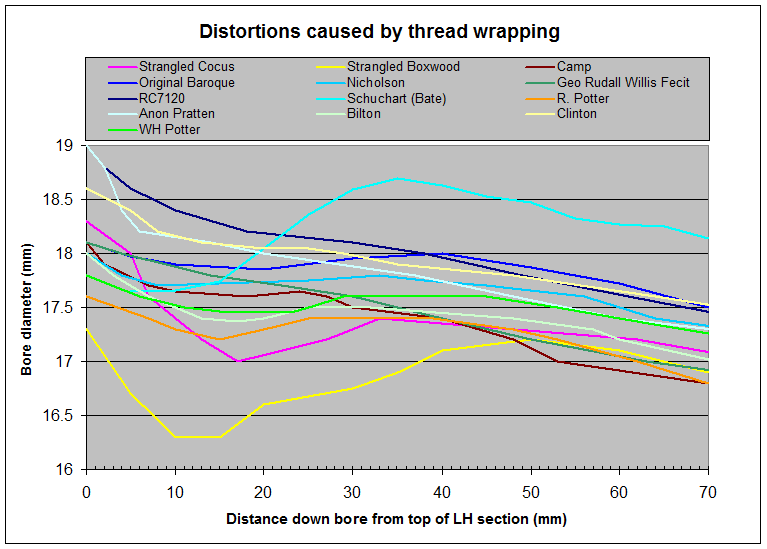
And finally, I guess, because I’ve seen so much of it. Even in this little survey I did at the start of the series, almost all the flutes appear to have serious compressions including discontinuities at the top of the LH section. Remembering that most of the flutes shown here have head bores around 19mm, look how their LH sections start out - anywhere between 17.3 and 19mm:

The centre of the threadband will be around 15mm in, and that’s where, predictably, you tend to see the greatest compression. But clearly, it often affects right back to the start of the bore. The Strangled Boxwood flute is a startling case.

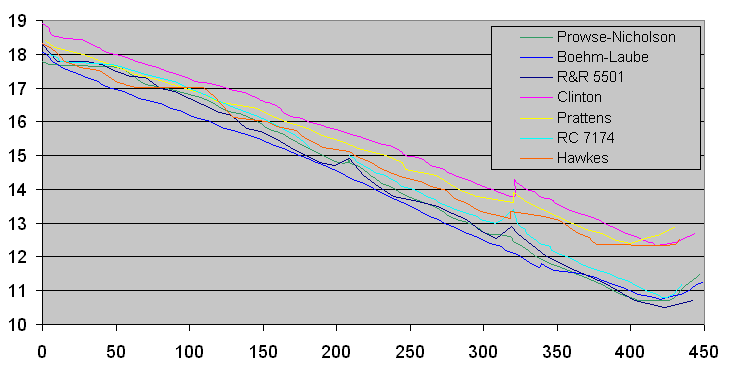
And many of them had similar issues further down, as shown here:

though note some are discontinuities (vertical on the left side and sloping on the right) and some are just compressed (sloping both sides of the junction). Interesting.