This info is tremendously helpful. I am so thankful for you guys willingness to share your knowledge and the pictures.
I was able to get several assorted springs from a local woodwind repair shop. The general policy is that he doesn’t sell parts, but since I’m not trying to repair something he made an exception. He even gave me some tiny screws. Andy, thank you for the Ebay link. I kind of forget Ebay exists sometimes. That’s quite a reasonable price for the springs.
Terry, I am attempting to model my key similar to your McG#. It is putting my CAD skills to the test. I can model square boxes with rounded corners all day long, but naturally shaped and curved surfaces are forcing me to learn more about geometry. This means I don’t have a prototype printed yet, ha. I also have only had a couple hours to work on it the last few days.
I like the idea of the double springs, but for now I will plan on just one to eliminate extra moving parts and alignments. If I had a rock-solid mounting method already I would consider it, but I have a long way to go.
I am back with an update! Before you get your hopes up, I do not have a working key on a working flute, but I have made progress. Designing things that work seem to always take longer than I expect, but I enjoy the process and I’ve already learned a lot. I’ve printed two models so far, and the second one is promising.
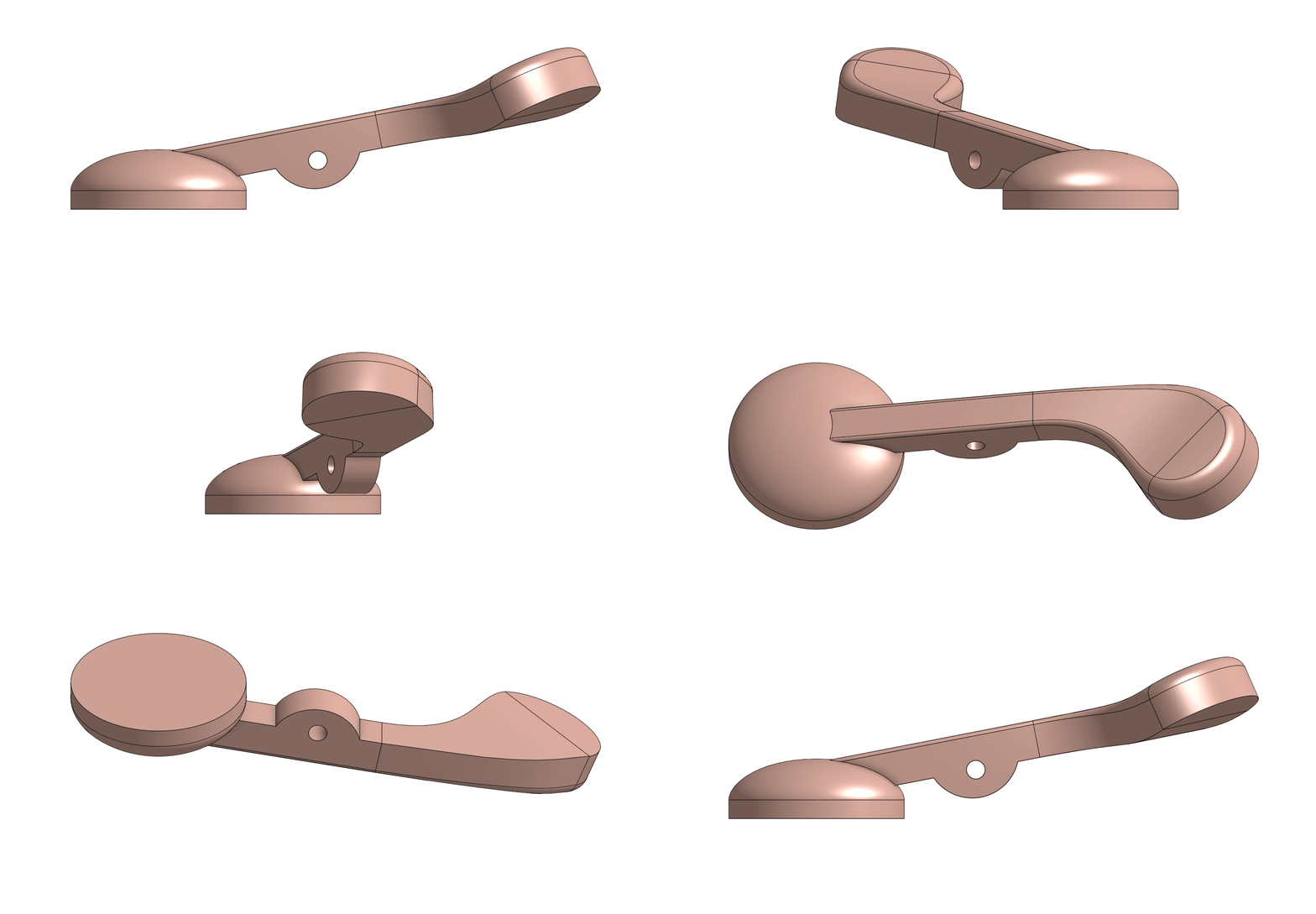
Designing: I am no 3D design genius, and I am always happy to get helpful criticism. Before this, most of the models I’ve made could be sketched flat on a plane, and then extruded in various directions in various layers. That method isn’t useful for more complex shapes. I almost extensively used “lofts” to make this – drawing multiple flat sketches in different planes and then connecting them to each other. I tried to imitate the McG# shape as best as I could.
Prototype: The first print especially made me realize how low quality my 3d printer is. I printed with PLA in 0.08mm layers, and it was rough. I had it a little too thin, (it was flexible) and the spring screw went right through the touch. The 2nd print is a little better. I used a rough file to clean up some imperfections, but didn’t do any sanding.
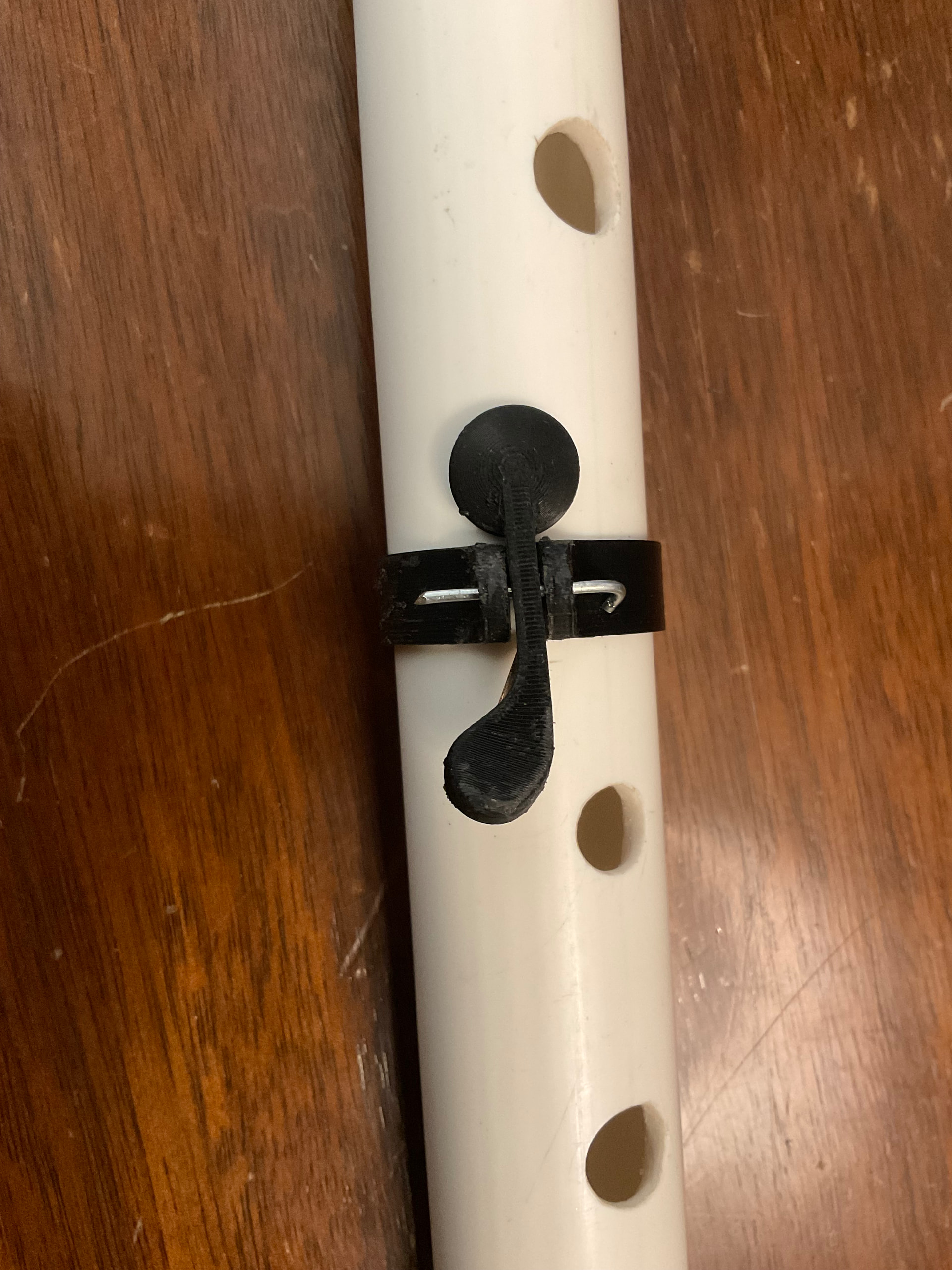
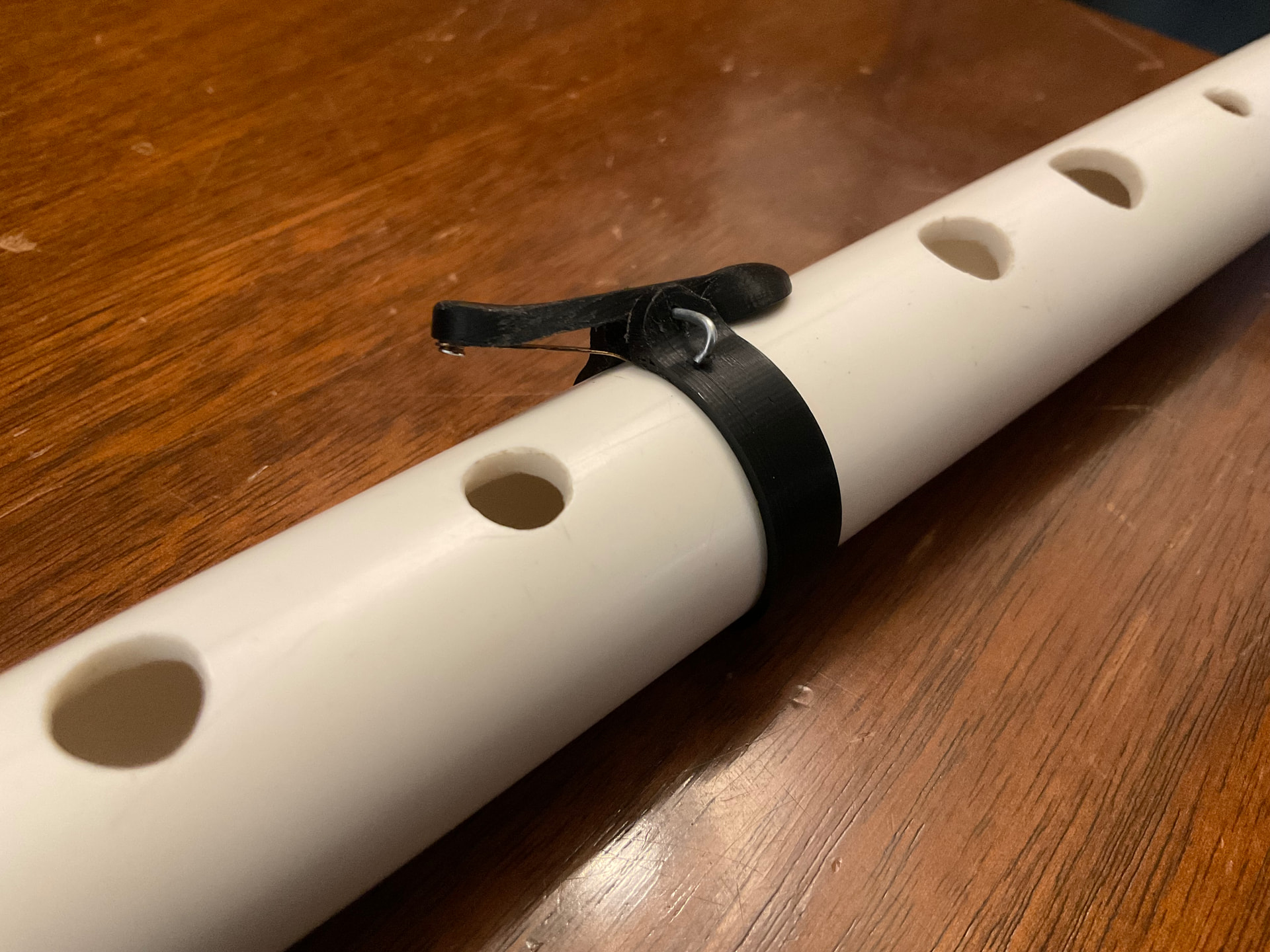
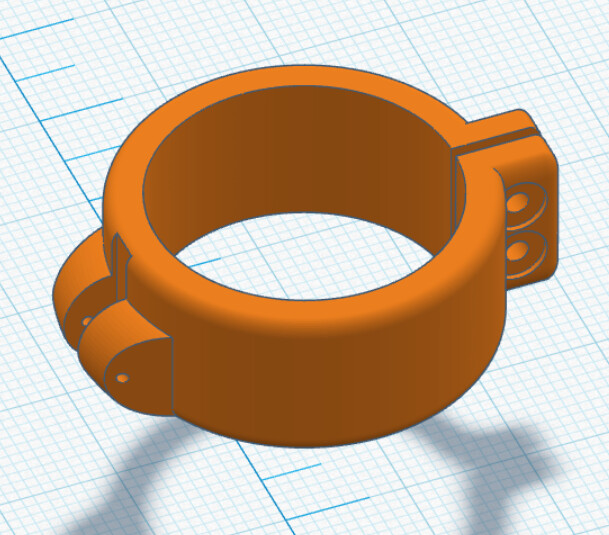
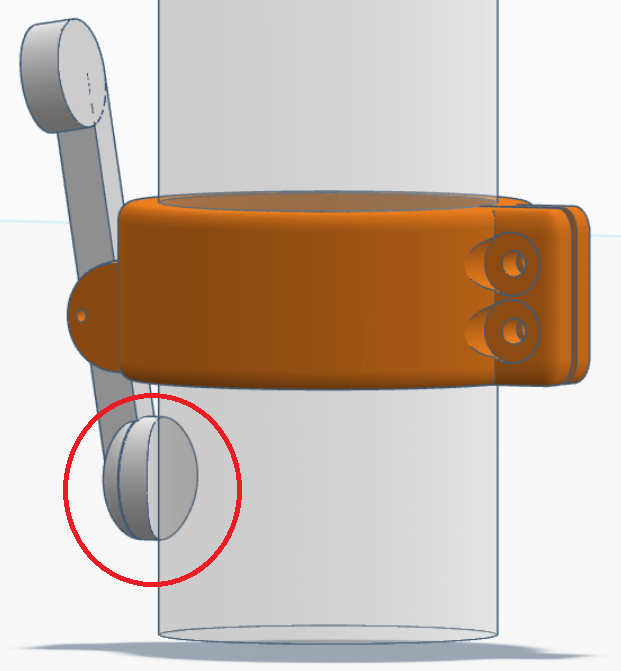
I have it temporarily positioned on one of my first bad PVC flutes. No G# hole, no pad on the key yet. The printed ring has a slot that allows the spring to theoretically get past the fulcrum point, as well as keeping it from splaying to the side. The spring surprisingly worked to my satisfaction without any modification. Compared to a concert flute or clarinet key (with needle springs) it feels firm, but I think that will help seal the hole better. When I press it all the way it has less resistance than when its sitting closed! Here’s a video. 3d printed simple system flute key prototype V2
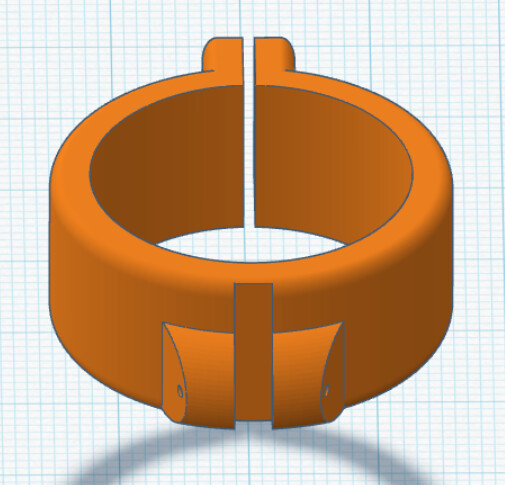
Next version with have some minor geometry changes, and I will tighten the space between the key and the “blocks” so it can’t wiggle side to side (see the first picture).
It can be fastened on a flute/whistle (25mm OD) with two M2.5 screws through the back holes.
(I would suggest you using PETG, which is stronger than PLA and have longer life.)
Here is the download link of the STL file:
And when you are making keys on a thin wall flute, it will be hard to form a counterbore for the keypad, so I would suggest you make the top of the key curved, and use thin EVA foam as keypads to get a good seal.
I do quite a bit of making replacement brass leaf springs for antique flutes. There aren’t really any “standard” thicknesses as such. I have documented the process, or parts of it, many times within my various photo albums on Facebook. You may find some time spent browsing them useful. Almost all are set to “public”: https://www.facebook.com/jemtheflute/photos_albums
Regarding G# key design/mounting, IMO the French crossways design is mechanically the best, though it does entail making the long C touch with an arch to vault the G# arm. It’s much better than the Monzani or Meyer 45° designs. (Playing-wise I prefer the classic in-line key to the 45° ones.) Of course the typical French ones are pillar-mounted, but there are block-mounted examples on some full size D flutes, whilst they’re quite common on smaller flutes like (English) F flutes, Bb trebles and D or Eb piccolos. If it can be fitted (of necessity - no tool for longitudinal mounting) on a picc, it’s doable on a concert flute!
Regarding bearings for spring tips, the glued or wedged in slip-plate is common on block-mounted examples, especially for the shorter keys. With pillar-mounted keys we generally find one of two historical solutions. On the earliest French pillar-mounted keys where the pillars are attached to mounting plates inset into the wood and screwed on, they usually provided a little groove on the mounting plate where the spring tip could bear and be limited from slipping sideways. Later, when pillars were screwed directly into the wood, they took to screwing in little German Silver/maillechort studs (same material as the pillars and keys) with a slot or groove in the top, located correctly for the spring tip (between the pillars and a little to the touch side of the axle). Initially a French idea, these are later found on some English pillar-mounted flutes, especially ones by Hawkes, who also adopted the French preference for blued steel leaf springs attached to the key with little blued steel screws.
Because I thought it would be quicker and easier than doing photos to illustrate some of the above, I’ve made a short video, but we can’t upload videos here, so it’s available on YouTube: https://youtu.be/joPuNZ2NMKE?si=GQGyjU2Pd0Y47Dmb