G’day all, I haven’t posted here in a good long while, so forgive me father for I have sinned  . Anyway I was hoping that someone here would be able to give me some specs to make my own Bass G whislte. I have plenty of PVC and Delrin to practice on, and I’ve already made a couple of Low D’s, a Low F and a few high d’s in Guido fashion with a mod or two of my own. So if someone can either take the time to write out some instructions on tube size, hole spacing and sizes or direct me to a site that has that down, it would be appreciated.
many thanks in advance,
Mick
There are several tools out there to help, if that is what you want. I wrote one - follow the link in my signature line (I recommend the downloaded version - it has a dedicated tuner!). Or search the web for Flutomat (Pete Kossel) or TWCalc (Daniel Bingamon). All three will help you with size/location. You may need to consider bore/length ratio, but I cannot remember the recommended range. I made a reasonable bass-A with 32mm id tube.
HTH
If I’ve done this right, here’s GG’s LowTech Whistle PDF.
Ok, it didn’t work. GG’s website should have it.
Sorry.
Jude
That would be here, actually.
Not sure why you wanted to link to that since the OP had indicated that he has already used the gentleman from Verona’s method to make several whistles, was seeking specs for a bass G and GG’s site has plans down to low C - which is not the neighborhood of bass G.
Makers will vary in their preference for the optimal lenghth-to-bore ratio. Boehm seemed to like 30:1 and makers of other flute styles like 20:1. If you keep things between those ratios, you should get a workable design. Your whistle will tend favor the high-end notes if you use a ratio closer to 30:1 and conversely it will tend to favor the low-end notes if you use a ratio closer to 20:1. Pipe with a bore from 1.25" to 1.5" might work out. It’s gonna be a big one, isn’t it? Have you considered the size of a bass G in terms of typical arm and finger sizes. I am reminded of Hatao’s video playing the Foggy Dew on his Overton bass G. Good luck.
Feadoggie
Thanks for the replies, I was looking for something a little Guido-esque as I work best with a drawn plan. Having said that I like DrPhill’s link. Far simpler to deal with than TWCalc. Complex mathmatical problems are not my strong point. It is precisely because I saw Hatao playing the Bass G that I want to make one for myself. The outlay to purchase Goldie’s Bass G on the speculation that I’m going to be able to play it, is too much. So I figured if I can make myself a reasonable Bass G and can learn to play it, down the track I will spend the money at the house of Goldie, and get a professionally made one, knowing that I have a good hance of being able to play it.
I will have to check the ID of my supply of PVC to see what I have, but I think it is 25mm (1") I can always get something bigger if I have too of course. It’s cheap enough and obtainable locally. Delrin is also cheap and obtainable locally if I need it.
Of course if it fails as a whistle, I can always use it as a bludgeon for home defence  .
.
Mick
Do you plan on making one with keys? I can calculate the holes for you.
I use 1-1/2" which is 1.6 inch ID PVC for the Low-D, you could probably use 1-1/4" PVC or 1" PVC for the Bass G. 1-1/4" Schedule 40 would be optimal.
Here’s a link to diameters for Schedule 40 PVC pipe: http://www.engineeringtoolbox.com/pvc-cpvc-pipes-dimensions-d_795.html
Thanks Daniel, I’m going keyless. I have 25mm OD PVC at hand (approx 21mm ID). You think that would do? Or should I get something bigger. I’ve made Low D’s from that. I would say they aren’t perfect, but for me they do the job fine. I have a proper Low D (a Goldie) for any serious playing, even though some pro muso friends were highly impressed with my home made whistle.
Mick
Keyless!!!
That would be some serious finger spread - I would say definitely pinky for the bottom hole (making the bottom hole too small will cause problems with octave intonation)
I’ve been messing with trying to predict bore ids recently and my somewhat educated guess (very somewhat) would be about 26mm id - 21 is more suitable for a low D. I may try to make one just to put a point on my graph of bore V id - but I think I would try to figure out keys as my whistle calculator is suggesting a bottom hand spread of about 120mm!
Good Luck
Highwood is right about the intonation.
A keyless bass whistle G=195.998 Hz with keyless toneholes comes out to this:
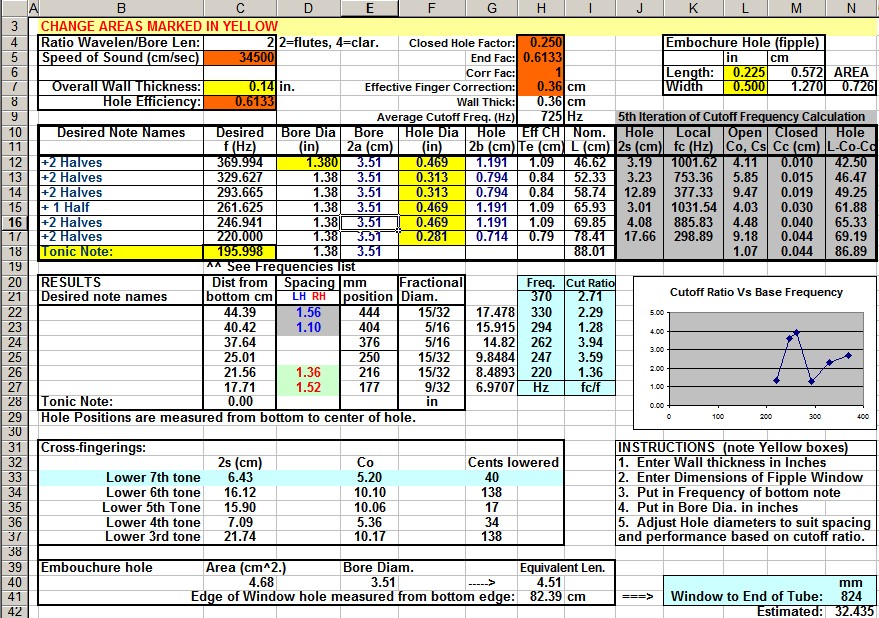
http://www.kingsmills.us/bass-g-cf.jpg
Spacing and Drill sizes in columns E22 and F22 going down.
It would be better if there was a one key on each hand.
If you were to build this using 1-1/4" Sched. 40 PVC tubing, you would start out longer than 32.43 inches and trim it down until it plays in tune (the length formulas vary depending on building techniques.)
The lowest hole on each hand shows a cutoff ratio of less than 2, therefore those toneholes would sound fuzzy might not even sound at all in the second octave.
Well it seems I might be missing some vital technical aspect. How is it that Mr Goldie can build a very playable keyless Bass G in Aluminium, but I would most likely build a barely playable one in PVC or have to include keys (Putting aside for the moment, the fact that I am a rank amateur and Colin is a veteren builder)?
I don’t mean to sound rude or arrogant, I’m just a little frustrated here. I’m still going to have a go at this, but I would like to give myself the best chance for success by learning the pros and cons before I set out on this mini journey of mine.
Mick
a very playable keyless Bass G
I searched for the bass g video and found one that I had not seen before: http://www.youtube.com/watch?v=GGAXe1p-KN4
It does not look easy to play but I will agree that it is playable.
I’m not trying to put you off but rather forewarn you of some pit falls.
I tried my hand in the position in the video and think I could probably reach about 112mm (first to third finger). By making the bottom hole smaller than I usually would and tuning the low octave a touch sharp (to bring it up the instrument a bit more and to equalize the octave errors) - and making the third hole up larger than ‘normal’ and maybe making it a touch flat in the first octave (or just living with it being sharp in the second octave - note that I don’t think the 2nd octave C - xxx ooo - is ever played in the video) the spread is reduced and could be close to 112mm - so it is doable (which if you watch the video is obviously true!)
Offsetting the holes will also help - I make my larger whistle in several pieces to facilitate adjusting the offset, even trying to get right for one person is not easy but is possible.
The top hand is probably not a problem, though I have not really checked
So how far is your reach?
What size tube do you have - id and od
Maybe we can get this designed yet!
Bill
There are some other compromises that you can make if you want to go the keyless route. I needed to use these compromises to make a bass A whistle that I could physically play. Keys were too complex an option for me to attempt.
First I needed to put a bend in the pipe, as my arms were not long enough to reach the bottom holes comfortably. Then I discovered that my finger-spread was greatly increased by using thumb-holes for T1 and B1. Finally I increased my comfort level by moving B3 round the pipe a little.
Using thumbholes is a little awkward - actually holding the whistle for C# is tricky - but the greater spacing allows the holes to move closer to their ideal positions with increased sizes. The increased sizes give louder volume and a ‘fuller’ sound.
All of these techniques are well known - they were all suggested to me here on C&F. None of them requires any different calculation although I have a suspicion that the pipe bend changes the measured length. This matters little, since I trim the tube to match the tuner rather than the calculator.
I have a you tube video of an early solo playing attempt, and one playing with others, if you are interested.
HTH
I was planning on going out and getting some schedule 40 1.25" pipe today, but decided to hold off 'til I had this thrashed out here. Like I said, I would rather give myself the best chance of success. Doesn’t mean I will succeed, just that I will give myself a fair go to do so. I do have 1" on hand and thought it may be possible to make a ‘narrow’ bore Bass G. Any thoughts on this?
I never expected that a Bass G would be an easy whistle to play, but as Hatao has proven, the Goldie is a playable whistle, providing you can make the stretch. Which brings me to my hand stretch. I can, at the moment, cover a 125mm from index finger to ring finger on my bottom hand. and slightly more than that on my top hand.
With some practice I think my distance would increase as I used the hand to reach…Similar to the stretching practice required to go from high d to Low D.
I would really like to keep this whistle as true to traditional appearance as possible, so bends and offset holes either not added or kept to a minimum. I think I can do this without either, or perhaps that is the heart over-ruling the head. I would also like to thank all you blokes for taking the time to discuss this with me, and to help thrash it out. It really is very much appreciated.
Mick
Hey Mick, there’s a mob up your way that sell acrylics, in tubes and sheets, that might give you another option for material to use. You’ll find them on Ebay. I’m playing with some 40mm tube for a low low D (with keys).
@DrPhil - what id pipe did you use for you bass A? And I would think that using the thumb would take some getting use to - though it makes the spread much easier.
@Mick - offset holes will make the stretch easier and more comfortable to play and less likely to cause hand discomfort, from looking at the video I linked to I would say the Overton has offset holes on both hands.
I have a Low D which I made in 5 pieces - head, 2nd piece no holes, third piece three top holes (in line), fourth two holes, fifth piece with bottom hole.
I find it much more comfortable to play with the fourth piece slightly out of line with the top three holes to the right, and the bottom hole slightly more to the right.
It still looks pretty traditional.
Aluminum can afford to be thinner than PVC - this prevents deep chimneys in the toneholes, which in effect changes spacing. Thinner metals would be even better, but the expense and weight of the material is at hand.
Regarding pipe bend, I use a bend on my Bass-D Basswhistle. The pipe does widen somewhat when it bends and the area change has a small effect. Even a 15 or 30 Deg bend brings the direction of the tube back within the reach of your arms.
Everyone has their own playing techniques and the amount they can stretch - personally I try to play by fingertips - but that’s my own playing style.
Tonight, I pulled out a old piece of copper pipe that I’ve been saving. About 1.25 inch inside diameter, ~0.047 WT (approximate Wall Thickness). Would be kind of expensive to buy this today. It was lurking in the shadows of my workshop for a while, blew off the dust and clean the spider webs out.
I made a wood mouthpiece for it since I didn’t have anything big enough in plastic or acetal.
The piece is about 4 foot tall and it now easily plays a 146.83 Hz Bass-D. Tomorrow, I’ll trim it up to a Bass-G and try some toneholes in it.
Here’s a spreadsheet for the Bass-G copper:

The bottom is quite a stretch but can be reached by the pinky finger.
ID ~= 32mm, OD ~= 36mm. I used solvent-weldable pipe so that I could form the head easily without pins.
Thumb-holes do take some getting used to, but it comes with practice. I have also placed the holes so that I can use my finger pads so that I do not need to use a pipers grip. This meant that I could use larger holes which require more flesh to seal well.
My resulting whistle may even be classifiable as a new instrument - it differs more from a low D than a low D differs from a high D, so I can see why it’s eccentricities may not appeal.
Here the copper pipe Bass-G before trimming and toneholes
