Four keys for nine fingers?

So perhaps it’s a strange question, but I’ll start from the beginning…

Despite starting life a finger short on my left hand (frustrating, but trivial compared to what some have to deal with!), I’ve been playing music all my life, studied recorder in the UK and Holland, make my living teaching music and wouldn’t be too embarrassed to hear myself described as a multi-instrumentalist. But for all that I’d been strangely neglecting my first love (woodwinds) for years until a surprise request to play at two friends’ wedding this summer set me going again… and now I simply can’t stop! So it’s been mostly whistles since then, but now I’m back on flute as well (keyless for the moment) and find myself coveting a few keys, but what? Logically I’m thinking four-keyed flutes because you’re arguably getting everything you ‘need’ (yes, I’m aware of issues like the D to F slur without long F), I’m not sure how practical it would be to arrange the long F for me (about which more in a moment) and there’s always the option of a C thumb hole where a C key might help, but am still unsure whether a standard ‘old-style’ G# key will work for me? To clarify further, I’ve always played the G# on the Boehm flute with the crook of my LH pinkie (my ‘third’ finger, remember), but bring my RH first over to trill, don’t think I could manage that pinkie trick with perforated plates and realise that the Boehm G# hinges in a different plane from the simple system. But then again, I’ve also played a bit of oboe and briefly had the thumb-plate system B and Bb keys extended to bring them under the crook of that same pinkie (note the open A hole there, but it’s smaller than any flute hole I can think of) before ‘defecting’ to baroque oboe for a while, so guess the regular flute G# could work with or without some modification, but am less sure about the long F (oboe-style modification possible but again affected by both the plane of the action and what it does to my A hole cover?).

So what do some of our flautists here think? Four keys or six, and what might I want to be discussing with potential makers? (Not sure yet what I’d be going for, but ideally something nice but not enormously expensive, quite fancy Delrin, not necessarily a ‘copy’ of any particular old design and thinking something like a Copley keyed Delrin might fit the bill?)

Thanks
P

Well, with a suitably designed short F, persistence and practice (Nicholson fashion), the long one is dispensable, more so if you opt for a French style small-holed flute which offers the forked F natural. I should think some kind of R thumb or R1 G# (and even duplicate F) might be preferable to having to attempt dual function with your L3 pinkie, with the awkwardness of trying to keep it sealing the A hole the while. I reckon compensating for the normal support role of the R thumb being partially interrupted while operating such keys would be simpler than the hassles for L3. Or, again, a small-holed flute would probably give a good cross-fingered G# as well. Or there’s always the L thumb G# as on the more developed Ziegler type systems.

Just musing a bit there. I’d say definitely worth trying out on a French 5-key - they are not necessarily quiet flutes, though they won’t have an English bark to them. Needn’t break the bank, either, and they are often very well made with nice embouchures, though finding one at 440 rather than 432/5 can take patience.

Peter, which LH finger is the absentee? Sorry, I think I’m missing that, and I can’t quite tell from your avatar.

Dunno, but suppose it’s the middle or ring finger! My second finger is basically both fused from a double knuckle, so what I’ve got is one longer finger with a thicker base, skewed well to the side (normally play octaves on the piano with both that one and the pinkie on the lower key!) but coming back in to meet the index finger when bent…

Aye, it might (and I’m listening), but that pinkie thing comes surprisingly naturally after doing it on Boehm flute for c.35 years! OTOH, it’s useless if (as we both suspect?) the finger’s going to roll off the hole and leak, in which case R1 maybe sounds good. But surely that’s getting into ‘talk to the maker and pay for it’ territory?

Or, again, a small-holed flute would probably give a good cross-fingered G# as well.

Could be a useful bonus, but how many do? (Not my small-holed Sweetheart anyway!)

though finding one at 440 rather than 432/5 can take patience.

Not ruling anything out when I’ve only just posed the questions, but not sure I’m either wanting an old flute (which might be your first choice?) or likely to find anything that works unmodified.

Some further thoughts here (sorry for talking to myself, aka three replies in a row!), starting with a slight digression re. my left pinkie…

It’s a funny finger, clearly getting more exercise than the ‘average’ LH pinkie, sometimes flying like any other finger but sometimes (unpredictably) completely leaden/earthbound. Which is frustrating when L3’s such a crucial finger for flute/whistle ornamentation and neat gracing starts (IMHO) with being able to tap (or open) the hole so quickly you’re barely aware of the note. Now, while I’m quite happy to play low whistle with RH middle pads but prefer LH end pads, I’m also aware that my pinkie’s potentially faster when playing L2 (my fused finger) with the middle pad. Then, experimenting with my Sweetheart D this morning, I discovered that I could relieve a fair bit of LH tension by doing exactly that and it’s not feeling alien the way it does on the whistle (it’s the different angles, you see). So I’m seriously thinking of adopting that grip for flute (new tricks for old dogs, eh?) but ever more convinced that we’re talking custom G# solutions when neither grip’s looking good for my Boehm flute method.

All of which (to get to the point) brings me to a couple of questions about block-mounted keys… starting by asking how (if, as I believe, the blocks are a truly integral part of the body) the maker shapes the body next to the blocks when you presumably can’t turn a round shape with square obstruction on the lathe? And (if I’m right about that) whether a custom block in a different place is likely to be a big deal when they’ll surely have all their tooling set up for the standard options?

The blocks are turned round, and then either filed by hand, or milled away to create the final profile.

Don’t know if you are on Facebook, or if these are public enough to view, but try looking at Jon Cornia’s pics:

https://www.facebook.com/photo.php?fbid=1104979396834&set=a.1097894339712.2015382.1597255292&type=3

https://www.facebook.com/photo.php?fbid=1250319030234&set=a.1250316630174.2036803.1597255292&type=3

or the Folder showing a sequence of turning and cutting blocks:

https://www.facebook.com/media/set/?set=a.1250316630174.2036803.1597255292&type=1

[EDITED] - Dang, I guess Facebook will only allow you to view via those links if you are logged in, and you probably also have to be accepted as a friend. Maybe Jon has them posted elsewhere more accessible, or will give permission for me to copy them here.

Kevin Krell

Now thinking (while not too keen on RH thumb) that LH thumb has real potential…

Aye, I’m on Facebook, can’t see these, but thanks for the info and hoping to see them yet!

Also wondering if some of you could try something for me, which is to finger your G with LH index, ring and pinkie fingers (other combos with pinkie also possible, but maybe poorer matches for my ‘configuration’) and see if:

  1. You can even reach your G# key with the crook of the pinkie?
  2. You can depress the key like that without leaking the G?

Would obviously also be helpful to know the make and model of the flute!

Thanks
P

My flute teacher (Rob Sharer) has modified (lengthened) the touch on the G# key on his prime flute to be very long and fit just under the finger that closes the L3 hole, normally the ring finger. In fact so close under that straightening the finger can open the key and keep the hole closed both. He is quite adept at playing either note with one finger.
L

Hi Peter

I tried this on several flutes, the result was interesting and possibly helpful.

Original (i.e. 19th century) Prattens and a Rudall Carte were very difficult. I’d assume from that that modern copies would be equally difficult.

A typical German flute with its slanted key was impossible.

A French 5-key, by Lecomte, was considerably easier. The French 5-key has an "over-the-top G# very similar to the Boehm. Some modern Irish flute makers use this approach, so that could be worth following up. Be careful that some French 5-key flutes have surprisingly short touches on their keys - they would not be easy to use in this mode.

My own flute, with my “Bent & Twisted McG#” key, was also much easier.

I wasn’t expecting that, but I think I have an explanation, and that might help in your considerations. With my bent & twisted design, I can and do mount the slot closer to the top of the flute than is possible with the traditional symmetrical design. That I value because it gives L4 more of a downward action than an inward action. That is possibly helpful in your case. The other result is that you don’t have the skirt of the key touch under your finger, you have the central spine.

More at http://www.mcgee-flutes.com/mcgsharp.html

I’d have to say though, that I still find either mine or the French style difficult to use this way, though of course I don’t have the benefit of years of experience with your hand as you have!

I wouldn’t suggest just getting a flute with an over-the -top G# or my style McG# key - if you decide to go into this, I’d recommend you work closely with a maker to come up with the touch shape optimum for you. For example, I’d imagine making the key touch longer and thinner, to sneak under your pinkie further.

If you decide to come at it another way, consider also these options:

  • ditch the usual Lthumb Bb, replacing it with an R1 Bb. Give the Lthumb a G# key. Or,
  • keep the L thumb Bb and add an Lthumb G#, hinged just beyond the Bb hole with its touch above the Bb key. I have a German 11key with this arrangement and it works fine. (I couldn’t reach its down-the-side G# key in the approach you query.) I could send you an image of this arrangement if it sounds attractive.

Finally, here is an image of the amazing Captain Rebsomen as an encouragement:

Terry

Very helpful, Terry, so many thanks for the thoughtful and detailed post! (Also happy to tell you that, like so many others here, I’ve already spent hours engrossed in your fascinating site.)

The French 5-key has an "over-the-top G# very similar to the Boehm. Some modern Irish flute makers use this approach, so that could be worth following up.

Yep, Hans Bracker sent me some info about his Dominic Allan flute which does, but I’m still increasingly thinking that what works for me on covered Boehm plates (and worked with tiny oboe holes) is likely to prove far less satisfactory with my pinkie stretched to cover an open flute hole.

I wouldn’t suggest just getting a flute with an over-the -top G# or my style McG# key - if you decide to go into this, I’d recommend you work closely with a maker to come up with the touch shape optimum for you. For example, I’d imagine making the key touch longer and thinner, to sneak under your pinkie further.

With you all the way there!

If you decide to come at it another way, consider also these options:

  • ditch the usual Lthumb Bb, replacing it with an R1 Bb. Give the Lthumb a G# key. Or,
  • keep the L thumb Bb and add an Lthumb G#, hinged just beyond the Bb hole with its touch above the Bb key. I have a German 11key with this arrangement and it works fine. (I couldn’t reach its down-the-side G# key in the approach you query.) I could send you an image of this arrangement if it sounds attractive.

And interested in all of this, especially with (as stated a couple of posts ago) LH thumb solutions increasingly appearing the most elegant.

Finally, here is an image of the amazing Captain Rebsomen as an encouragement:

Now that really is something! Reminds me of some fantastic single-handed recorder arrangements, although part of my problem may be that (as you’ve probably all guessed) I’m basically expecting/hoping to be playing as smartly as anyone else despite my more modest ‘handicap’…

Thanks again
P

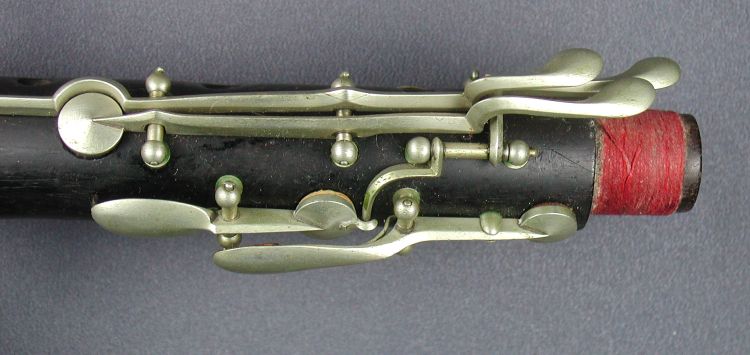
OK, here’s a quick snap of the relevant section of the 11-key:

We’re looking at the driver’s side of the lower end of the LH section - you can just make out the three fingerholes at the top of image.

Bottom right is the Lthumb-operated G# key. We can’t see the usual G# key because it’s around the other side of the flute. To the left of that is the normal thumb-operated Bb key. You can see it also has a linkage which enables it to be played by R1. You can see the usual R1 c-key, and a high e trill key, also operated by R1.

You can see that the thumb-operated G# key is no more complex to make than the common thumb operated Bb. Indeed it could be readily made in block mounting or post mounting, so any slightly adventurous maker should be able to do it. It might require fairly agile thumb work in tunes that have both A#/Bb and G#/Ab - perhaps players of such esoterica might like to mime it and comment.

It will certainly require a free thumb, and I’d recommend the 19th century three-point grip to ensure that. See my site for period descriptions, e.g:

http://www.mcgee-flutes.com/Rocksto_on_holding_the_flute.html

No reason of course why you shouldn’t go for a belt-n-braces approach - have a more typical (but carefully sculptured) left side G# key as well. This flute does.

Best of luck with it!

Terry

2:45am here, but some things are just too interesting to leave! So I’ve been trying to get some helpful photos, but suggest not reading too much into any blood-draining over-gripping, differences in arm position etc. when I was struggling to get them at all with tripod, manual focus and self-timer…

What you can see quite clearly here is how my pinkie rolls to the edge of the G key to get the G#…


Have also been checking what I’m doing here and have no doubt that my left thumb has complete freedom to move (and always has done) on both flutes!

:slight_smile:

2:45am here, but some things are just too interesting to leave!
Have also been checking what I’m doing here and have no doubt that my left thumb has complete freedom to move (and always has done) on both flutes!:slight_smile:

Of course, a Boehm flute player wouldn’t get far with a stuck thumb! Very good, so the Lthumb G# should be a definite goer.

Looking at your image of G# on the Boehm reinforces for me that it would be desirable to have a maker tweak the key specially for you.

Incidentally, a variant would be to have the Lthumb G# as per the German flute, and an over-the-top lever hooked under it near the pad so that it could be operated from the audience side too. Or the opposite, an over-the-top G# with an auxiliary lever for the L thumb!

Sleep now, Human…

Terry

Terry and I were thinking along similar lines… and your further thoughts plus your pictures clarify things. I think, on the G# front, the way forward is a French style G# key with a touch extended and angled as per Rob Sharer’s to facilitate L3 operation/slide-over, plus an extra “Tromlitz lever” to its cup for a L thumb key in a kind of reverse of the normal extra Bb touch. That would be a flexible resource and could be constructed quite elegantly. It would even be an easy modification to make to an existing French (key style) flute. (FWIW, there are later C19th English-made flutes out there with French-made or French-style-copied keys on 'em!). It would probably be a good idea to have the extra Bb lever for R1 as well.

Two further thoughts arise. One is that you may well be better off going for pillar mounted rather than block mounted keys, whether you opt for a new-made or antique (and adapted) flute - they are less likely to get in the way. The other is that, if you are going for having a long C key, your possible modified L middle finger position may pose problems in that the finger will collide with or overlap the shank of the key. You will probably have to chose between having the standard key and retaining your original hand posture or modifying the posture and having to either dispense with the C key or have that custom re-located too.

Another design consideration if you are going for new-build is whether to have a one- or two-piece body, as that affects the possibilities of tone-hole and therefore key placement (and maybe extra interlinkages) I suspect you would be best having a “Pratten style” one-piece body, regardless of the bore and tone-hole styles applied to it.

So, the L hand/upper body design seems to be in hand… :smiling_imp: Which leaves the R hand (physically normal) and the F natural question. If you dumped the normal G# in favour of a thumb-key only (or thumb key with R1 lever like the Bb), you could then have an extended long F touch instead: I doubt having both long F and G# would be practicable, howsoever cleverly constructed. Otherwise you are back to short F only, with or without tone-hole construction to allow for a viable forked F. If you had a one-piece body, there would be the possible option of another extra L thumb lever to open the short F

I have a demo video clip of a (slightly low pitch) 5-key French flute somewhere which shows how not-quiet and good sounding they can be - no time now, but I’ll try to upload it and make it available over the next few days. My thinking here is that you could acquire a French flute for relatively little money (under £200, even under £100) - it might not even matter if it was LP for test purposes (though if it worked well, being unable to use it in company could be frustrating!) - and even have experimental mods made on it comparatively cheaply (Ormiston, Reviol, Dom Allan, Worrell?). If you get a concert pitch one, it might be the ultimate solution, and even with modification costs, almost certainly far cheaper than a bespoke new-build. If not the final choice, it would help greatly in working towards a final design which you could be confident about for special order. (I have some in hand, though not worked on, and could even bodge up an experimental G# key extension.)

So obvious as soon as you think about it or pick the thing up! :wink:

Very good, so the Lthumb G# should be a definite goer.

Also good because it keeps the key on the same joint (assuming separate LH and RH joints)?

Looking at your image of G# on the Boehm reinforces for me that it would be desirable to have a maker tweak the key specially for you.

Absolutely! So it looks like I’ve got little or no room to move before starting to roll the pinkie off the hole and little below it to avoid accidental G#s, although this also raises the question of whether a slight leak from the hole’s going to kill the G# the way it kills the G?

Incidentally, a variant would be to have the Lthumb G# as per the German flute, > and > an over-the-top lever hooked under it near the pad so that it could be operated from the audience side too. Or the opposite, an over-the-top G# with an auxiliary lever for the L thumb!

Liking your thinking here, especially with the thumb option probably the percentage choice and one hole for two keys a tidy way to implement both!

Also thinking we’re probably talking relatively small-holed flutes with my pinkie stretched to cover L3, so have taken some crude measurements off my Sweetheart, giving us L1 at <=8mm, L2 at <=9mm and L3 at c.7.5mm with even centres of c.37.5mm. On which note I dunno how much bigger/wider I could go, and would simply have to try before committing there!

All good stuff, Jem, but responding separately because it came up while I was previewing my previous reply…

Two further thoughts arise. One is that you may well be better off going for pillar mounted rather than block mounted keys, whether you opt for a new-made or antique (and adapted) flute - they are less likely to get in the way. The other is that, if you are going for having a long C key, your possible modified L middle finger position may pose problems in that the finger will collide with or overlap the shank of the key. You will probably have to chose between having the standard key and retaining your original hand posture or modifying the posture and having to either dispense with the C key or have that custom re-located too.

No decisions yet about that L2 finger position (just play-testing for pros and cons, and need time for that).

Another design consideration if you are going for new-build is whether to have a one- or two-piece body, as that affects the possibilities of tone-hole and therefore key placement (and maybe extra interlinkages) I suspect you would be best having a “Pratten style” one-piece body, regardless of the bore and tone-hole styles applied to it.

Interesting (and I can see your point!), although I was also wondering if separate sections would leave me the option of tweaking my optimum LH angle?

So, the L hand/upper body design seems to be in hand… > :smiling_imp: > Which leaves the R hand (physically normal) and the F natural question. If you dumped the normal G# in favour of a thumb-key only (or thumb key with R1 lever like the Bb), you could then have an extended long F touch instead: I doubt having both long F and G# would be practicable, howsoever cleverly constructed. Otherwise you are back to short F only, with or without tone-hole construction to allow for a viable forked F. If you had a one-piece body, there would be the possible option of another extra L thumb lever to open the short F

My head’s buzzing (need to stop and work out how many keys we’re discussing now and what they do!)…

I have a demo video clip of a (slightly low pitch) 5-key French flute somewhere which shows how not-quiet and good sounding they can be - no time now, but I’ll try to upload it and make it available over the next few days. My thinking here is that you could acquire a French flute for relatively little money (under £200, even under £100) - it might not even matter if it was LP for test purposes (though if it worked well, being unable to use it in company could be frustrating!) - and even have experimental mods made on it comparatively cheaply (Ormiston, Reviol, Dom Allan, Worrell?). If you get a concert pitch one, it might be the ultimate solution, and even with modification costs, almost certainly far cheaper than a bespoke new-build. If not the final choice, it would help greatly in working towards a final design which you could be confident about for special order.

Have to say I really appreciate the likes of Terry and yourself taking such an interest, so rest assured that (despite my enthusiasm/excitement about it all) I’m not rushing into anything!

(I have some in hand, though not worked on, and could even bodge up an experimental G# key extension.)

Edit (following your edit): some whats, Jem? French flutes, concert-pitch French flutes, G# keys?

Cheers
P

French flutes. Can’t recall exactly what offhand and am in work now until 1 am. At least one 8-key, maybe a 6 key and a couple of 5 keys, some diapason normal (LP), maybe some at 440. Varying states of disrepair/amounts of work required. Will check tomorrow.

OK, so my ‘four-keyed’ flute has five keys opening four holes (Eb, short F, Bb and ‘dual action’ OTT/L thumb G#) and my ‘five-keyed’ flute has six opening five (adding the C)? Alternate R1 Bb and L thumb F touches (if both practicable and desired) bring me up to eight (potentially still opening just five holes?), and thank goodness I’m not interested in low C and C# because ten’s sounding like expensive clutter when my OP’s asking about four!

So how about this C key? The thumb hole’s clearly out of the question if I’m needing my L thumb for G# and Bb but, assuming I’ve got a good forked C (say OXXOOO), how do we rate clarity of keyed note, additional venting for C# and ease of moving between B and C? (No problems cross-fingering as a recorder player except where cross-fingerings cramp your trad style!)

Also, some more general thoughts (not key-specific) on aesthetics, materials etc. to consider…

  • While I prefer the appearance of a simple D foot to those longer versions with venting ‘C’ and ‘C#’ holes, I’m willing to be persuaded of their merits.
  • While I know that Terry’s opinions re. tuning slide construction and head linings may not be universally shared (indeed can’t be when good makers are still building fully-lined heads et al.), they make sense to me and I’d need some convincing to consider a ‘non-compliant’ new-build in wood.
  • I’m open-minded about block or post mounts for keys (can you still do post mounts on a Delrin body?).
  • I won’t touch boxwood with a bargepole for a new-build! (Irrational, perhaps, but never loved my expensive low-pitch Bressan-copy recorder quite as much after it warped while still new.)
  • While I can’t see myself rejecting properly-repaired cracks in an older instrument, I do have this thing about warping even when things play fine (see Bressan-copy recorder above).
  • While working with a relatively local maker obviously makes sense in terms of potential for hands-on collaboration, the most important thing’s got to be working with someone (wherever they are) who both understands what I want and accepts my foibles/hang-ups (see boxwood, lined heads etc. in new-builds).
  • Can’t help wondering whether makers are more likely to think ‘great, custom-build, something a bit different to try, potential website feature, let’s get cracking’ or ‘awkward job, difficult customer, really don’t fancy this’, but guess I’m looking for the former!

Might add that I’m bound to go trying baroque/classical repertoire on this flute despite being well aware that trad-optimised simple-system models are no more ‘baroque’ than Boehms. But then Bach still ‘works’ on Boehm flutes and pianos and you can’t give me keys and expect me to leave them alone!

And finally (as they say on the news), you should know that I’d written all of the above and saved it as a .txt file pending posting (or otherwise if I was saying too many silly things!) before heading back to Terry’s site, where I’ve just spent another hour or two discovering there’s nothing new under the sun and I might as well post my unoriginal (but not too silly) musings verbatim…

Cheers
P

Making pretty good sense, Peter.

For interest’s sake, have a look at this new eBay listing from Grzegorz Tomaszewicz, who lists quite regularly on eBay. He does doctor old LP instruments up to 440 (I have no idea how satisfactorily), but usually states that in his listings - though I’d be inclined to check with him before bidding on anything. If that flute does play with good intonation (of its kind) at 440, his asking price is very good value for money. But the main point in linking it was so you can examine the key lay-out of a French flute. Of course, this one has the added advantages of a long F and full C foot. One reason I often advocate antique flutes in conversations like this one is that there no extra cost in the bottom end keys when you buy an antique! Moreover, you might well be able to use (with due liaison with your maker) the antique foot on a modern bespoke body with your other mods built in!

Here’s the French flute demo clip I promised and you should be able to view some detailed photos of it here (let me know if you can’t).

One advantage of making experimental key modifications on a French flute is that their springs are almost always screw attached, making it simple to remove them whilst soldering, avoiding annealing (softening/de-tempering them), whereas English flutes until quite late tend to have sprue-rivets (part of the original casting) and German ones through-drilled rivets, so removing/replacing the springs is awkward/rather more work. Whilst the G# key on this particular French flute is not really reachable with L3 in its standard position, I can easily see a way to solder on an extension and bend it to bring it into a suitable shape and position.

As for what I have in hand awaiting attention which might be of interest from a consideration of technical possibilities angle (I’m not chasing sales here :wink: : the anon French flute in the clip/photos is fixed up but provisionally spoken for, BTW), there’s another decent anon 6-keyer, slightly low pitch with slide closed, but conceivably re-tunable with not too much difficulty, then there’s a definitely low pitch Couesnon 10 keyer - this has the normal 8 keys with C foot plus a high E trill and a Tulou F# lever - the latter being another thing you might find worth consideration!

Lastly there is a large holed 440-playable anonymous English 8-keyer with French style L hand keys and Bohm style rod-axle foot keys - the foot keys and the non-original long F are a mess at present, but readily fixable, and the lateral G# key is actually operable with L3 as-is in the way you probably require (I can just about do it without leaking the quite large A hole!) and could easily be improved a bit to that end. (If I just did this flute up for normal use I’d actually need to bend the G# more out of the way of L3!) This flute is in good condition apart from a routine head crack (non-embouchure) and the messed up old key alterations. It might well offer most of what you seek and be easily modifiable with regard to extra keys/touch levers as previously envisaged.

I haven’t any photos of this English or the two French flutes at present, nor time to do them this week due to other things needing doing, but there are possibilities. I think getting your hands on some of these things, even if not playable, would be a useful exercise for your development ideas, Peter, if there were a way we could arrange that.