Well, as you probably can tell from other questions I’ve posted, I’m looking for a keyed flute. I’ve put my name on the Olwell list, but am looking for an instrument to work with until mine is made. Whilst on this quest, I started to think about a serviceable antique.
Now, not being knowledgeable about antique woodwind instruments, I turn once again to you people for help. Are there instruments out there to be had? I know that there were more (and perhaps better) instruments available in the past (prior to the seeming Irish music revolution of the late twentieth century), but are there any good instruments still out there to be had for a reasonable price? And, if so, could anyone direct me to where they might be found and what to look for when choosing one? Also, with regards to repairs or reconditioning, are such services available and whom would you recommend if you can say it.
Do what I did. Mention to your favorite flute maker that if he/she ever has an old flute that they’ve fixed up that they’d like to sell, you’d be interested in buying it. Many flute makers buy antique flutes in order to learn more about how they were made and to restore them to playability, and often they’re willing to sell them if they need cash or want to turn around and buy some other old flute to learn from/work on. Typically if a flute maker sells a restored flute they’ll do it outside of the regular waiting list for their own flutes. And if you buy a restored old flute from a flute maker, you can be pretty sure it will be a good flute.
Takes more then CA glue to repair some of these cracks. We are talking major surgery… Wood grafts, ream jobs shortening and lengthening joints, I should have been a doctor…
My latest, that hasn’t been posted yet, is a Firth Hall & Pond 8 key. I had to replace all 3 sockets, that is boring out the socket and gluing in new wood. Head and barrel cracks, lower section had 2 cracks, but it is coming along nicely. I do occationally stick myself to the flute, thank heavens for CA glue removal!
Good point John has, flute makers can always use some cash flow.
An important thing to consider, if you want to be able to play easily with modern instruments, is the scale of the flute. Early 19th century flutes (eg “Geo Rudall, Willis Fecit”) had very long body scales, and therefore give a very “expanded” scale when played at modern pitch. Low notes very flat when the flute is tuned for A 440.
Mid first half 19th century flutes (eg Rudall & Rose) have a somewhat long scale - still tending flat at the low end, but closer to manageable.
Some second half 19th century flutes (eg Prattens Perfected) have scale lengths quite suited to modern playing. Some however (eg Rudall Carte) didn’t update their scale lengths until the end of the 19th century.
Vendors of old flutes often supply the “sounding length”. Unfortunately this tells us nothing of body scaling. My “C#-D# length” is an attempt to measure the issue - see
Terry, apropos of one of your flute models you say “It’s based on Rudall & Rose No 5088 played by Thierry Mayes in Paris. It comes from the period where the tuning anomalies had been mostly ironed out, making the flute playable at today’s pitch without modification.” The chart from your RR, RR+C survey suggests that this flute dates from 1847-48 (more or less the time of Pratten’s Perfected). So does this mean that there are some R+R flutes from mid-century that are in tune? Is there a measurement that would identify these?
I used the term playable as its owner Thierry Mayes was playing it without seeming difficutly. None the less, for my R5088 model based on it, I tweak it significantly to make it much closer to what we aim at these days. I’m always happy to make direct copies if wanted, but no-one’s asked me!
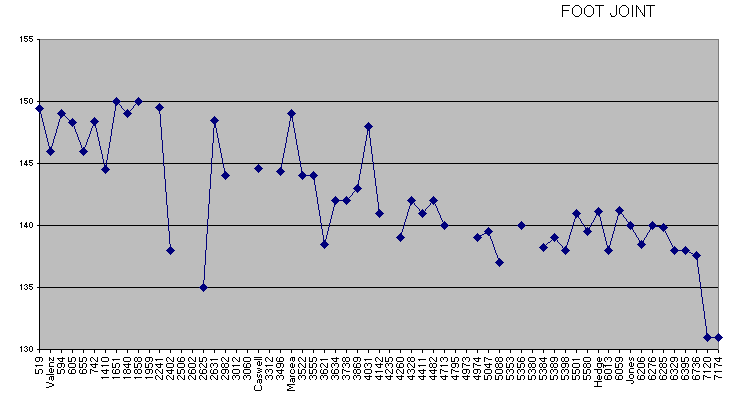
Unfortunately, I don’t have a graph that illustrates what was happening with R&R body lengths (must do one!) but this might help. It’s the length of foot joints versus serial number.
You’d expect to see the feet (and the bodies) getting shorter as pitch rose from around 430 at the start of the century, to encompass high pitch (455) at the middle of the century, then pop back up to somewhere in between when High Pitch gave away to A439 abruptly in 1895. But as you see, it just drifts downwards all century, before plummeting (not popping back up) at the end of the century. The bodies and feet of these flutes were never tuned for high pitch, their short heads just allowed you to get there if you needed, although with appalling tuning.
To answer your question directly, Rudall flutes only became well tuned to modern pitch at the very end of the 19th century - see the flutes 7120 and 7174 on the tail end of the list. Which is strange because Pratten’s were from around 1852. I can only think that Pratten was aiming at the professional players who needed a flute that could play at low (430) and high (455) and so designed his flute for halfway between - coincidentally about where we want it. But Rudalls targetted amateur players with their 8-keys. Any professional customers of theirs would buy their Carte, Boehm or Radcliff multikey flutes.
As to measurements that might indicate good tuning at 440 Hz, I’d be looking for flutes with a C#-D# length around 245mm. It is only an indicator of course, because you can do a lot by playing with hole sizes. The Mayes Rudall original is 254mm, like most around that time.
Even with a later flute you will probably find you need to use ‘old’ fingering. Fnat vent to get F# up to pitch, c key to get C# up, and flaten A by using covering a hole(s) lower down. For faster notes not really needed but for more sustained notes it is.
Some old flutes with flat low D can be easily pushed with some extra umph up to pitch and it can be quite a nice effect. I’ve also tried one modern flute which had this very flat D which could be honked up.
Terry, thanks for this very helpful and informative reply. This board is lucky to have someone with Terry’s expertise who is willing to take the time to share it with us.
my experience has been that if you want a 19th c. flute by a recognised maker at a reasonable price, you will often be buying a flute that needs some repairs and therefore it might not be very playable when you buy it. Unless you can take someone with you who can see right away if the flute is going to be economic and technically feasible to repair, then stay clear and only buy something that is already in playable condition.
Even then, if it is an early-to-mid 19th c. flute, they all have their idiosynchracies - even those of reputable makers like Rudall & Rose. You can end up paying out quite a lot of money and being disappointed, if you don’t really know your onions.
My advice for the novice is to stick to modern instruments. Even if you have to buy s cheap one just until you get to that magical place- the top of the waiting list - for a really good 'un. (or if you are lucky enough to buy a used example).
Thanks. I was looking at that one, but something looked strange to me too. Maybe it was the case, though they say that that is not original to the instrument. Perhaps it was the C and C# keys on the foot-joint. They just look too, how shall it put it, too clean. I mean, the touches (is this the right term), aren’t angled or overlapped like a Rudall or earlier flutes I’ve seen. If you look at George Ormiston’s website, he has a picture of several types of C foot-joints that he makes, one of which looks very similar to the foot-joint of the flute you have pictured. In the caption, he says that this is a C foot-joint with German-style C and C# touches. The link to the picture is this


 Wood grafts, ream jobs shortening and lengthening joints, I should have been a doctor…