I’ve had this 6-key Eb piccolo for quite a while, but just started playing it recently. It’s part of an interchangeable set with a flageolet head and in a nice original felt lined wooden box. No makers stamp but it is in very good condition, no cracks and all the springs seem to be good. I’ve read about how these small piccolos need a tighter embouchure. The aperture is oval not round and I seem to be getting a half-decent tone with my usual embouchure which I’m not going to complain about. I really like the compactness of playing this piccolo. Is it that it’s shorter sounding length (244mm) takes less air to resonate?
English? German? Date I would guess to be around late 19th century but I don’t know for sure. Where would an Eb piccolo/flageolet typically have been played when originally bought?
I was gonna say nach Meyer, c. 1900, but three things make me recant that. I have a nach Meyer d piccolo, and the head-barrel connection doesn’t have that bulge. That would also seem to mean that the embouchure chimney is somewhat deeper than the Meyer. Second is the G# key has that angle that the French used. Last is that it has the interchangeable flageolet head, which also points to French or English.
As to why it would take a tighter embouchure – you’re moving less air and making higher notes. So you need to put out less air but just as fast, which means a smaller aperture.
The man who might best know is Peter Dunn, who posted here as Pdunn. He was last seen here in 2020 or thereabouts. He maintained a blog called ‘The Irish Piccolo Page’. The last activity shown there is 2017, but the blog is still up. Since we shared an interest in keyed flageolets I had some correspondence with him, but again, that was some time ago.
Thanks Bob, I’ll go and search for the blog page you mention.
Maybe Peter will spot this thread at some point and give us all the benefit of his knowledge. I know that I’m really liking this piccolo sound.
These piccolo/English flageolet sets were quite common in the later C19th and first third of the 20th. Many were English-made, but unsurprisingly the German woodwind makers also made them - often for the English market and at Old Philharmonic Pitch A452.4. Mostly they’re in D, and it can be hard to determine if you have a High Pitch D example or a modern Concert Pitch Eb one - though usually a HP D won’t really work usably as a CP Eb. Actual Eb ones at either pitch certainly exist. They also sometimes crop up in Bb, at whatever reference pitch. It’s quite common for one or other of the alternative heads to go missing, more often the flageolet head.
I think the block mounted OP example is almost certainly English. The SL of 244mm does suggest it is actually intended as an Eb rather than D instrument. The angle of the G# key doesn’t tell you anything about origin - it’s effectively the only practical method on an instrument this size!
When found as a piccolo with no flageolet head present, the style of connection between head and body is a dead giveaway it was part of such a set - piccolos made as piccolos pretty much never have the head tenon which goes straight into a receiver in the body.
I think the flageolet was probably intended as the primary form in such pairs, with the piccolo a handy substitute.
That’s fascinating information Jem. Funnily enough I did check with my tuner set to A4=445hz and that was indicating around Eb. I haven’t yet tried the same test at A4=452hz. My involvement in research into my other instrument early English 6 and 7-string banjo has made me aware of the lack of standardisation in mid-Victorian pitch. Without going into long-winded detail there is a practical pointer, certainly when played with concertina, that the tuneable banjo would’ve had to tune to the concertina (as it would to piano). Anecdotal evidence from concertina repairers is that the majority of the instruments that they have retuned the reeds to modern pitch were originally pitched higher than A4=440hz. Typically somewhere in the range A4=444hz to A4=450hz (Society of Arts pitch or thereabouts). Antique tuning forks from the 1870’s that I have some of which are accurately dateable (one stamped Metzler & Co) seem to bear this observation out. My tuner is more often at these pitches than it is at 440.
Can you explain the differentiation in Victorian terms between band flutes, fifes and piccolos? Hopefully that would clear the fogginess I have about these instruments in their original contexts. Our research is bringing to light evidence that English 6 and 7-string banjo was commonly played with piccolo and flute (and flageolet) in diverse contexts. A better grasp of context would be a head start on understanding the tuning relationship of banjo and piccolo.
In relation to the 2-piece fit of head directly into the body I have an earlier wooden, conical bore 4-key George Butler piccolo that has this arrangement. Was that more common on earlier piccolos ?
Can you explain the differentiation in Victorian terms between band flutes, fifes and piccolos? Hopefully that would clear the fogginess I have about these instruments in their original contexts.
The terms “band flute” or “marching flute” are probably more of a modern thing to disambiguate these flutes from true fifes. They seem to have been called “small flutes” in period, or, as now, mistermed “fifes” depending on size/tonality. The topic has been adequately covered here and elsewhere (see links from that one). The practical musical role of the assorted small flutes made during the C19th (in almost all tonalities) is really something of a mystery, at least until the development of the flute marching bands using F, Bb and maybe Eb flutes and piccolos in the later part of the century. You should find parts of this document of mine relevant. As I mention in that material, the term “piccolo” was pretty much restricted in usage to small flutes an octave or more above the standard full size concert flute (D and above).
Our research is bringing to light evidence that English 6 and 7-string banjo was commonly played with piccolo and flute (and flageolet) in diverse contexts. A better grasp of context would be a head start on understanding the tuning relationship of banjo and piccolo.
I don’t think I have/know anything directly helpful to that (marriage made in H…? ).
In relation to the 2-piece fit of head directly into the body I have an earlier wooden, conical bore 4-key George Butler piccolo that has this arrangement. Was that more common on earlier piccolos?
Two piece piccolos (and band flutes) are common enough throughout - especially cheaper ones. But they have the old/ordinary form of a wooden tenon at the top end of the body and a socket in the headjoint - basically the head hasn’t been cut in two to afford a tuning slide. The ones built with a metal tuning slide from the head going straight into a metal-lined body socket (rather than a separate, intermediate barrel segment) are pretty much exclusive to the flageolet/piccolo sets, from all I’ve ever seen. Even my Alexander Liddle flag/picc pair, which has no metal tuning slides, has the socket in the body and wooden tenons on both heads (pictures on FB here. I think its the configuration of the whistle head structures which makes this design necessary on such small instruments, and if there’s to be a piccolo head too, it has to follow suit. It’s relatively unusual to find this later type of English flageolet (made wherever) with the whistle head having a socket for a body tenon, though I have seen such (a German-made example, if memory serves) - but not with an alternative piccolo head associated.
I don’t think I have/know anything directly helpful to that (marriage made in H…?
The tone of the gut-strung banjo c.1860’s and 1870’s was much less harsh (and quieter) than the steel-strung bluegrass sound that most people associate from the modern banjo. The combination with piccolo, flute and flageolet, often with any mix of concertina, violin and guitar was so common that it suggests a sense of suitability and harmony to mid-Victorian ears. We are finding that banjo - piccolo duet was quite common too. Let’s just say these are long forgotten relationships that we are now studying!
I have another nicely made and maker-stamped (Hawke & Son) 19th century English piccolo(?), 2-section, block-mounted 4-key, probably rosewood, that is even smaller that I’m in the middle of cleaning/re-padding/re-threading the combed tenon. The sounding length is 209mm. Any ideas of the pitch? I’ve got a note from the head joint that my wife described simply and succinctly as ‘piercing’.
I put a question mark after ‘piccolo’ because despite reading the page Jem linked above, having keys and small cylindrical (9mm) bore make me unsure which category it falls into.
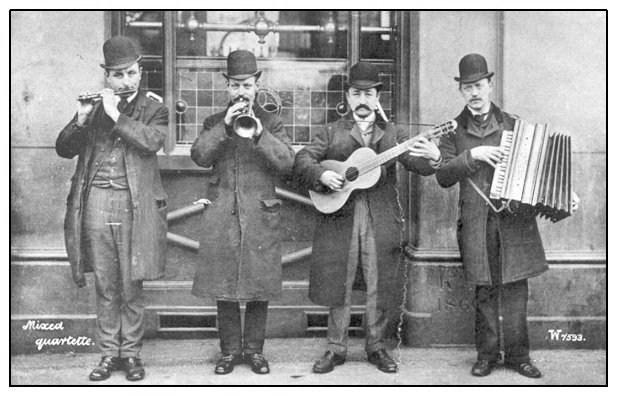
Very interesting about the mixed ensembles and a fantastic photo!
A SL of 209mm is going to be an F picc. They’re rather variable, however - more so than bigger flutes.
I have the following examples:
a Hawkes & Son block-mounted 4-keyer with plain head which is 207mm and is in effect in F# at A440 - very High Pitch F.
a JWSL 6-keyer with barrel tuning-slide which is 206mm - unplayable so pitch not determined.
an anonymous English 1-keyer with barrel tuning-slide which is 216mm and usable at A440 open c7mm.
an anonymous English or German 6-keyer with barrel tuning-slide which is 208.5mm - not adequately playable but maybe A440 usable with undetermined slide extension.
an anonymous English or German 6-keyer with barrel tuning-slide which is 212mm and definitely A440 usable open c7mm (the most usable one I have).
a Henry Potter block-mounted 4-keyer with plain head which is 225mm and seems to be around A440, but it’s questionable if the head belongs to the body.
a Henry Potter 6-keyer with plain head which is 207mm and, like the Hawkes above, effectively in F# at A440 - very High Pitch F.
Thing is, especially at this small scale, tiny design differences impact pitch significantly and the bores, embouchure and tone-hole sizes all vary to a considerable extent, so the SLs are rather less helpful than they can be (with reservations/caveats!) on larger flutes. However, I think we can be fairly sure that any SL between 205 and 225mm is going to indicate an instrument intended to be “in F” at some reference pitch. (Eb piccs are usually in the 240s mm.)
I’ve read the section on tuning in ‘A Treatise on the Instrumentation of Military Bands’ C.Mandel, 1860. That raises another question for me; how, for example, is a flute commonly described as an ‘Eb piccolo’ actually tuned to Db? If the description refers to the lowest note produced when all 6 holes are closed, where does the whole tone lower Db tuning derive from?
Secondly, - and more a social history question - in informal ensemble playing with banjo and concertina c.1860-1880 one might naturally assume that any flute included would most usefully be tuned to C; the Anglo concertina tuning is fixed at C/G and C being one of the common tunings for early English banjo. But…based on Mandel, C tuning in contemporary flutes related to what were described as ‘concert D flutes/piccolos’. Weren’t these concert instruments at the high end of the price scale? Therefore too expensive for working and lower-middle class musicians in local vernacular settings? Had the orchestral switch to Boehm flutes made these concert D flutes professionally ‘redundant’ and cheaply available in London as early as the1860’s? We read that narrative in regard to uptake of high quality English ‘D flutes’ in Ireland, though at a somewhat later date.
It’s easy enough to understand how the banjo could potentially have tuned to any small flute in a duet setting. But the tuning inflexibility of the Anglo concertina tells us something else was going on with tuning in relation to (commonly evidenced) vernacular ensemble playing that included Anglo concertina, banjo and flute.
Thirdly, in the fascinating photograph posted above. What is the consensus here on flute type? Piccolo or Bb small flute?
The Victorian age had a whole mishmash if different pitch standards.
Wheatstone concertinas could be ordered tuned to a number of pitch standards. Steve Chambers posted a Wheatstone pricelist on concertina.net highlighting this, I can’t find it right now but the topic has been discussed there several times in the past.
The Victorian age had a whole mishmash if different pitch standards.
Yes, if you’re referring to non-standardisation of concert pitch. A4=440hz wasn’t agreed upon as an international standard until the late 1890’s.
However in regard to my tuning question above, in a specific ensemble setting neither the wider contextual non-standardisation of pitch or the fixed pitch/tuning of the individual concertina is the crux of the question. A concertina likely could’ve been pitched at A4=A444hz or A4= 449hz or anywhere in-between. The banjo would’ve known and been familiar with tuning at that same pitch i.e. for sake of argument both concertina and banjo could’ve both been playing in the key of C pitched at A4=A444hz. My question relates not to pitch but the practical aspect of any flute in relation to those other two instruments. We can understand that a contemporary flute would’ve also have been made at a higher pitch. But in c.1870 what would’ve been the most commonly affordable and available type of flute that vernacular musicians had access to that would enable the flute player to integrate with the banjo and concertina in the key of C? (or, to add complexity, the concertina’s other home key of G!)
From our modern perspective in theory we can say ‘concert D flute or piccolo’ but if at the time these fine concert D instruments were beyond the moderate means of ordinary musicians, that poses a practical problem. We know these three instruments were commonly played in ensemble in vernacular settings. So there must’ve been a practical meeting ground of price and tuning for that to have commonly occurred.
Primary sources from 1860-1880 typically describe ‘flute’, ‘piccolo’ and ‘fife’ in relation to banjo and concertina. We are aware of the common early mis-naming of ‘so-called fifes’ that Mandel refers to. What these primary sources indicate is that we can’t assume that a D piccolo playing in the key of C was the flute players consistent instrument of choice when in ensemble with banjo and concertina.
I kinda deal with that in my Flute Nomenclature document linked previously. (Forget reference pitches in this regard - that’s a whole other story and extra complication.) It is a bit mind-boggling, but the transposition necessary and therefore name by the transposition system (for flutes and whistles and flageolets, not other instruments!) is always a whole tone lower than the actual native playing tonality of the flute/whistle, for which said instrument was and is traditionally named. What we call an Eb piccolo has a lowest note of Eb (with D fingering) and a fingers-off-in-order scale of Eb major. It is pitched a semitone above a concert piccolo in D. Therefore written music for it needs to be written out a semitone lower than it will sound - so D written and fingered sounds Eb. In classical terms, transpositions are always named for their relationship with C (presumably because it has a blank key signature, so in that sense is the centre of the key signature system), so a flute or piccolo or whistle which to our minds plays in Eb and is a semitone above a baseline D (non-transposing) instrument is, to a score writer, “in Db” because that is the transposition for which s/he has to cater - sounds a semitone above C, so write music a semitone lower to produce correct sound. That will ensure the correct key signature is written, which the trad tonality name would not
This whole boggle is also why so many people coming from a Böhm flute background, who think the flute is “in C”, when they want to try out tin whistle automatically buy one labelled “C whistle” because they understandably expect that to be the baseline and to equate to the flute. But of course it isn’t/doesn’t. In transposition terms what we call a C whistle (cos it plays in C, dammit!) is “in Bb”(!) and what you need to read from untransposed dots and to use more-or-less familiar fingerings in relation to what they’re called and how they’re written, is a D whistle.
Secondly, - and more a social history question - in informal ensemble playing with banjo and concertina c.1860-1880 one might naturally assume that any flute included would most usefully be tuned to C; the Anglo concertina tuning is fixed at C/G and C being one of the common tunings for early English banjo. But…based on Mandel, C tuning in contemporary flutes related to what were described as ‘concert D flutes/piccolos’. Weren’t these concert instruments at the high end of the price scale? Therefore too expensive for working and lower-middle class musicians in local vernacular settings? Had the orchestral switch to Boehm flutes made these concert D flutes professionally ‘redundant’ and cheaply available in London as early as the1860’s? We read that narrative in regard to uptake of high quality English ‘D flutes’ in Ireland, though at a somewhat later date.
Again, on flute pitch naming etc. see my Flute Nomenclature document. As for the market - the flute was the “everyman’s” instrument for most of the C19th, holding the sort of place socially the guitar has since the mid C20th. There were relatively cheap (and sometimes nasty!) D flutes readily available with from 1 key (looking like but not really playing like the baroque flute) at relatively accessible prices. Playing in G major is easy on a 1-key (or more) D flute, but playing in C major isn’t unless you have one with a fully keyed C foot and at least an F key on the body, although a 4-key D foot flute can do quite well if the player adjusts the music if it goes below low D (just as we do in trad nowadays). Low flutes in C (“Bb” transposition) weren’t really ever a thing until modern times - they’re very rare, much rarer than the anyway rare low Bb (“Ab” transposition) flutes. But by the time of the spread of concertinas and other free reeds, many concert flutes with more modern systems (post Böhm) were about which could more readily play in C major.
It’s easy enough to understand how the banjo could potentially have tuned to any small flute in a > duet > setting. But the tuning inflexibility of the Anglo concertina tells us something else was going on with tuning in relation to (commonly evidenced) vernacular ensemble playing that included Anglo concertina, banjo and flute.
Be careful not to confuse tuning to a given reference pitch with tonality and naming of instruments. I believe most British concertinas (and harmoniums etc.) made in the C19th were originally tuned to Old Philharmonic Pitch A452.4 or to other High Pitches prevailing. Contemporary flutes usually had tuning slides (except for the cheapest ones) and were constructed to be capable of being tuned to a fairly wide range of reference pitches because there was no real standardisation and they might need to tune to quite disparate pitches. That has nothing to do with the tonality of the instruments, though it does cause us identification trouble nowadays because some instruments built for the extremes of High Pitch are even more than a semitone above modern concert pitch A440, so if they’re not marked with a tonality name, it can be hard to work out what they were intended to be! People quite often get confused by High Pitch concert flutes and piccs and mistake them for Eb (“Db” transposition) ones at A440 because they’re nearly a semitone up from modern pitch (usually not quite, though I’ve met some crazy HP examples!), though in fact they usually do not work usably thus.
Thirdly, in the fascinating photograph posted above. What is the consensus here on flute type? Piccolo or Bb small flute?
It’s a piccolo of some kind, but no way to tell if it’s D or Eb, and I can’t see for sure what system it might be. I think I can make out a long F key, so probably 6-key simple system. It’s proportionally too small to be a Bb band flute.
It’s looking more like G was the common key, which does make a lot of sense.
We’re intending to add recordings with flute and banjo duet (and eventually banjo, concertina and flute) to the early English banjo channel in due course. It looks like I’ll need to acquire a period (c. 1860-1889) D piccolo or 1-key D flute! As part of our research we’re careful not to solely record high-end instruments. Understanding and practical playing of what ordinary amateur musicians had to hand is part of what we’re studying.
Metzler & Co., Butler, and Prowse were three contemporary London manufacturers/dealers that we see evidence supplied a high volume of banjos in the period we’re looking at (G.Butler-retailed banjos, made for the company off-site, are particularly well made and fine-sounding instruments). Among others I play two original Butler-stamped banjos c.1876 and c.1880 for some of the recordings). Of course, all three companies also sold flutes and Metzler also sold cheap and highly popular tutor books for flute, banjo and anglo concertina. I have a 1-key Butler Bb flute that is very nice indeed. But frustratingly no use for our research purpose!
Our research project budget doesn’t stretch to anywhere near what period 1-key Metzler D flutes now sell for. What would you recommend on a small budget as a period English simple system D flute/piccolo option (as I mentioned in my OP my preference is for the sound and compactness of a piccolo) that is fairly readily available and easily playable in good condition? The type of flute that a young Victorian London clerk could’ve afforded. I’m able to do basic repairs/maintenance for an instrument that is complete but needs some attention. I may be interested in a trade+cash for my English Eb flageolet/piccolo set if anyone reading this has a D piccolo they don’t play that fits the bill.
I believe most British concertinas (and harmoniums etc.) made in the C19th were originally tuned to Old Philharmonic Pitch A452.4 or to other High Pitches prevailing.
We’ve tested period-correct gut strings on early English banjos up to A4=448hz and even at the top of that range the increased tension in period tunings doesn’t cause any practical problem. We are yet to test up to A4=452hz. If under this tension we find increased string breakage or tightness that affects playability, we can deduce that anglo concertinas weren’t consistently tuned to A4=452hz. What we’re finding at the moment points to anglo concertinas more typically being pitched between A4=444-449hz.
Before making assumptions, I really recommend looking up the Wheatstone pricelist I mentioned above and look at the various pitches they had available at the time. Some four different ones IIRC.

 ).
).