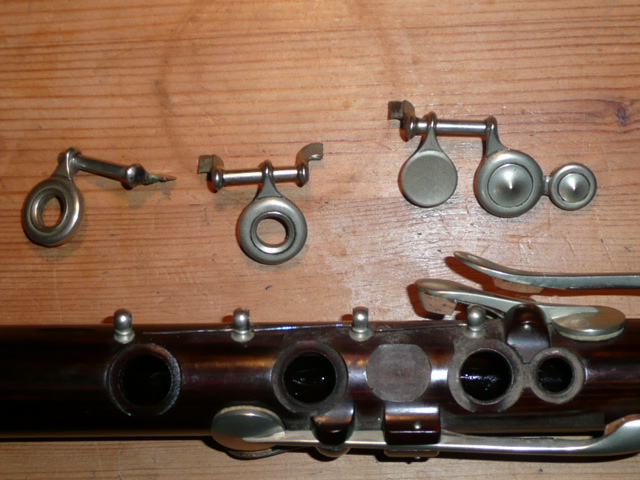
Boosey & Co. Prattern System pitch

Hi,
I have strayed over from the Uilleann forum and apologise for lack of knowledge regarding flutes. I have just picked up a Boosey & co Prattern System flute from the 1890’s according to the serial number, I’m not really a flute player but it does seem to play sharp of concert pitch, were they made as high pitch instruments?

Cheers,

Charlie.

The later Boosey’s were definitely a bit sharp. My recommendation is to get a modern headjoint made for it.

Is this a cylindrical bore, or a conical tapered bore?

Regarding the bore it is cylindrical and touch under 20mm, it is stamped R. S Pratten’s Perfected on the head and body if that helps.
Regarding a new head, I’m playing enough things at the moment and can’t see that I would be taking the flute up but I would be interested to know what it would cost for a new head and who would be best to do it.

Cheers,

Charlie.

There are others already on this thread with greater knowledge and experience of Prattens than I have, but from what I know of them the later, cylindrical bore ones, like similar Siccamas, were mostly High Pitch (because of the British pitch standards of their era). I’d be doubtful whether the investment - probably about £300/U$600, at a guess, in a decently made replacement, longer head would be worthwhile as the scale length would be too short - but you’d need to get it to a real expert like Jon here or Terry McGee so they could check it out properly and decide if tonehole/scale length alterations were feasible/value for money. Such operations on a Boehm system of similar vintage are virtually impossible (they just have to make a new body, transplant and adapt the keywork to fit a longer scale, but keep the head), but a simple system with less and smaller holes might be more susceptible of a successful doctoring. In fact, a new body re-using the keys and head and possibly foot might be a better option if you really wanted to sort it for modern use (but expensive). Or just possibly it might be easier to adapt it to play in Eb for those oh-so-common Eb sessions (! :stuck_out_tongue: !).

However, given your limited aspirations in flutery, I’d suggest that, if it is in good, playable (or easily made so) condition, keep it as it is and enjoy it solo for what it offers: spend your money on a decent modern keyless Pratten style if you want a flute for occasional practical use.

Anyhow what’s it sound like, pitch aside?

P.S. Patrick Olwell certainly makes headjoints
for old flutes, FWIW.

The flute does sound good, I am not an irish flute player, but did play classical flute a bit many years ago so my embouchure is OK’ish, it speaks well over 2 octaves, the bottom C is duff though. The action was a bit sluggish when I got it earlier today, but I’ve had the keys on rods off and cleaned the bearing surfaces and it’s smartened up a lot. The large E and F# holes take a bit of getting used to, but when sealed well give a solid bottom D. It’s cosmetically fine apart from the E flat key bracket which has been broken off and has a replacement cheek in what looks to be rosewood, not a bad job, but certainly visible; the other fault is a crack the length of the head joint, but as it does not effect the embouchure and the as head is lined with nickel silver it does not effect playability. If anyone is interested I could probably do a picture or two.

Cheers,

Charlie.

Pics are always nice! Trot 'em out.

A lot of simple system flutes from that era were sharpened just by shortening the head joint…Terry McGee has a good way to measure the body to see if this is so…

You might be lucky and just need to extend the head … :confused:

folks, you’re all assuming it is an 8key flute.
It probably is not (and certainly shown by charlie’s final note about rods).

Pratten system flutes began as the 8key variety (with Hudson in c.1852, then Boosey in c.1856) and moved along until they were 17-key flutes like the others of the day, yet kept the “pratten’s perfected” moniker.

In fact the first ads by Boosey in his publication “Musical World” of the Pratten flutes had many varieties from the 8key up to the multikey platform. all of them “perfected.”

The darndest thing about the early Booseys (though not the Hudson’s for some strange reason) is the C# which are typically flat unless you vent it with the long-C key. The Hudson/Pratten flutes (who knows how many there are, but I only know of 6 worldwide) are not that way, yet Hudson kept the design with him when it went to work for John Boosey. shrug. I don’t know.

I will say the caliber of cocus was much nicer at Boosey though the Hudsons are good, too. Just older and denser grade of wood in the first 500 or so from Boosey. Great feel on the hands.

the scaling of the late 1800s is likely to have been a=452 for the band flutes that Boosey was churning out in England. They can play 440, but probably do best at 444 which is where so many sessions are ending up it seems.

I’d be interested, Charlie…how many keys on your Boosey?

dm

I have uploaded some pictures to my website, you can see them at: <href="http://www.charlieskelton.com/flute.htm>

I see that my HTML did not produce the desired result, never mind, it’ll be a cut and paste into the browser job!
Regarding the number of keys, from the bottom: C, C# and D#, Keyed D, short and long F’s, E and F# are open holes, G#, Keyed G ( strangely with two holes directly coupled so there’s no option of opening just one), long C, and B flat, the B and A have half covered keys ( with rather lovely linkages). In terms of metal touches there are eleven.

Cheers,

Charlie.

Direct link:

Charlie’s Boosey Pratten

Nice pics, Charlie. I’m sure David can fill you in best of all. I suspect most of what I said will hold, but Jack may have a point - it is certainly worth doing the C#-Eb measurement (which is the best indicator of the design scale-length regardless of nominal pitch in Hz of A or D) and comparing it to Terry’s chart. That will give you some idea of what may be worth doing with it.

In flute evolutionary terms, this flute is a post Boehm hybrid system - basically 8-key simple system on a cylindrical body with Boehm’s “parabolic” head but with rod-axle mounted Siccama type extensions for L & R 3rd fingers. The French style pierced platters for L1 & 2 and the extra mini-hole and platter attached to the G are interesting variations. Also interesting that they have retained the old style foot, even down to pewter plugs, and a mixture of block and pillar key-mountings.

That seems to be spot on, the head is indeed parabolic ( I’ve just had it apart ). I do not know about the C# E flat measurement method ( presumably across the open c# and the second octave e flat) , that’s a new one on me, can you post a link to Terry’s chart? I’ve a bit of a cold at the moment and the hearing is not perfect but I would say would say that the E flat is around 7 cents flat of a tone away from the C# based on the pythagorian scale. The C# by the way is well pitched. I’ll borrow a tuner and check ogr real.
Regarding the G key, my guess is that it would have required a very large hole and to preserve the aesthetic of similar sized keys the lower small hole was added, there may be a benefit in the third octave which I’ve barely explored. I’ve just taken the keys off that bit and the three top holes are 11mm ish, the bottom hole around 7.5mm, I’ve added pictures at www.charlieskelton.com/flute.htm

Cheers,

Charlie.

OK Charlie - it’s not a pitch-difference measurement you have to take but a physical length one, in mm from the centre of the C# tone hole (L1) to the the centre of the Eb tone hole - twist the footjoint so the Eb key is in line with the main run of toneholes to make it easy!

Terry’s useful bits on this topic are High Pitch Cures and C# - Eb measurements which is where you’ll find the chart.

Have fun.

BTW, you can make hotlinks on here by posting the URL bracketed by tags using the tag boxes in the header of the posting window. It looks like this: [url=http://www.mcgee-flutes.com/HighPitchCure.htm]High Pitch Cures[/url] less the asterisks I’ve put in to make this example visible and not a hotlink! Do images by bracketing the picture URL link with the IMG tags (obviously you have to have the image web-hosted on your own or a hosting website for it to have a linkable URL).

I’ve pirated one of your photos thus: [*img]http://www.charlieskelton.com/10.jpg[*/img]

Hi Charlie

Interesting one. This is Boosey’s A169 model, or A170 if the keys are sterling silver rather than german silver (looks like german silver to me). They did the same model in all post mounted form as the A171 and 172. The A169 retailed for 8 guineas (8 pound, 8 shillings) circa 1900 (german silver), and the A170 for 12 gns. That was in “cocoawood” (cocus). A few pounds extra for ebonite. A straight 8-key (A164) in cocus and german silver fetched 4 gns, in sterling 7 gns, 8 in ebonite.

As Jack said, essentially a Siccama (they never called them that in the factory records or catalogs, neither was there any mention of Pratten in the factory records), that is there are extensions for holes 3 and 6 so that they can be in their ideal acoustical locations and still be reachable.

I imagine that extra G# key permanently attached to the L3 key is to improve one of the third octave notes (possibly E3, to save having to open the G# key). It would also assist making the A’s sound clearer.

I usually find with flutes of this style that they play well enough in tune at modern pitch when the head is extended to the point it’s falling off. When pressed hard in they can almost reach Eb (which often causes confusion). The pitch at which the head is withdrawn 3mm (1/8") is probably what they had in mind. Yours is from about 1890, 5 years before the collapse of high pitch, so I suspect it will follow that pattern. The strange thing is that when pressed hard in, the tuning is usually terrible!

If it follows that pattern (in good tune at 440Hz when pulled right out) I generally recommend a new, longer head. Partly because it’s hard to come up with an effective way to lengthen the existing, partly because the existing heads are often cracked. But also because those thinnd heads without a lip plate don’t really have the chimney depth needed for good low end response. Choices are to have a thicker cylindrical head (which can get a bit head-heavy on a thin walled flute), a thinned head with raised lip plate (which works great but has a more modern appearance), or an “eccentric bore” head, where the head appears to be cylindrical but the bore is not in the centre at the top end. (You can have your cake and eat it too!)

The page people were recommending is probably http://www.mcgee-flutes.com/flutelengths.htm - you’ll find high pitch and low pitch figures for cylindrical 8-key flutes in the middle of the first table.

But you might also find http://www.mcgee-flutes.com/BallBeavon.htm interesting. It deals with fitting a new head to an existing cylindrical flute.

Thanks for showing us your A169!

Terry

Thanks for the positive identification, it is the german silver model. I have had a look at the charts and my flute weighs in at 241/2 mm putting it in the high pitch class, with the head out about 1cm it plays at 440 but I will conduct experiments with other flute players to confirm this.
I’ll have a think about a new head, but may just move the flute on and let someone else have the fun of that operation.
Many thanks for everyones input, it’s certainly been a steep learning curve for me.

Cheers

Charlie.

well glad to see we got that one solved!
i just had a feeling it wasn’t an 8key.

Terry…seeing as you got a peek at the Horniman-owned log books…

did you ever get a count on how many 8key PP were listed?
I’ve often wondered just how few there are and suspect it to be in the area of ~1000

thoughts?

If only I’d posted pictures at the start of the thread!
I studied woodwind making at the London College of Furniture in the early 80’s and from what I’ve seen from you folks over the past couple of days, things have really come on in the understanding and knowledge of the instruments since then, Aah!! the wonders of the internet.

Again, many thanks,

Charlie.

Dave, I haven’t been able to spend time with the factory records (they had not gone to the Horniman when I was last over there), but I have been able to go through a summary of the records. It’s a bit puzzling though when you add up all the numbers quoted, you only get about 10,000 wheras the serial number range is over 20,000. So I don’t really know how to interpret that, and have left it on the back burner until the full records become available.

None the less, whether you assume they are all in there or that you have to double the numbers, it’s still very interesting.

Firstly about 3/4 of them are military instruments - fifes (almost all in Bb) and flutes in various sizes of Bb, Eb and F. Of the 2352 left, about 800 are concert flutes, and 930 D piccolos. 351 are Boehm and 151 are cylinder. 52 Siccamas (although they don’t call them that!). So, answering your question, I guess as close as we can get at this stage is in the range 800 to about double that.

I do hope that the Horniman will get the records digitised and put on line, so we can all pore over them. Indeed, we should really be mounting a lobby campaign to get that done. (It would presumably strenghtn their arm when applying for funding if they could show demand.) They have put the Wheatsone concertina records on the web, so the idea isn’t new to them. The records incidentally include the Rudall and Carte records as well as the Boosey, so I salivate when I even think about it.

Terry