I’m embarrassed to give my results, but try the test. Here’s what it is about:
“We are interested in studying musical perception ability in the general population. The following 2 tests, developed by Isabelle Peretz (University of Montreal), take less than 8 minutes each. They involve listening to pairs of tunes and deciding whether they are the same or different. Once you have completed both tests you will receive your scores.”
I’m not able to learn a tune from just listening. I need to know the first note, and often need the sheet to look at. (I love midi file versions as i can watch and hear the progress of the tune at the same time)
That was an interesting test, and people should allow enough time to take it since it is a little longer than some. I got 26/30 and 28/30. I like that you can push the button when you are ready for the next pair—that made me feel much less nervous. Although a person who could not distinguish tones wouldn’t do well on the test, it seemed to me it was my musical memory that was being tested. I also thought that the “tunes” on this test were a little more melodic—this might not be the right term— than they were on a test that was posted some time ago in which the notes often seemed completely random to my ear. I think I did better on this test because my ear could more often find something to grab onto. I rarely felt certain of my answer, so there was definitely some guessing there too.
From the website:
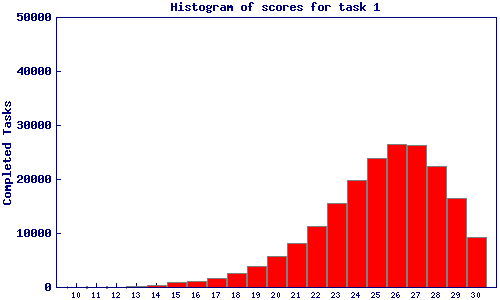
Test 1
The average score on this test is 25.41 .
The histogram below shows the distribution of the scores achieved so far.
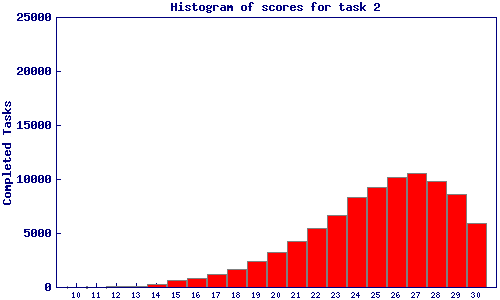
Test 2
The average score on this test is 25.01 .
The histogram below shows the distribution of the scores achieved so far.
Ah, University of Newcastle Upon Tyne. Yes, I did this a year or so ago, and they emailed me back and had me do a secondary test, and my family as well. My wife and daughter ARE tone deaf. Alas. Well, that’s why I practice in the park. I can’t remember my login, though. (probably in my inbox, somewhere…)
Thank you for your participation. You scored 28 out of 30 on the first test and 26 out of 30 on the second test.
Well, I guess I can be happy with those results. I was a little paranoid going into it as I’ve been plagued with ear problems ever since I was little, and have had several ear surgeries by the time I was 12 years old. Now at 36 years old, I have an 82% hearing loss in my right ear, and a 23% hearing loss in my left.
It’s good to know what hearing I do have left, is working correctly. lol
I haven’t read the bumf about the survey on their website, but it seems to me that what these tests both do is test melodic memory more than anything else. Sure, non-musicians with unpractised ears may have more difficulty discerning pitch changes, but as (I’ll assume) we all play something on this forum, we are more or less experienced at listening to pitch and our ears are accustomed to it. Classically trained people will have very highly attuned pitch recognition, but maybe less melodic retention than we, who are perhaps atypical of a wider pool of western musicians in that, except for the newbies, we are very accustomed to memorising simple melodies and to learning by ear from the performance of others at short notice. One might expect us to be better than average at spotting changes in melody (something I believe humans are in any case generally pretty good at - most of us have excellent melodic recall even if not “musical”), assuming that our basic pitch and time perception apparatus works OK!
I wonder what the design parameters of the test are? I’ll have to go back and have a look, but so often surveys and questionnaires fail to put questions in terms that can elicit truthful answers in the terms that they allow - I’m quite cynical about such things! I think these tests DO test melodic/time&pitch pattern perception and memory, but not basic pitch perception alone as an auditory function, as suggested by the original poster’s thread title. I’m glad you posted it, though, Mike/Slowair!
I guess to really know how appropriate the test is for tone deafness, we would have to know some of the people that are tone deaf who have tried it, and see what their results are.
I do agree, if you are musically inclined, and play an instrument you’ll probably fare better on this test than someone who isn’t in that category.
What seems so obvious and apparent to us as a difference between the melody/pitch of #1 and #2, may completely be off the radar screen for someone who is tone deaf.
Would it be possible to test tone deafness by only playing one note, followed by either the same note or a different note and see if the participant can tell that they were different? That would eliminate the musical element to the test.
I wonder if this is on par with the color blind tests where they place a colored number in a field of other colors and see if you can pick it out.
I was mildly amused by the test being taken by folks here on C&F as probably many would be able not only to discern any difference in the clips but also be able to play it back on their whistle or flute!