I’ve been reading everything I can find about pvc whistle making, and also about pvc flute making. I’ve got two questions.
One source states that undercutting a tone hole on the upper side (towards mouthpiece) raising the second octave pitch. Another source says undercutting on the upper side raises the pitch for both octaves while undercutting the lower side raises the pitch for the upper octave. Is one of these statements wrong, or is the affect different for whistles and flutes? I don’t remember where I read the second statement.
Some people are making pvc whistle or flutes with pvc tenon joints. I’m totally new to all this. Are those joints made using a lathe to take down the outside of one piece of pipe and to widen the bore of another piece of pipe?
Thanks a million. This group has been great getting me started.
An excellent question. I’ve seen the same confusion about undercutting. I’ve also seen it explained as effectively enlarging the tone hole. In my own experiments I’ve never been able to get consistent results with undercutting. It may simply be that PVC is too thin to get much affect from undercutting (as opposed to a wooden flute).
I believe, however, that whatever the effect, it ought to be the same for whistles and flutes.
Some people are making pvc whistle or flutes with pvc tenon joints. I’m totally new to all this. Are those joints made using a lathe to take down the outside of one piece of pipe and to widen the bore of another piece of pipe?
Yes, I believe that is how it is done. Doug Tipple turns tenon joints on his flutes, you could always send him an email to inquire as to his methods.
Also, you might want to take these questions to the flutemakers group on Yahoo:
Obviously those statements disagree so they both can’t be right… or can they?
Sometimes it seems small variations in doing something can effect the result. So maybe both statements are correct!
Undercutting should raise the pitch - it is effectively making the hole larger. Enlarging the hole towards the the top moves the hole up the instrument as well as enlarging it.
And conversely enlarging the bell end of the hole effectively moves the hole down the instrument, the two tending to cancel each other.
These changes can and do effect the octaves differently - many years ago John Mack helped me tune the G#s of my oboe changing one octave while leaving the other alone, working on the ‘top and bottom’ of the hole. Bright nail polish is useful so that you can reverse the effect - of course removing material is non reversible except by adding stuff back which does not really get you back to where you started
Tenon joints: I have made tenon joints the way you suggest. It is difficult but possible to get the sizes perfect so that the joint does not slip too readily. Part of the problem is machining pvc - it heats up readily and so melts and flows, and it also gives making precise cuts much more challenging than with wood or metal.
Brass tube can also be used for the joint, in which case you just bore out both head and body and glue the tube into one, if you go overboard in boring one you can get another piece of brass tube which is a slip fit over the first and glue it in place.
This could possibly be done without a lathe - with drills
Problem with this is the brass tube slips a little easily and so your whistle tends to change in pitch as you play!!!
Oh and I’m talking about the brass tubing that can be found in many hardware stores in the US brand of “K&S” which comes in various sizes which slip over each other. Web site for K&S was recently listed by Daniel_Bingamon (Thank you, my local hardware store does not carry this tubing) - found it www.specialshapes.com
Just read your post again and no I do not think the effect of undercutting is different for flutes and whistles. As I said the details of how something is done can make a big difference.
So make a tuneable whistle and make several bodies (one of the advantages of a tunable whistle) and experiment and let us know what you find.
if you are interested I can post a photo tomorrow of my tenon joint - whistle and camera are at home.
Can you explain this statement? My understanding of the acoustics is that tone holes work because they open the resonant chamber of the flute to the outside air, essentially “unpinning” that end of the resonance. I don’t understand how undercutting the tone hole would increase that effect in a noticeable way.
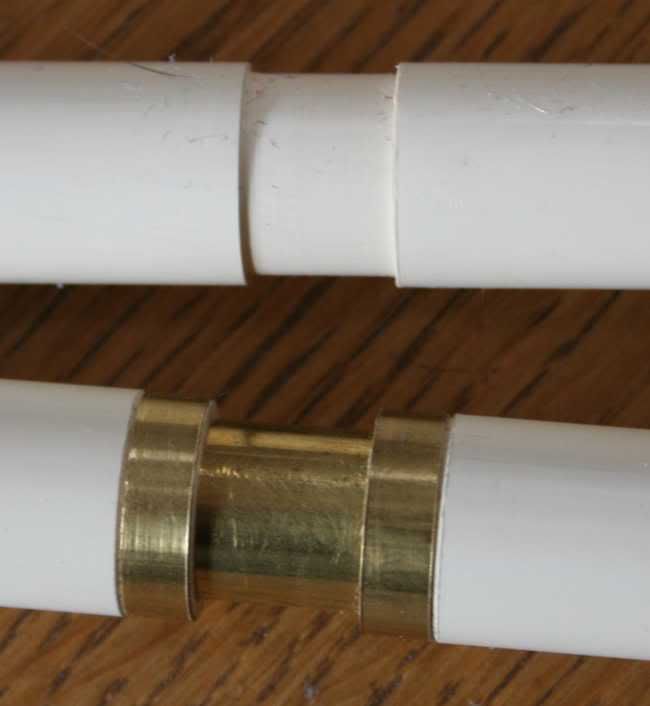
If a picture helps, I can offer a look at a couple of tuning slides on my own CPVC whistles. Sorry about the cat hair.
Both are turned on a lathe. The top one is strictly the cpvc tube where, as you have described, the male tenon is turned down and the female socket is bored out to create a nice firm fit. The lower joint is made using K&S brass, as highwood described, where the cpvc is bored out to accept the brass tube. The rings on the outside are there to support the thinned plastic joint as well as being decorative. These are both workable systems but the brass has less effect on the tuning of the instrument since it is rather thin walled and provided the brass bore closely matches the plastic’s bore well. The all plastic joint works but it can result in a more noticable bore expansion as the slide is pulled out. Trying to minimize the thickness of the tenon is a balancing act between the strength of the tenon and the effect on the tuning.
You can also make another type of joint easily but I would stop short of calling it a proper tuning slide. It’s still helpful in prototyping your designs though. This is simply to use an external collar to join the two tubes. Priovided you are using CTS type tubing, then either copper pipe joints or cpvc pipe joints will work. If the pipes are pushed all the way into the joint they will perform as a one piece tube. If they are pulled apart much, the increased bore diameter at the joint will effect your tuning. But it’s cheap and worth trying as a first step. Here’s one of those -old whistle, old camera, poor focus.
I am going to stay away from the undercutting discussion for now.
I have made and sold many whistles of cpvc, and pvc. I use a lathe with very sharp cutting tools. I use a slow turning wet grinder, and EZE-LAP diamond hone to maintain the cutting edge. As the cutting tool becomes dull it may warm the pvc but I have never had it get so warm it would melt. As it becomes thinner a smaller cut must be taken or the cutting tool will have a tendency to push it away as it is cutting. A fan takes the fumes away that are produced when cutting. The few times I did breath the fumes did not make me sick but did congest my nose. Always have good ventilation when working with cpvc, and pvc.
Before obtaining a lathe I made mortise and tenon joints with a drill press.
Because cpvc/pvc has an odd size and you are boring an odd size I made my drills from spade bits for drilling wood. Grinding the spade bit to size with a wet grinder is time consuming. Then boring the two ends that are to be joined together to a size about half the wall thickness. Take another piece and bore it all the way through the length of the other two ends. This makes a thin walled tube that is to big. Cut a small piece out length wise then clamp and glue it together. Glue one end in one tube and leave the other for the slide. A drill press must be used. A hand drill will just bonce around when trying to boar into the end.
Clicking on the link below then scroll down a little there is a picture of some Bb whistles I made from gray pvc. I also make them in the key of A.
Perhaps melt was an exaggeration - but the plastic will ‘flow’ rather than cut rather easily, and the smell is unpleasant, and the fumes are also probably not good for you. A compressed air/coolant spray banishes the fumes and makes the machining easier.
I didn’t think that was much of an exaggeration, personally. It can happen.
I agree with Tommy that sharp tools, conservative cutting depth, as well as appropriate turning and feed rates are always the way to go. It may take a couple blanks to get those right.
I have no problems with cpvc; it seems consistent and predictable to me. Of course it is hot water pipe and can take a little temperature change. Some pvc pipe, on the other hand, has surprised me. And I have made a lot of whistle out of that stuff too. I can cut tenons on a couple dozen tubes making sure to keep the cutting point well dressed and then one will heat up and warp. That can happen very fast too. I have not had an issue with the grey pvc electrical conduit but the white pvc schedule 40 cold water pipe seems to surprise me now and again. I have a small bucket with mishapened parts serving as a memorial for me to mind my methods well. I’ll spare you the pictures.
Like Tommy, I also made tuning joints using K&S brass by drilling both tubes on a drill press before I moved to a lathe. I think Doug Tipple had a picture of how he did this on his site at one point. I can’t find it tonight. Centering the joint on both tubes can be an interesting challenge.
That is a real nice looking joint on your pvc. Obvious that your tools are sharp.
What I used to clamp my pvc to the drill press was two blocks of wood bolted together. Placed a piece of cardboard between them then drilled a hole the size of the pvc in the center of the blocks where they met. Then leaving one block clamped to the drill press removed the other and the cardboard. Then placed the pvc that I wanted to drill and clamped the other block to the block on the drill press. The space left by removing the cardboard allowed the two blocks to tighten on the pvc. Leaving one block always clamped to the drill press the drill concentric to the hole.
However using a spade bit ground down to size did have a drawback. To prevent it from heating the pvc I had to grind from the tip size tapered back to allow some relief. Then when the drill became dull and resharpened it was a smaller size. So it worked for some but not to make a lot of them. Good learning curve to go ahead and buy a lathe.
Good solution, Tommy. Jigs are often the last thing we spend time thinking about when we make a couple whistles. But after a while, and a few more whistles, the wisdom of designing and using them becomes incredibly clear. I tried a similar jig to drill sockets for the brass tuning slides. I tried using spade bits first and then forstner bits to drill the socket. I could never leave the block centered in place on the drill press table. The lathe was a better solution anyway.
It’s handy that the cpvc has a common diameter dimension so that you can just drill a wood block and split it with a band saw to get a custom holding fixture.
I am like Feadoggie, don’t want to talk about undercutting. Put the tone holes in the right place first and there is no need to undercut except for a slight bevel to clear the tone. But then if you like a more trad tone leave the corners.
I was more interested in exploring the possibilities of a/altering the tone and b/tuning individual notes and their octave, for example if one note and its octave did not match but the other notes were ok, this is more a hypothetical question as I haven’t found a need to do this yet.
I believe in putting holes in the right place, and since I mostly build tunable whistles it is easy to just make another body if needed. I use a small mill which makes reproducing a particular hole pattern or slightly altering positions easy. Presently I’m trying various tunings and voicing.
I sometimes wonder if we make too perfect a whistle whether it will loose the quality that makes it a whistle - then I listen to an out of tune cheapie and …
I would also be very interested in people’s thoughts on some of the characteristic tone differences of different notes (for example C nat 0xx000)
I was given an aluminum low D whistle by a famous maker, and it was 40 to 50 cents flat on all but B and C# and D bell note. I took a sickle shaped hobby knife blade and under cut-shaved towards the fipple side of the tone holes and enlarged the hole in general and over the course of a week, I slowly brought it up to pitch.
It is my favorite whistle now, and it ended my whistle disorder, at least for low D’s
A small mill! I’m jealous. Whoa’s one thing but tool envy is another more expensive malady.
Putting the holes in the right place is the rule of the day here. I am more likely to design a new tube and move a hole altogether than spend a lot of time undercutting a particular hole for tuning. I do smooth the inside edges on each hole for all the right reasons given above. Still the matter of tuning via hole shaping is a concern to us all even if only hypothetically. I was reluctant to get into this because there are so many design factors to consider before you can even talk about these tuning effects. There are a number of well written articles concerning this topic. Many, I recall, concern the tuning of recorders and wooden flutes. I am not sure exactly what I have taken away from those articles though.

 We stayed on topic.
