Hi Everyone,
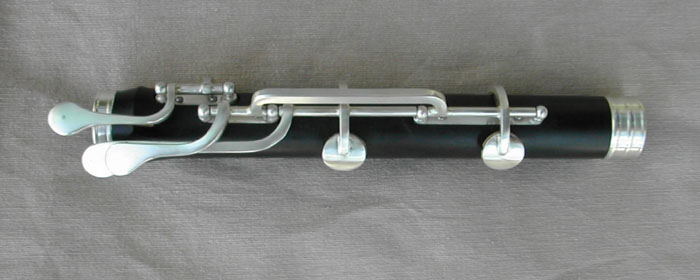
Its very rare that I do extended footjoints for my flutes as these are a pain to do and take lots of time and energy away from my normal flute production. However, I couldn’t refuse Grey Larsen’s request for one to fit onto his low A, so this week I set about doing some new silverwork for him finally. This was my first attempt at making a low foot for one of these low flutes, extending its range down to G.
A few details for other makers. The spring on the A# key (what would be the Eb key) is a normal one, located under the touch. For the bottom two keys, I use springs similar to those I use on my short F keys, located on the bars that extend across the axle from the pads. These bars also control the opening of the keys, and have cork bumpers embedded in the body underneath to quiet them. Since the purpose of the springs here is to keep the keys open, not closed, the tips of the springs go past the axle, almost to the pads themselves (these nicely pull out of the way when the keys are closed). The timing at rest between both keys is adjusted with a spot of cork on the underside of the upper touch. The pads on the low keys are cork, glued to curved “flat” pads and sanded to fit the profile of the flute body. Both are sanded simultaneously while closed, until both play in well, thereby adjusting the timing.
The touches I make by fusing additional metal onto some 6 gauge silver, then pounding it to rough shape on the anvil. The inside curves are rendered with a special in-cannel gouge that a blacksmith friend forged for me (similar in shape to what is used for reed cane gouging but made specifically for me to cut silver) and the outside curves are clipped and filed to shape.
The axles are made from .144 tubing reamed to a 3/32nd bore for the pin. Alignment between the upper and lower pin mounts is crucial, for the system to be free of binding. The slots for the mount straps were made slightly oversize. Then while gluing these in with epoxy, a hardened steel pin was used to align the pin holes, and the epoxy used as a bedding compount for adjustment. This pin alignment technique was also useful when soldering the connecting bar between upper and lower sections of the low G key - though some final tweaking and alignment was necessary.
I thought folks here would enjoy seeing this. It was fun to do something different!
Casey Burns