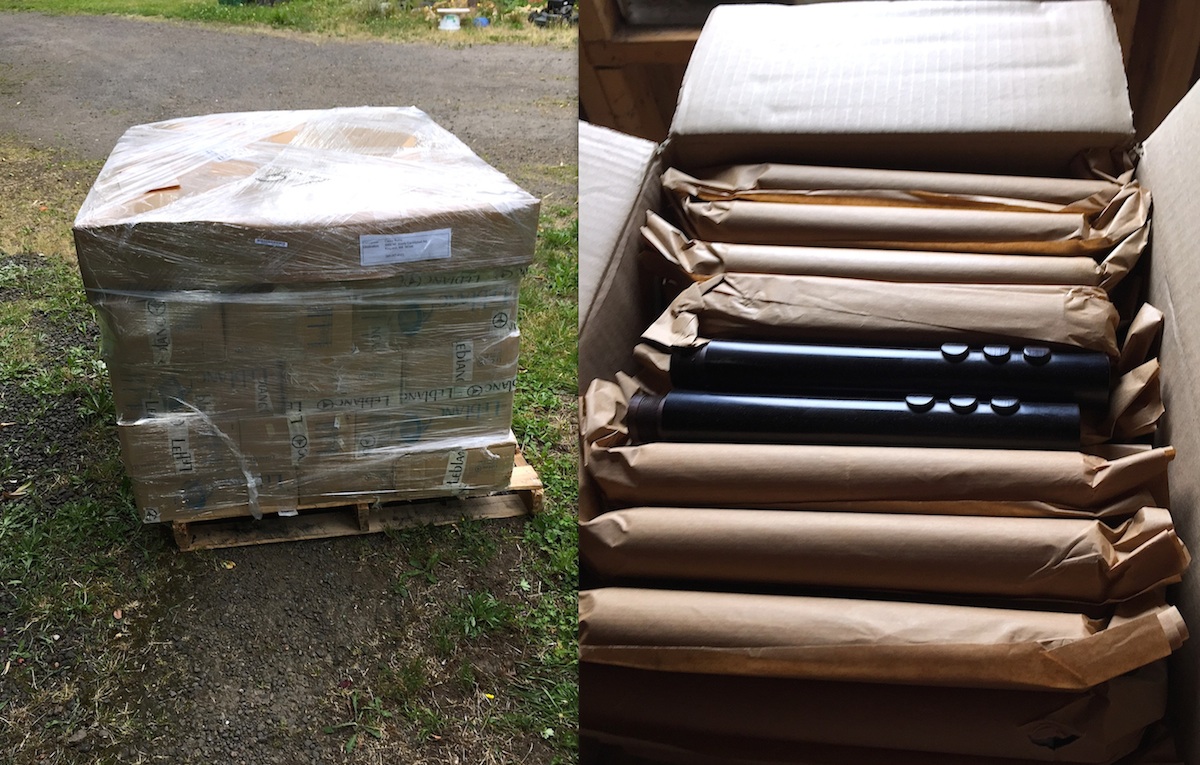
Here is a big delivery of wood that I received yesterday from American Science and Surplus. It seems they ended up with a large pile of turned but otherwise unfinished blackwood clarinet bodies from LeBlanc, from the factory in Kenosha Wisconsin that shut down in 2008. These were intended for their entry level Professional-grade Sonata clarinets. The wood, well aged and cured, is excellent and pretty much defect-free. It would have to be at this stage of manufacture - just before keys and tone holes were to be added. Fortunately, no tone holes have been cut - they are just tubes at this point. I tested a few pieces and found that there is enough wood on these both inside and outside to render them into middle and lower joints for my popular Folk Flute models. Since the wood is already selected for high quality, rounded, and pilot bored, it will save me considerable manufacturing time, and reduce wait time. I like the concept of repurposing this wood into flutes.
Seems pretty ideal. Would you mind letting us know the dimensions that the pieces come in if you feel so inclined? How big of a pilot bore are we looking at? I might be after snatching up a few for myself, if you’re not already planning on raiding the rest of their stock. Thanks!
pilot bore around 13.75mm. Max OD is around 32mm. Lengthwise I can cut the 205mm I need, though sometimes this includes the tenons on one end. Fortunately these are larger than the ones I use so it all gets turned down. At this point, I have enough of these pieces to last my career and am not planning on purchasing any more. They still have a considerable quantity in stock.
Any US members buying a largeish quantity I could tag onto? 6 or a dozen of each joint and a few bells? I would pay a percent on top and obviously the extra shipping.
I’m currently making ren. flutes and chalameaus for fun and would love to work with some nice blackwood.
Without an International (Australia) shipping option I need to beg for some help!!!
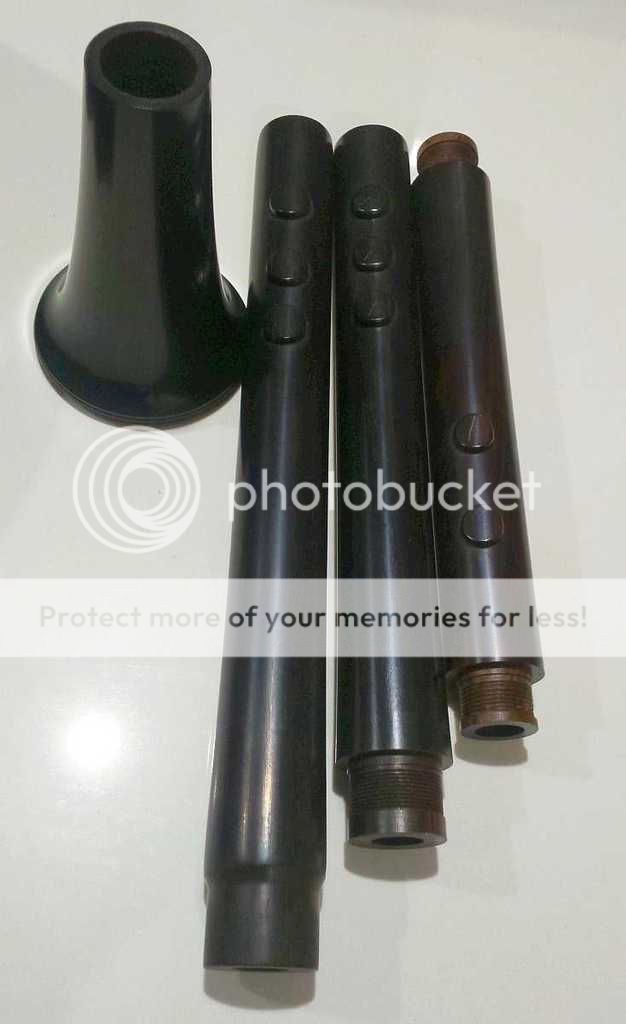
I bought a few of the 3-bump clarinet tubes. They just arrived. They are pre-bored with a 14 mm pilot hole. The outside diameter is tapered from 32 mm down to 29 mm. Some have a tenon and/or socket cut, and some do not. The socket is probably too large for use in a flute, so you lose some length there, but there is 210 to 230 mm useable length (depending on whether the socket is cut or not … which it was on about half the tubes I got).
So in terms of a D Irish flute with a two part body and a conventional Rudall or Pratten style bore, these tubes have enough material for head joints and upper body sections, but the pilot hole is just slightly too large to allow them to be used for lower body or foot sections (because those sections generally have a minimum bore diameter less than 14 mm). I have not seen any of the 2-bump clarinet tubes, but my understanding is that Clarinets have a cylindrical bore, so the pilot hole in those sections is also likely to be the same 14mm size as the 3-bump tubes. Can anyone verify this?
Still, for $2.95 per tube this is a killer deal! Thanks for bringing it to our attention Casey!
Thanks to an extremely helpful US C&F member for coming to this Antipodean’s aid and forwarding to me a good supply of these ‘bumpy’ Blackwood tubes and bells.
SciPlus seem to report that they are now out of stock (temporarily?).
Yes, I actually bought the last pieces they had in stock. Initially I got about seventy-five of them, then when I saw them I got another hundred. Then after contemplating that such a deal may never come again, I went back a third time and got the last seventy-four pieces they had in stock. Having worked with them and seen the quality I regret not breaking open the piggy bank and doing what Casey did and get a pallet full of them! That was wise. Pre-seasoned, pre-settled, pre-bored, pre-turned, pre-inspected and totally solid. For less than $3 each? You simply can’t beat that deal. I hope they get more, but it does seem like a one-time-thing. If they do, I’d certainly stretch to get a hold of more of these babies.
My man in the USA has delivered!
I just (very promptly) received my box of 10 x upper joint blanks, 10 x lower joint blanks and 5 x milled bells.
The quality of this wood is very nice.
The lower joints (3 bumps) are not equal in dimensions as mentioned above. 6 of mine are 9.85" (250mm) long Bb soprano lower joints with a tenon receiver at the top and a socket at the end. The other 4 are 11" or 280mm long and probably alto clarinet lower joints with a tenon receiver at the top and just an indentation and the bottom end. Or are they for an A clarinet? I don’t have an A soprano or an Alto to compare.
This is a super rare chance for a weekend woodturner/flutemaker to try his hand at the ‘good stuff’.
Thanks to the C&F forum for letting me find the wonderful person to come to my aid and obtain these blanks.
For those that haven’t been, the NFA convention is an amazing experience for any fluteplayer, even us who only know how to play Irish flute.
Did you hear about my encounter with Ralph Sweet at the convention many years ago? At his booth he had 30 or so Irish flutes, half in maple, half in rosewood. I noticed all the maple ones had a bigger tone, the rosewood ones a more muted tone. I right away (like many Irish fluteplayers) started pulling off the headjoints and sticking a finger in the top of the body section to feel the bore ID, and I pointed out to Ralph that all the maple flutes had a bigger bore size than all the rosewood ones.
He was utterly puzzled. “I don’t understand it. I use the same tool and the same number of passes…”
Then a lightbulb came on and he said “I know now! Maple is softer and the tool takes away more wood!”
I frankly was amazed that a guy who had made as many flutes as he had (around a thousand at that point) didn’t know what the bores of his flutes were.
Anyhow I’ll come by. I’m easy to spot, I look like Dr Henry Jones Sr.
Interesting! I would have ventured that the rosewood had shrunk a bit after reaming rather than the maple lost more material during the reaming process. My own experience has been that stable dry woods ream to the exact same dimensions with the same tool, providing that there is enough “meat” to the piece (a large enough O.D.) to make it stable during reaming. I’ve re-reamed flute bores on flutes that are already formed (a delicate task if you don’t want to crack the flute) and some woods are highly flexible and resist the reamer a bit if the walls are thinned, sort of flexing around it in a rubbery fashion, making it harder for the reamer to take a bite, depending upon the type of reamer being used. But I’d cast my vote for the shrinking rosewood. Most of the rosewoods I’ve used, even when very dry and stable, tend to shrink a bit after reaming (which is why it’s a good idea to re-ream them a bit after they rest). I would assume the maple was just drier and more stable (possibly having been kiln dried?) Unless of course he measured the bores and found that the rosewood still had the exact profile of his reamer, in which case I would also be mystified
Doggone it; the 3-bumps are gone! I can make heads from the others.
216 - 75 = only 141 pcs remaining!
I could have used some blanks of a different size for my smaller insturments. Oh well, I will proceed accordionly, as we say in the music business.
Looks like this clarinet wood was a one-time thing, sadly. I called them up to ask if they thought they’d get anymore and was told no, at least not in the foreseeable future. I suspect they simply acquired the lot as a one-off. So I suppose I should count my blessings