What was Sam advising you to get? Personally, D#/Eb, Bb, G# and Fnat will make the flute fully chromatic, forever. For ITM, G# and Fnat seem to be the most common keys you’d need.
Which three keys did he say you’d need? If it was the two F keys and G#, that’s about right. That will get you through virtually any Irish tune. The C natural key is sometimes useful, especially in the second octave. (See my other posts of a day or so ago in another thread for more on this.) I use my Bb key on one or two tunes in G minor, but you know if I didn’t play those tunes at all no one would think any less of me as a flute player than they already do. I’ve never used my D#/Eb key once in the nine years I’ve had a keyed flute.
The other two keys on an eight-key flute are the low C and C# keys. They take a good bit of work to play (Think playing a good low D is hard? You ain’t seen nothin’ yet!) and not all makers offer them anyway. In the right hands (e.g. Kevin Crawford’s) an eight-key flute is a marvelous thing, but most players get by perfectly well by just playing those two notes up an octave when they show up in tunes. You’ll find many players with eight-key flutes (old flutes especially) don’t even use those keys even though they have them on the flute. Unless you’re really really serious about wanting to play those two notes, and are willing to put in the necessary work to do it, spending the extra money for those two keys on a new flute doesn’t make much sense. Also, there are people who will argue that having those two keys (which sit open except when being played, unlike the other keys which are closed except when played) will muffle the sound of the low D because of the plugs hovering over the bottom two holes (which are totally open on a six-key flute).
Four keys (D#/Eb, F nat, G# and B flat)will get you all the accidentals , and six (second F nat touch, C nat) will give you some easier fingering options. However, I confess that I love having eight … it’s like having a car with enough power to really move! Okay, I don’t necessarily use the low C & C# keys in Irish music – but there’s so much out there: Dill Pickle Rag (it modulates from D to C major) and Metsukkakia (in G minor) are two tunes that give all my keys a real workout and are a blast to play.
I don’t have any problems getting a good sound out of the low C & C# on my Dave Williams flute – providing my hands are relaxed and the foot joint is turned properly. If one or the other is off, then my left middle finger loses its seal, but that’s a problem that practice should cure.
I have a 5-keyed Noy. It has the 4 essential keys for chromatic playing (without half-holing) plus the C. It took some concentrating to learn to use the C key but there are certain turns where it is easier to have a C key than to finger the C. I’d like an extra foot so I could go down to the lower C & C#, though. Is there such thing as a foot to go down to B?
Well, the original question was raised specific to Irish music, so I answered accordingly. However, relative to the low C and C# being difficult to play or not, keep in mind that in Irish flute playing the hard low D is paramount, and indeed almost all of the embouchure work is built off of it. (In other words, by the time you have mastered the hard low D, you will have to have mastered all other aspects of embouchure for Irish playing.) If you’re going to play Irish music on an eight-key flute, then your low C and C# are going to have to match up with your hard low D - they can’t be wimpy step-sisters to that note, else why play them? If you can do that on your eight-key, then great, more power to you. But I like to think that I have at least a halfway decent low D, and on the few blows I’ve taken on eight-key flutes over the years I’ve barely been able to get the low C and C# to sound. Hence my comment that those two notes can be difficult to play.
There’s something to be said for that if you’ve got an 8 key flute, but I say get yer low D first. I’ve got the low C#/Cnat keys, and I use them, but they’re not essential to ITM playing. The C# tends to be pretty easy on my stick, but the Cnat requires more relaxation, for me, than the low D to get a strong tone.
I’d recommend seriously considering the Eb/D#, in addition to what ever other keys you decide on: I suppose there aren’t many purely IrTrad tunes, with Eb notes, but there are some crossover Scottish tunes and others that you may very well find you like (Crested Hen, Roslin Castle, etc.) , but without the Eb key, you’re simply out of luck because the dinky little sixth hole on the vast majority of conical bore flutes just isn’t capable of a decent Eb note with any volume.
Another thing to consider is resale value: If for some reason you decide to move to a different flute at some point, a 3 or 4 key flute is a good bit harder to sell than 6 Key.
Assuming a large-holed flute, for a fully chromatic two octaves, at minimum you need the E-flat key, as Loren has pointed out, also you’ll need a G-sharp key (i.e. Mason’s Apron is much easier with the key) and a short F key (Julia Delaney’s, the Sunset come to mind).
Most flutes can do decent-sounding cross-fingering on C-natural and B-flat.
If you’re going to do G-minor hornpipes in particular, a B-flat key is very handy.
Some tunes involve a D-to-F-natural (or reverse) movement that can be awkward with only the short-F key, a long F comes in very handy for those tunes.
A C-natural key is handy, especially for bringing the second-octave C-sharp up to pitch, but you can live without it pretty easily.
The other 2 keys of the 8-key are low C-sharp and low C. You don’t really need these unless you’re going to play other kinds of music besides classical, and they may weaken the timbre of the low D as well if they are present, so I’d recommend against them unless you know specifically why you need them.
Sure, assuming they happen to be the 4 keys you want The market is larger for used 6 key flutes - since one can more easily make due with a 2 keys more than they “need” for their purposes, but 2 keys less simply won’t cut it.
The question was how many keys you should get,
not how many you need. Let me respond to the
first question.
IMHO, FWIW…six keys are a good idea for ITM.
By the way, the C natural key is very useful,
I find–it often simplifies fingering. If you have
the money, I don’t think you will regret getting six
keys.
Flauta, how is your playing progressing? Some time ago, I remember you posting with some questions about low notes, embouchure etc. Is it getting easier? I ask because I am at a similar stage, can play a few tunes, better sound, still struggling getting reels up to speed.
The more experienced posters have pretty much answered your questions. As someone with a keyed flute as well as a keyless, and still in the beginner stage, you might like to hear my perspective.
I have a Sweet 6-key blackwood that I picked up through this forum. I find it a little easier (and sweeter) to play the upper octave than my Casey Burns folk flute, so that was a nice bonus. However, it is significantly heavier, which does make a difference when you play for a long period.
I got it partly because I also play Australian trad music, with box players that like C or even F. I also play with singers occasionally. One thing I discovered is that playing in C on a D-flute means that you are up in the octave and even higher most of the time. Only for this reason, the low C foot would be nice (for me) to have. If you rarely play in C, I think the disadvantages (cost, weight, effect on low D) outweigh the advantages. If you play regularly in C and F (I know you don’t - this is really me musing aloud), it might be worth considering a separate keyless in C instead of trying to cram keys all over your main D flute.
The key of F works well enough, as there is a good spread of notes across both octaves. You need at least one F-key (preferably the long one if you only have one) and a Bb key. Speaking of Bb, I find it difficult to operate the Bb key with my LH thumb, which is normally glued in place as my main support. It’s almost easier to use a cross-fingering.
Even if you are just playing ITM, the C-key is useful. I didn’t think I would use it, but I was learning a tune from a more experienced player and she showed me how the C-key made a b-c-b phrase smoother, so I am now a convert. Also, I have tried a couple of times to use F-nats to create little triplet runs, and they are nice as well. I also use G# for Scottish tunes in A.
If you can afford it and really want keys, I would go for 6. If you really want 6, but can’t afford it now, I think you can have the blocks installed for later addition of the keys. If you were buying used rather than ordering a new flute, I would settle for 4 or 5 if the right flute came up - there are bargains to be had. I don’t think I would bother with 8.
Hello,
You may also consider buying a keyless flute at first, (even without premeditated blocks attached) as post mounted keys can be added as needed in the future. They work just fine and as your playing style ergonomics settle in, your key placement postion can be precise.
This fine tuning assumes you will have" in person access" to your flute maker. Not always practical I grant.
All the best,
Brian
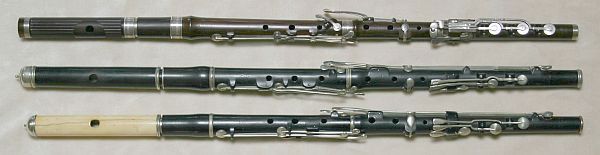
 The market is larger for used 6 key flutes - since one can more easily make due with a 2 keys more than they “need” for their purposes, but 2 keys less simply won’t cut it.