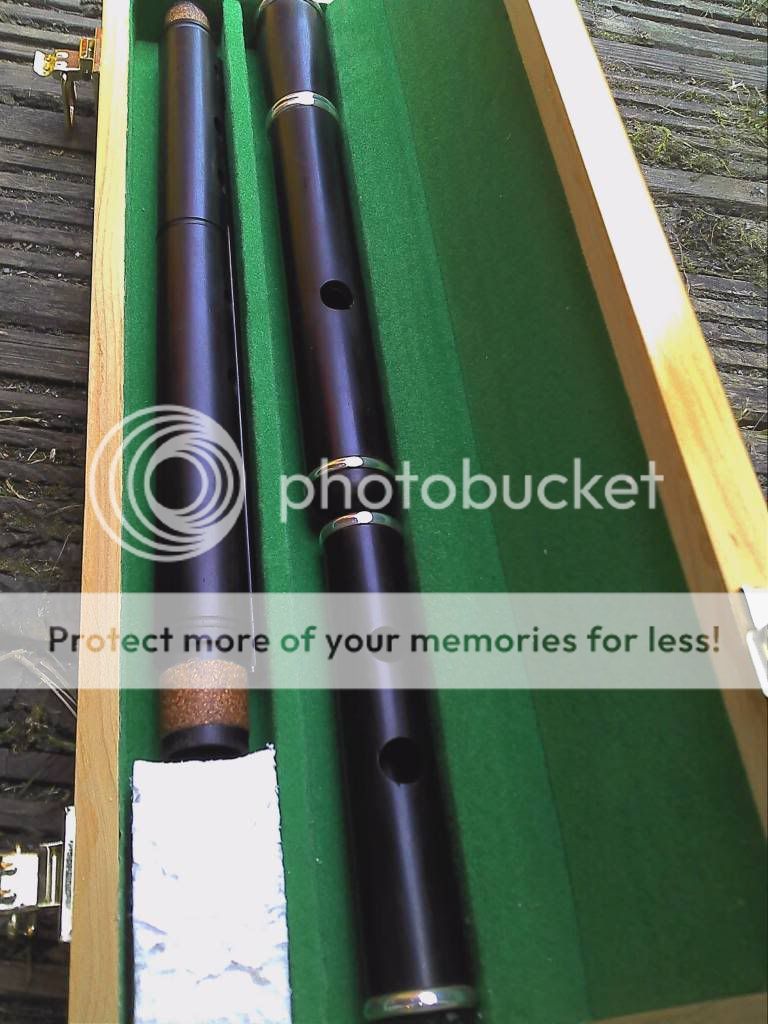
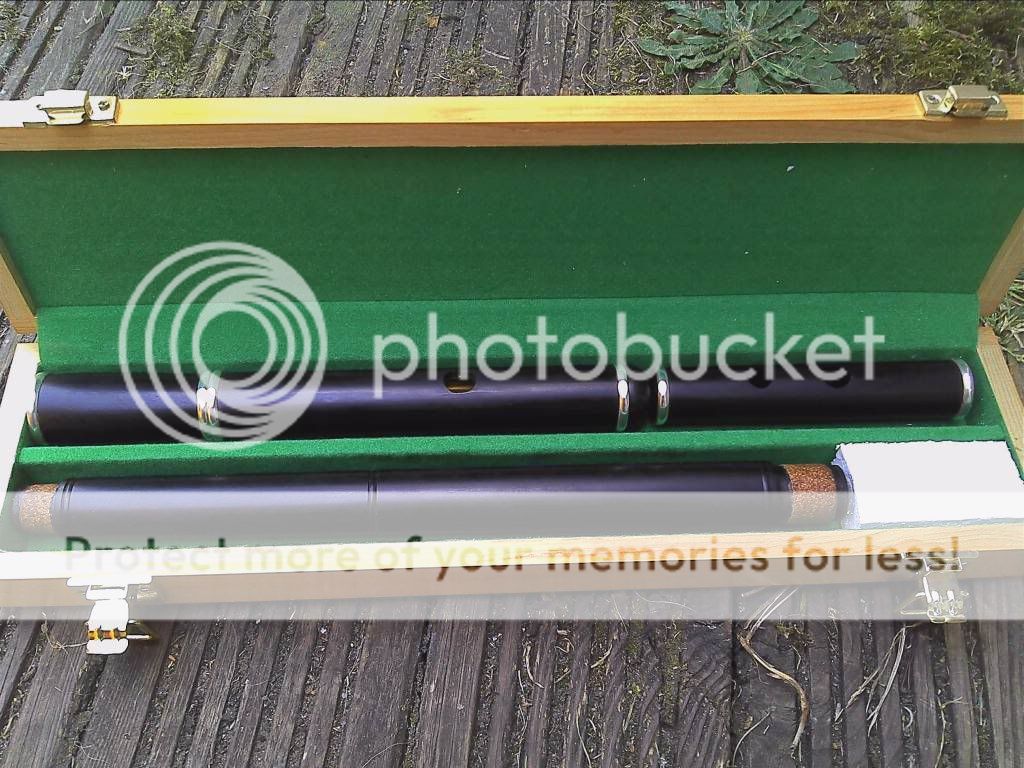
Hi all… after having played around with my Tipple Low D for almost a year (On & Off) and having a great deal of fun (Not to mention heaps of frustration also) i found this Low D on ebay, took a chance & wondered if anyone could help on identifying make etc? There are no makers markings & it was advertised as ebony. Whatever it turns out to be is cool, as i’ve played it & it’s just fantastic. Lovely to hold & play. It comes in a box and is identical in every way to the GR2166 VIGNOLES D FLUTE on the hobgoblin site, including the case.
Thanks for looking anyway… here it is… & i love it whatever it is. I paid £55 for it.
I meant to post this in the “Pictures” thread but for some reason it got posted here… i hope that’s OK, and apologies if i have posted in the wrong place.
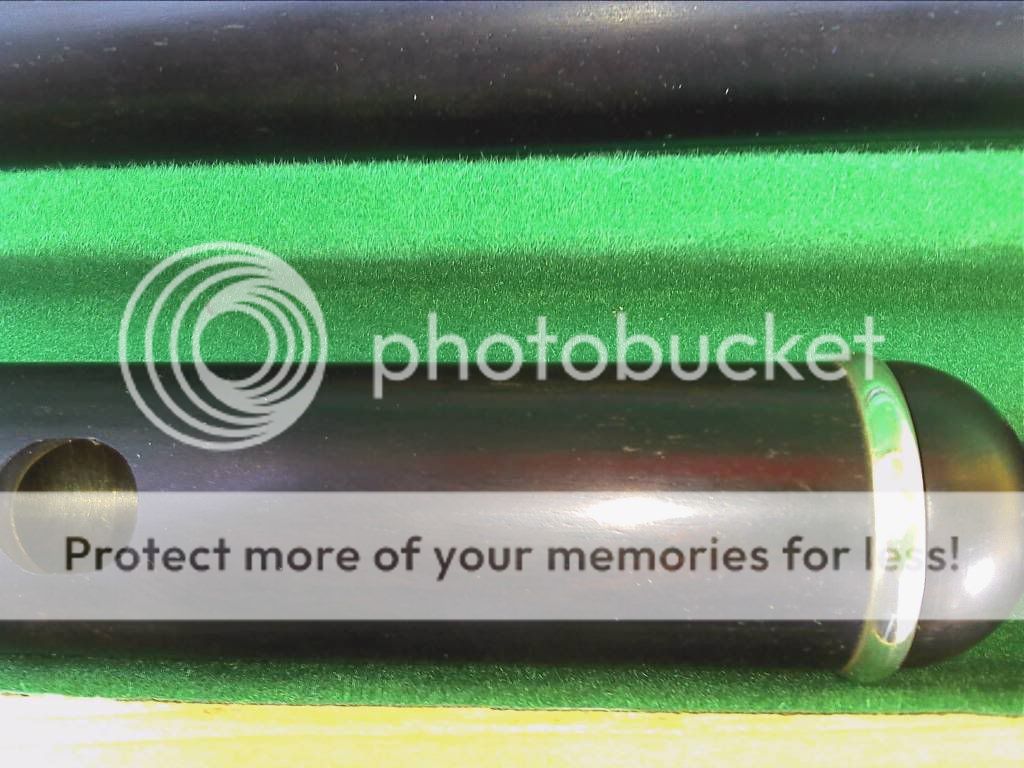
Can’t help you with an ID, unfortunately, but if you are happy with the flute it looks like you got it for a steal. For what it is worth, it looks more like African Blackwood in the closeup than ebony to me (which I would say is a good thing as from all reports the former is a bit less prone to cracking).
Be careful to read up on wooden flute maintenance and keep the flute humidified. This one looks like it has a fully lined headjoint and barrel, and those can be subject to cracking if the wood gets dried out. Also I would recommend disassembling the flute when you are not playing it, and drying out the interior after every playing session. Finally, in the last photo it looks like your cork stopper (in the headjoint) is too close to the embochure hole (though that may be just the photo). Typical dimensions for this location are ~20 mm from the center of the embochure hole to the face of the cork. Mark an appropriately sized dowel with this dimension and use that to adjust location if required.
Good luck with your new purchase and welcome to the world of conical simple system flutes.
Hello Latticino. Thanks for the quick reply. The reason i assumed it was ebony (Apart from the fact that it was advertised as such) was because of the feel of it… i’ve played guitars with ebony fingerboards & they have this strange “Silk Like” feel? This has a very similar feel about it. But having said that i know next to nothing about wood, so it could indeed be African Blackwood i guess. And if it is & it’s less prone to cracking then that’s a bonus i think.
Be careful to read up on wooden flute maintenance and keep the flute humidified.
OK, will do… having previously only owned a PVC Irish flute (Apart from my Boehm’s) it’s something i’ve never had to think about.
This one looks like it has a fully lined headjoint and barrel, and those can be subject to cracking if the wood gets dried out.
Can they be “oiled” to prevent this? Or at least to help somewhat?
Also I would recommend disassembling the flute when you are not playing it, and drying out the interior after every playing session.
LOL, i already do that with my Boehm flutes & thought with this “Simple” flute, i wouldn’t have to do that anymore. But hey ho, it’s no biggie, and i’d rather do that & keep it in good shape. Thanks for the tip…
Finally, in the last photo it looks like your cork stopper (in the headjoint) is too close to the embochure hole (though that may be just the photo). Typical dimensions for this location are ~20 mm from the center of the embochure hole to the face of the cork. Mark an appropriately sized dowel with this dimension and use that to adjust location if required.
WELL SPOTTED!! You were absolutely spot on… just checked it using a cleaning stick (Which as you probably know already has the mark on) and it was indeed “Way Out” - i have since moved it to the correct position.
Good luck with your new purchase and welcome to the world of conical simple system flutes.
Thanks again for all your help. I’m really really happy with this flute. I’m a beginner anyway so i don’t have a need for anything elaborate, but this turned out to be something of a really nice surprise. It’s incredibly easy to play when compared to the Tipple (No offense to Doug there because i really like the Tipple & will keep that also). The finger holes also seem smaller & easier to get a seal with my fingers. Now i just need to practice practice practice!! I’m hoping that one day (soon) i’ll be good enough to join in & play along with someone… still a way off from that, but i’m having fun working my way towards it.
The following are only my thoughts on maintenance of wooden flutes, YMMV.
A light oiling will only reduce the amount of condensation/saliva that gets taken up by the flute when it is played as well as improve the inner bore surface slightly. Do a search of this forum for info on oiling (I use supermarket grade flax seed oil with a little vitamin E mixed in - keep in a dark bottle). It will not keep a flute from cracking due to severe drops in humidity (during winter or in highly air conditioned spaces). Your flute may not crack from these humidity changes, but why take the chance? If you do some research on the board regarding cracked flutes, and look at the propensity for antique flutes with lined headjoints to have headjoint and barrel cracks, you will see that this is one of the key avoidable maintenance issues for these flutes. I keep mine in a tupperware style container with a secondary smaller container holding water and a piece of sponge. So far it has worked well for me.
Disassembly is to keep the sockets from cracking. You don’t, and shouldn’t disassemble the slide connection. Arguably a socket repair is even more difficult than fixing a headjoint or barrel crack, as these points are high stress zones and prone to cracking again even with a professional repair (see Terry McGee’s site for detail on how to fix a socket crack with a internal wood insert. I’ve done that and it is no picnic). Also be careful not to force the tennon/socket connection, to rotate the joint during assembly, and to lubricate the cork or thread wrapping a those locations periodically with cork grease.
One of the differences between better made and cheaper flutes is often that the wood has not been properly seasoned (which takes patience and a lot of time). That is why I would be most concerned about your flute cracking as it slowly stabilizes. Try to “play it in” properly then keep on a daily schedule of at least 30 minutes of playing and you should be OK.
Check the mark on the swab stick to ensure it is at a minimum of 20 mm (actual mark is somewhat dependant on the diameter of the flute and should be approximately the same length as the diameter of the tuning slide). Some makers are not as careful and just use the mark location from a Boehm flute which is typically less. Also check if the cork is sealing well (suck test) as loss around this joint makes a significant difference in flute tone. Lubricate with cork grease and wrap with thread if loose.
As far as identification goes, it is hard to tell from your photos, but it seems that there are two circumferential grooves cut into the flute body just above the foot joint. If that is a standard it might aid in determining the manufacturer. I can’t find any good Vignoles photos online to compare. Perhaps if you provided a link to the former e-bay add it would be helpful. The case is a standard one for pratten style flutes. I had one similar for my Seery, though it had different catches.
It’s a bit hard to see, depending on your screen resolution, but definitely at the footjoint and I think the one in the middle of the center section is there too. End cap seems the same, and style of rings. I agree, looks more like African blackwood to me. Ebony doesn’t usually have visible graining nor brownish tones.
Seems like he’s primarily a pipe maker, and his instruments have gotten mixed reports. I wouldn’t let that bother you at this stage. It’ll have a lot to teach you - unless there’s something seriously wrong with response or tuning.
All the comments and precautions are very good. I’d be very careful to keep it well humidified, especially for the first year or so, and oiling will help. Many different thoughts out there, but I use raw linseed oil (= flax seed) periodically, and almond oil more often. But not inside the lined headjoint of course!
If you can get some humidifier gel at a cigar store, you can make a dandy case humidifier from one of those little plastic thingies they put on the end of cut stems at the florists. Drill extra tiny holes to let the moisture out.
First, a very HUGE “Thank You” to all who have so kindly shared their thoughts, comments & advice. It is very very welcomed & much appreciated.
I have taken some better pictures using natural daylight. I think the “African Blackwood” & NOT “Ebony” is pretty much a given… it just isn’t dark enough for a start, especially when there’s a light shining on it so that it becomes reflective? The you can see the grain in the wood much clearer.
Also, i have to point out here that it’s in no way “New”… in fact, i would hazard a guess that it’s at least a few years old, if not older. I base this mainly on condition… marks on the wood that don’t look natural, small chips or gouges etc, which are very few & very small, but they’re there nonetheless.
Also, there is quite a bit of detritus where the metal (is it brass?) rings are, which i would imagine comes from handling & playing… sweat etc.
It seems, overall, to be in good(ish) condition? There are no cracks etc and all the joints fit comfortably. I’ve just ordered some cork grease because i don’t want the joints/cork to dry out. I shall do as recommended with regards to the oil also.
I know nothing of Wooden flutes so this is going to be a great learning curve for me and thankfully it hasn’t cost me too much either. Whatever the flute is, i shall look after it as i have done with my Boehm flutes. Cheap or expensive, they all receive the same care & treatment.
I was under the impression (Falsely i now think) that Wooden flutes where somewhat more hardy than there keyed/metal counterparts and would demand less attention… LOL! I got that wrong. I now rather like the idea of caring for it more than i initially thought i would have to… just like i periodically oil my guitar fingerboards… well, i’ll do the same with this.
It’s going to take me quite a while to digest all this information but digest it i will. “Thank You” once again to one & all… I’m learning & growing in leaps & bounds, and it’s great fun.
Your comments have helped immensely, and have given me a great base of knowledge to work & explore from… Much appreciated.
With regards to oiling then, i take it that it’s not just the outside of the Flute that you oil, but the inside also? (Sounds silly i know, but i never imagined that, and yet it seems like a good thing to do) So, if inside, the whole flute “In & Out” but NOT the headjoint? Just the outside of that?
Disassembly is to keep the sockets from cracking. You don’t, and shouldn’t disassemble the slide connection. Arguably a socket repair is even more difficult than fixing a headjoint or barrel crack, as these points are high stress zones and prone to cracking again even with a professional repair (see Terry McGee’s site for detail on how to fix a socket crack with a internal wood insert. I’ve done that and it is no picnic). Also be careful not to force the tennon/socket connection, to rotate the joint during assembly, and to lubricate the cork or thread wrapping a those locations periodically with cork grease.
I have indeed just ordered some cork grease for that very purpose, as i didn’t get any with the flute. The corks look like they have been well greased in the past, and indeed, the more i look at the overall flute, the more i feel that it’s actually quite a few years old & whoever owned it previously took good care of it overall. The only assembly/dis-assembly i shall be doing is putting it together to play it, then taking it apart to clean it & put it away again.
One of the differences between better made and cheaper flutes is often that the wood has not been properly seasoned (which takes patience and a lot of time). That is why I would be most concerned about your flute cracking as it slowly stabilizes. Try to “play it in” properly then keep on a daily schedule of at least 30 minutes of playing and you should be OK.
Again, assuming that the flute is at least a few years old, and it looks like it’s been pretty well looked after, if i continue to administer a reasonable amount of TLC it should be OK?
Check the mark on the swab stick to ensure it is at a minimum of 20 mm (actual mark is somewhat dependant on the diameter of the flute and should be approximately the same length as the diameter of the tuning slide). Some makers are not as careful and just use the mark location from a Boehm flute which is typically less. Also check if the cork is sealing well (suck test) as loss around this joint makes a significant difference in flute tone. Lubricate with cork grease and wrap with thread if loose.
Hmmm, in that case i shall get some dowel or something, and make my own marker after measuring the diameter. I haven’t checked the cork seal, but i will do that also. I guess the best way to do that (Without any fancy equipment) is to remove the screw cap & just “Suck”?
As far as identification goes, it is hard to tell from your photos, but it seems that there are two circumferential grooves cut into the flute body just above the foot joint. If that is a standard it might aid in determining the manufacturer. I can’t find any good Vignoles photos online to compare. Perhaps if you provided a link to the former e-bay add it would be helpful. The case is a standard one for pratten style flutes. I had one similar for my Seery, though it had different catches.
There are 3 of those grooves on the middle section… “Top, Middle & Bottom”. The ebay listing is here should you wish to see it, and the reference to the vignoles is in the listing. As i mentioned previuosly, whatever it’s made of & whatever it’s intrinsic value, i’m more than happy with it… it’s a great step up, plays well, sounds really nice & hopefully will lead me on to better things & also improve my knowledge of how to care & treat wooden flutes. Fantastic!
Jinian, wishing you great adventures with your flute!
One more thing…someone mentioned that the cork seemed to be positioned too far toward the embouchure hole, and that seems probable. So the cork might move nicely, or it might be pretty firmly lodged in there. This flute might have been around for a while, so you might encounter the latter situation.
If so, get a dowel or other flat-ended wooden stick that is at more than half the diameter of the inside of the headjoint and maybe twice as long. If the end cap pulls off, do that first.
Insert and press downward onto a bench or counter, while holding your hand firmly over the other (back) end of the headjoint, where the cork might come flying out. Go as easily as you can, but you might have to rap the end of the dowel on the bench lightly to get it to budge. As long as you hold you hand or thumb over the back of the head and keep the cork in there, it can’t slip so far that the headjoint slams onto the counter.
That’s how I’ve done it anyway, but others here could doubtless give you other ways that would work well too. If the cork looks good, clean any residue off the inside of the liner, grease the cork well and re-insert to the proper position.
If the cork is badly made or doesn’t seal properly, you can make & fit a new one quite easily using a good wine cork (not the composition ones), a sharp knife, file and sandpaper. Personally, I’d rather do that than wrap Teflon tape around it, but that can work too.
Others might disagree, but I like to move my corks periodically just to keep them from getting cemented in there. I’ve had a really ghastly time removing a couple of crapped out corks on old instruments. Couldn’t drill those out either because the wooden positioning screw was glued into the cork - actually glued.
Uh-huh. Bear in mind that you’re likely to be playing a lot of tunes in D and G, and like a fiddler or any instrumentalist that isn’t stuck with the compromised equal temperament, the pitch your ear will like on 3rds, 6ths and 7ths (as another poster noted) are going to seem flat to the electronic tuner. So if those notes are 12-17 cents flat with nice, even breath pressure as you go up and down a scale, it doesn’t mean there’s anything wrong with the flute. It can reflect the maker’s intent.
Really good quality “raw” linseed oil from a hardware or woodworking store is fine. “Boiled” linseed mostly has additives these days to make it dry faster and I hear it’s not good to use at all, but can’t recall precisely why. Food grade flax oil is totally cool, and you can also buy almond oil for cooking (Spectrum is the brand I have on hand). Try health food stores or co-ops. Add some vitamin E oil to the almond oil to retard oxidation and it’ll last a long time without refrigeration. I puncture and squeeze about three capsules into an 8 ounce bottle.
Also, about the florist’s thing…really any small plastic capsule that will fit into a space in your case will work fine. As long as you drill some tiny holes. I have a set of instrument-size drills, but you could probably burn holes with a needle held in pliers or something like that.
Even better…just play it so often that it never has a chance to dry out!
So the cork might move nicely, or it might be pretty firmly lodged in there. This flute might have been around for a while, so you might encounter the latter situation.
As you have already moved the cork it is probable that the technique presented for moving a stuck cork will not apply (good tip though for when you get a real antique, I’ve had to do something similar myself.
With regards to oiling then, i take it that it’s not just the outside of the Flute that you oil, but the inside also
Yes the inside of the flute needs to be oiled periodically (depending on the wood type, finish of the bore, and your swabbing routine), the outside of the flute can be oiled at the same time, but it is not as important. Actually there is some controversy on oiling wooden flutes regarding material, frequency, need… My take on that is that it seems to help my flutes, isn’t that hard to do, and seems to make it easier for accumulated condensation/saliva to drain out of flute while playing. I do it at least once per season. Admittedly I seem to be a more “wet” player, but so it goes.
I haven’t checked the cork seal, but i will do that also. I guess the best way to do that (Without any fancy equipment) is to remove the screw cap & just “Suck”?
That should work fine, though many of us pull the slide connection apart, cap that with the fleshy part of the palm of hand and suck in on the embochure. Actually I think your method would be easier for those who don’t have screw adjustments on their corks. Do be careful to look into the bore first though, I swallowed part of the corpse of a spider once while doing that to an antique once without checking first.
Overall I think you got a great deal on what appears to be a perfectly adequate keyless conical simple system flute. I would have been happy to have paid three times what you did for one of that quality. You may have gotten such a good deal because the listing was so similar to the middle eastern knock offs (i.e. this e-bay listing)
Linseed is a drying oil and I WILL polymerize over time.
Boiled or not.
You do not want that.
Stay away from drying oils. It’s a practical matter not just personal.
There are various opinions about what possible benefits of trapping your flute in a drying oil but none that I find too persuasive.
At the very least. If you are not very careful it will gum and become tacky. That’s nasty.
The common advice is almond oil. It’s penetrating and non drying. The vitamin E trick is also advised but generally if you buy it in small enough batches you’ll probably not need to worry about spoilage. Doesn’t hurt to do it anyway though.
I’ve been using Jojoba oil for a number of years now. The wood loves it and it’s hypoallergenic. Good if you share your flute with folks that might have nut allergies.
As with any advice here of course… YMMV.
Any way… nice looking flute.
Get up a vid or a recording when you feel confident so we can hear what it sounds like.


 And if it is & it’s less prone to cracking then that’s a bonus i think.









 I thought ya already had
