I normally frequent the Uilleann Pipe forum but I also play some ITM on both wooden and steel flutes.
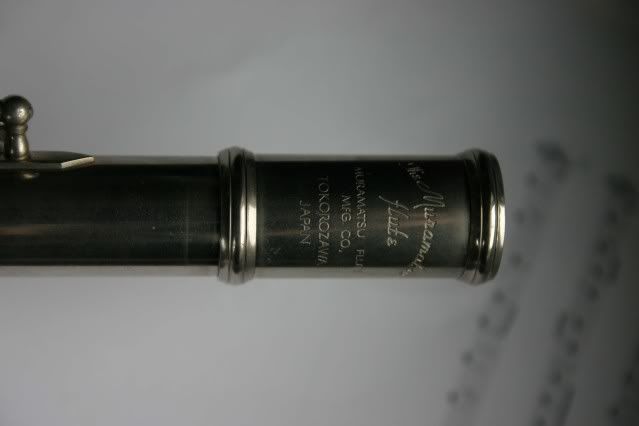
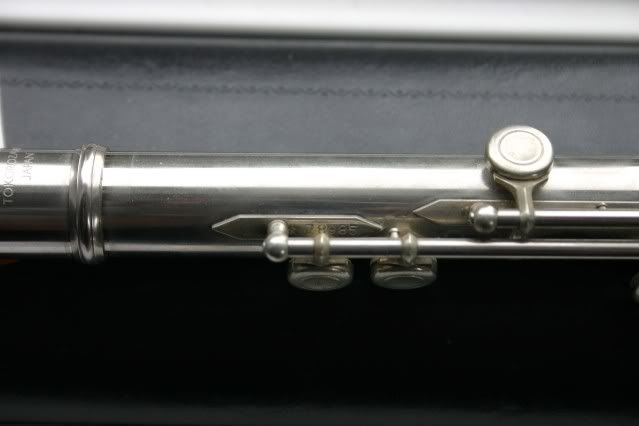
I am wondering if anybody can help with a Muramatsu flute I just bought? Its’s an older model and I’m trying to determine the model type, approximate age and potential value. All I have right now is the serial number z8985. I’ve tried lookling for SN lists on te web but am having no luck with the Muramatsus.
Can anybody shed any light on this? The flute needs some TLC but is certainly a “looker” even in its neglected state.
Hey, that’s only half of what I paid for it at the local Thrift Store. I’m thinking I got a really good deal . All it needs is a needs a bit of shining and fine tuning but no cosmetic damage and all key action seems nice and smooth.
I sent an email off to Muramatsu. What’s intersting is that all othe models I’ve seen have the SN stamped under the company name/logo where the headjoint fits. But mine has the SN on one of the the small tabs that is used to attach the keywork (rail, I’d call it) to the flute body. Also all other SN’s I’ve found are 5 digits wheras mine in Z8985. ome of the keys definetely have the appearance of being handcrafted too - they are not so perfect as those machine made. The more I look at the instrment the more I really like it - I just bought it on my lunch break and I’ve spent all afternoon here in my office looking at it and looking up stuff on it.
Some keys have a rough-ish texture to the tarnish. Suggestions or leave that to the pros?
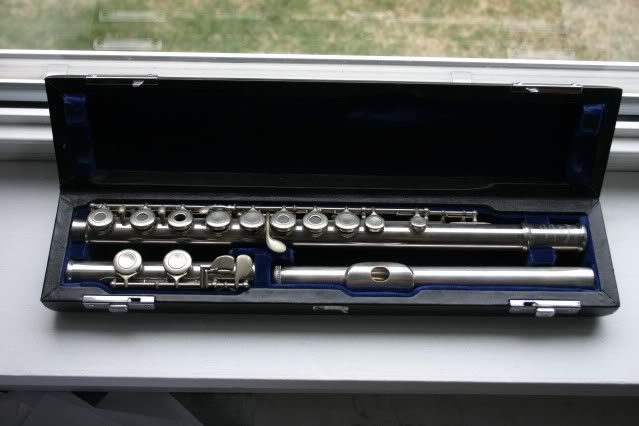
By the way, its open holed with no B foot. Solid silver headjoint with “fancy” engravings on the knurls.
Some keys have a rough-ish texture to the tarnish. Suggestions or leave that to the pros?
I would recommend waiting until you hear back from Muramatsu before starting any major work on this flute.
Concerning the rough-feeling tarnish, you may be describing corrosion (where metal is actually eaten away) as opposed to tarnish (where all the metal is still there, just oxidized and thus discolored). If the metal is corroding, I would recommend getting the help of an experienced repair person. The corrosion will have to be removed or it will continue to erode the metal beneath it. This is not really a do-it-yourself-at-home job, in my experience. It’s very easy to accidentally damage keywork by overzealous polishing, as just one example of many things which could go badly wrong.
Just heard back from Muramatsu (that was quick) - I’ve already got’em stumped on the SN. Most don’t have a letter to begin with it and they are generally located on the body tube - not like mine. I’ve sent back some more info and hopefully will hear something back.
As for the keys, its almost looks llike a satin/pewter finish! It doesn’t really look like corrrosion of the finish, per se.
If it’s a knock off - it’s a darn fine job. I’m thinking if you be replicating you’d put the SN in the same spot as well - or not have one at all. It aslo came in a Muramatsu case with Muramatsu cleaning stick
The craftsmanship is evident in this instrument. The keyword is much nice than on my semi-pro Gemeinhardt.
I’m waiting to hear back from Muramatsu again.
In the meantime, it appears that one key is slightly out of adjustment - just out so that it can’t be played. An ever-so- slight turn on of the one adj screws and she’ll be good to go.
I don’t see a reason yet to assume it’s a fake…although I’m no expert on Muramatsu flutes. I’ve gotten to try one a couple of different times, and I liked them, and that’s about the limit of what I personally can say about them.
Sir James plays them and, in the world of the Boehm-system flute, that’s a strong recommendation.
 . All it needs is a needs a bit of shining and fine tuning but no cosmetic damage and all key action seems nice and smooth.