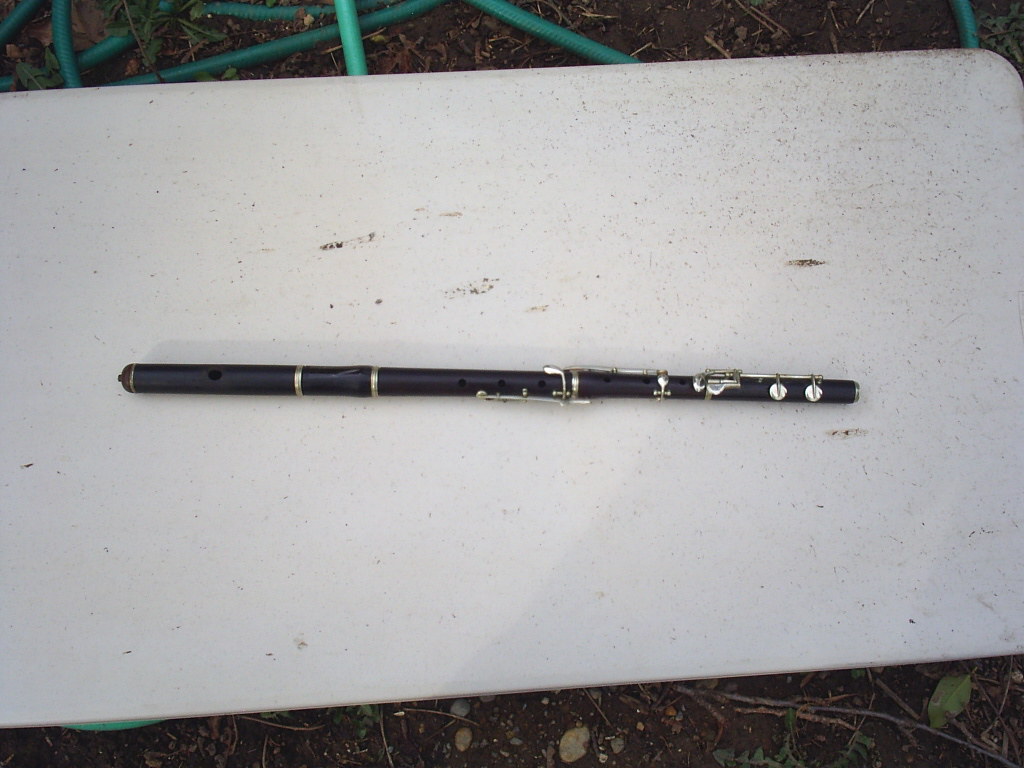
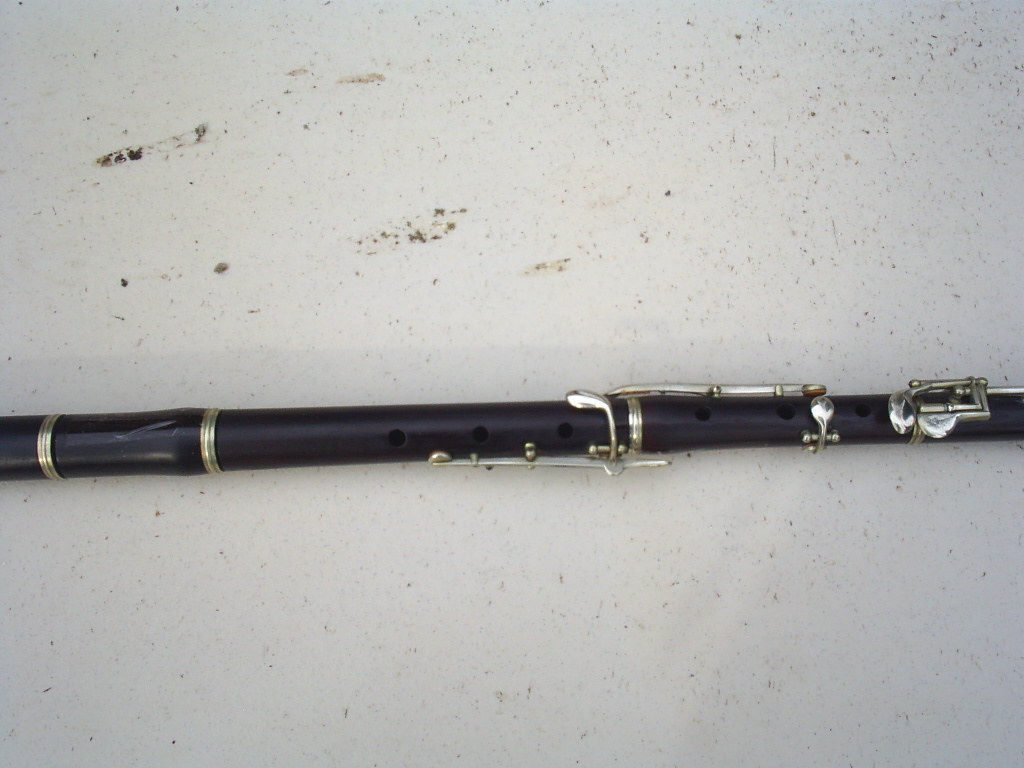
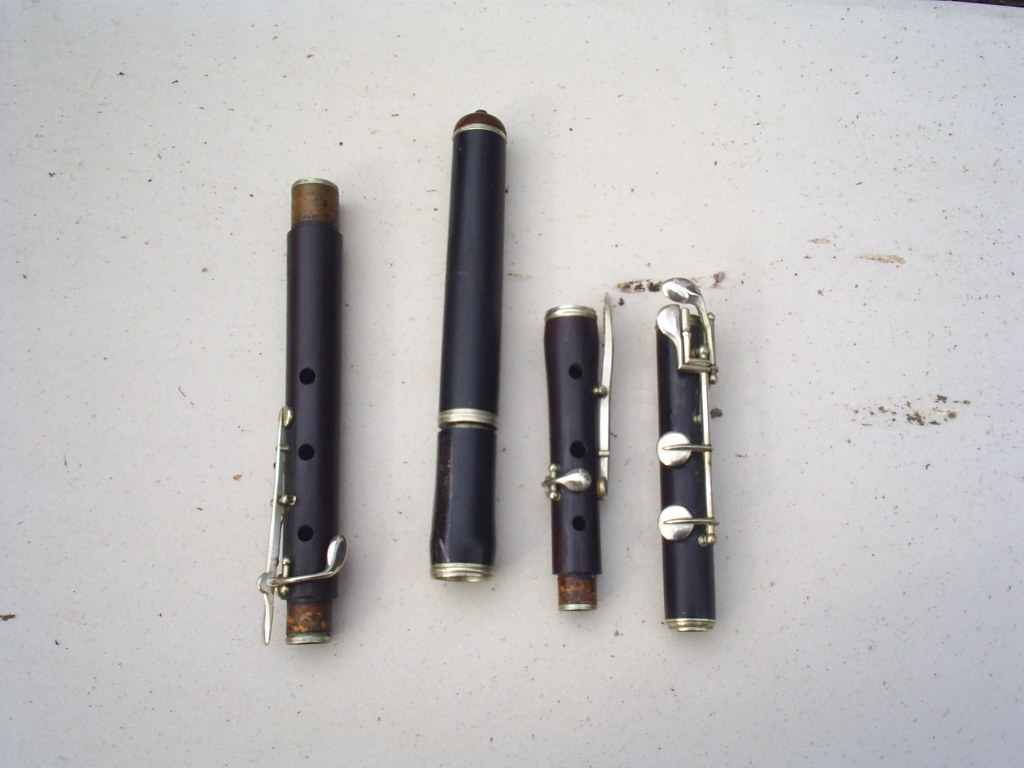
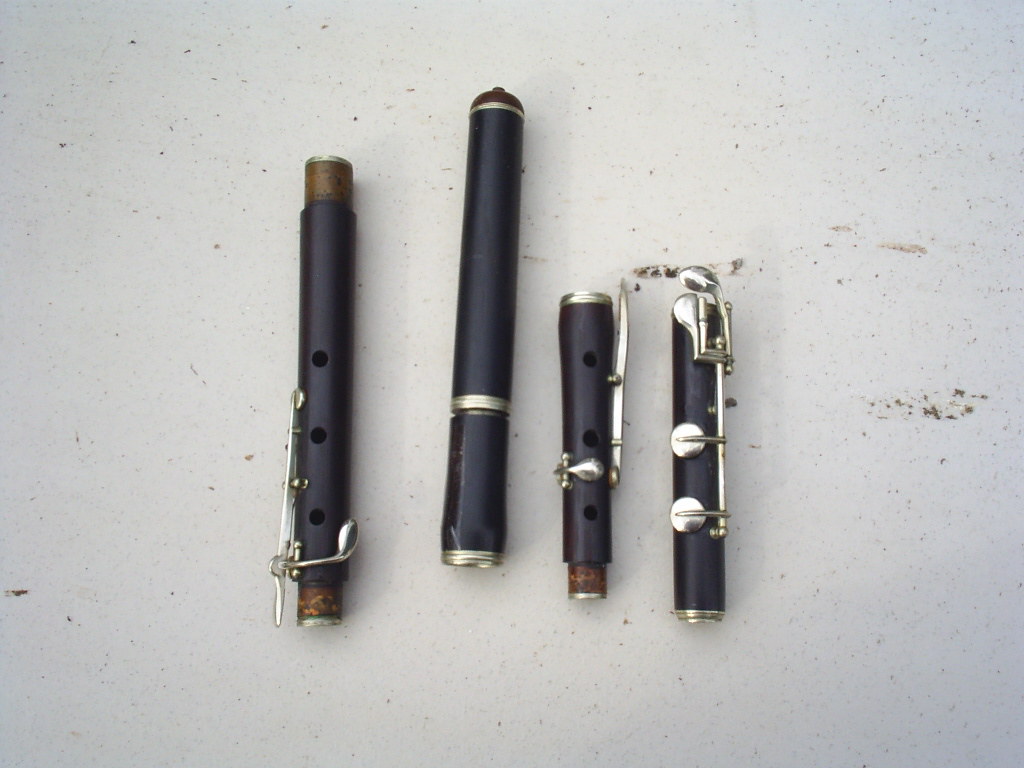
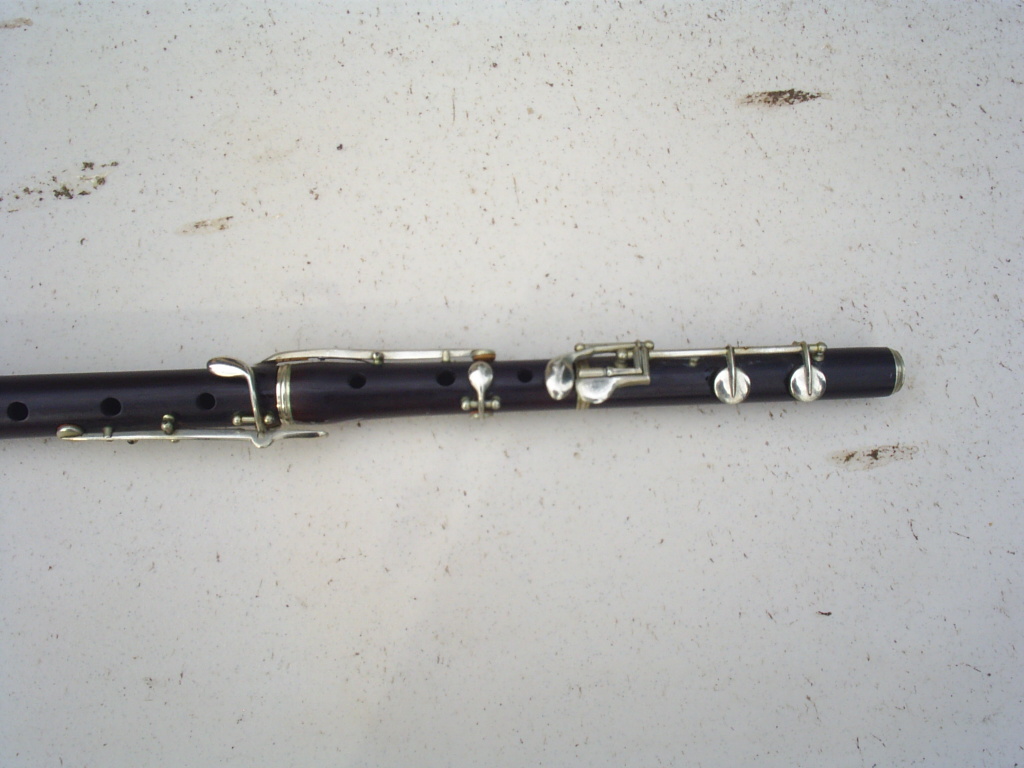
I just received this flute. It was advertised as “an old flute” and had a sounding length of 600 mm, so I took a snipe. From the pictures it appeared to be a French flute with a Boehm style foot, with no makers mark. It appeared to have reinforced sockets and metal tenon protectors. I found extremely faint stampings on the Headjoint, and the foot joint, showing "Douglas & Co., 7 unreadable, London, E ‘C’.
A search tells me that Douglas & Co. were dealers and importers, not makers. The flute plays at A=440 Hz. with slide extended about 3 mm.
The body is a dark reddish brown wood of a fairly hard and heavy nature. Cocus? The weird thing is the headjoint and tuning barrel are apparently of African Blackwood. The headjoint is only partially lined. Probably the reason why it remained uncracked. It had a crack in the tuning barrel and in the R.H. section upper socket. Pasting cello-tape on these cracks and the flute plays down to ‘C’ fairly easily. With the slide set to A=440 Hz., the bottom ‘D’ is only one or two Hz. flat. The F# is flat but can be pushed up close to spot on. The rest of the scale is bang on. The keywork appears to be Maillechorte and of fairly high quality. Screwed steel springs, inlet steel spring-guides. The whole flute appears to have been freshly padded. . .some time ago (twenty-thirty years?) and then set aside and left unplayed in a cupboard.
My question is: Aside from a fun playing flute, Do I have some sort of early Frankenflute?
Hmm. Thought I followed the directions, but I see the pictures aren’t loading. If you right click the “image”, and choose view image, it will take you to the flicker pics.
Can’t see the photos, might want to try another site for uploading, like imageshack.us …
Sounds like the typical early 20th century model, a few makers like Hawkes & Sons and Rudall Carte, we’re going over the the Bohm flute, Hawkes used the French keyword too.
Bob, see the example I posted in your Test Forum thread. You need to use the Shared option links on Flickr, or link directly to the URLs of the photos (as I did).
Very nice looking, typically French flute. Yes, Douglas appear to have been importers/dealers - I’ve seen several flutes with their stamps, all cheap German ones hitherto. This French one may have been made especially for them for the British market, probably post WW1 since it is not LP diapason normal nor English HP. (Diapason normal flutes - A = 432-5Hz - won’t or just barely reach A=440 with their slides fully closed.) French flutes in general were made to higher standards than English or German ones, wit the kinds of detail you note (screw-affixed steel leaf springs, screw-in key pivot pins, lined sockets, etc…), and part-lined heads are normal in them, though they too often part-crack over the metal-lined part. The metal-lined sockets are also as likely to crack for that reason as they are to be protected from other stresses which often crack unlined wooden sockets!
French flutes like this are usually very sweet and quite strong players - not quiet despite the smaller tone-holes (this example doesn’t look to have the smallest), but not given to low register honking. Remember that the F#s are meant to be played with an F key and the Eb key open - they’ll be a tad flat even then.
Oh, and I meant to add these points to my last post (got interrupted/had to go out). It doesn’t look “frankenflute-ish” at all to me - the rings on the head and barrel look to match the rest and the style of the crown and the upper end of the barrel are consistent with a French flute. These photos don’t even show any significant colour difference, but if there is one in the flesh, I still would not automatically assume they weren’t well matched originally. All cocus, too. The SL of 600mm, however, does shriek “diapason normal” (i.e. LP) at me. That’s at least 10mm too long for a CP conoid flute. Thinking about it, I’m surprised you find it plays acceptably at 440. But if it does, it does - great! It is a very nice find and not at all “oddball”. Congrats.
The SL of 600mm, however, does shriek “diapason normal” (i.e. LP) at me. That’s at least 10mm too long for a CP conoid flute.
Got me thinking, so I took my steel rule to the flute. With the slide fully closed, the SL is 584 mm. This discrepancy from the sellers description is to my advantage so “No Harm, No Foul!”
Would it surprise you to hear this inattention to detail was committed by a certain dealer in antique instruments who should be quite familiar to you. It does serve additional notice, tho’, to use caution when shopping around in Herefordshire
Thanks for checking up and philling in that minor detail, Bob! Well, that explains a lot. I dismissed any interest in it on eBay because of the stated SL! Damn.
If we expect to open up English flutes with closed SLs c575 by 5-15mm, your French 584 seems perfectly reasonable for CP with a little slide extension.