Went to a session and there was a cello player in attendance. The playing made for a very unpleasant experience. It sounded, well just very loud and did not seem to fit in. I don’t know if it was the instrument or the Player. I mean where do you draw the line? I think everyone at the session was to polite to say anything. I’m hoping this is a one time visit, or maybe the person could take up the fiddle? 
200 years from now, Cello may be a traditional part of Irish Session…
Consider yourself fortunate that you have a chance to experience this groundbreaking style in its infantcy! 
I was part of a company that included Packie Manus Byrne and a celloplayer once. It was just lovely. Loads of recordings, going back to the Old Ireland Quartet of the 1920s, included celloplayers.
As with all instruments, depending on the musician behind them, they can be a blessing or a curse. We had a foursome playing accordeon, fiddle, pipes and flute visiting a few weeks ago. We hope they never return. We had different people playing pipes, accordeon, flute and fiddle since, they were very welcome and will be so any time.
Perhaps you were sitting too close (like right in front of her!). From where I was sitting it sounded really good, and supported the melody well enough.
Matt Malloy used cello to back a few of his recordings; if that’s not irish enough for you…
Jay
I think you must just have been unfortunate, there are obviously various ways to accompany and it sounds like they picked the one that didn’t work or you didn’t like.
My partner plays cello and it generally sounds quite good when we play together and cello really works well with my smallpipes.
Unfortunately my flute playing isn’t anywhere near as good as her cello playing 
Iain
we once had a visiting oboe player turned up and made quite a reasonable fist of it (albeit sight reading from a tune book), double reed sounding quite pipe like at times. The two Swedish Nyckelharpa players were great.
We have a number of pro trad cello players in Nor Cal:
Barry Phillips – very eclectic player. Listen to the first track; more Swedish than Itrad but the potential is obviously there
http://www.myspace.com/barryphillipscello
Myra Joy – also an eclectic player, part of the the Black Brothers band
Natalie Haas – plays with Alasdair Fraser
None play straight ITM, but they could, certainly well enough for an ordinary session. Been in a session with Myra and it was great.
Someone once tried vehemently to convince me that the cello is an Irish instrument, invented in Ireland. She didn’t succeed. 
I’d think it depends how it’s done.
If the cello is taking a melody role, doubling the tunes an octave (or more) below, the player needs to be as crisp and agile as any fiddler. And then the result may depend on the overall mix of session instruments, else it could sound overly dark and perhaps labored in a small session setting.
If the cello is taking an accompaniment role - much as Natalie Haas usually does with Alasdair Fraser - the result will depend on the approach: playing countermelodies, rhythmic chords, bass lines, bowed or pizz. And, of course, the tolerance of the other players for harmonies and sometimes busy accompaniments which can overwhelm the melody if not done artfully.
I sometimes session with a mandocellist (in CGDA), and often I find the timbre and range alone too dark and “bottomy” for my taste.
Needless to say, the cellist also needs to know the tunes thoroughly, and have worked consciously and deliberately on adapting a trad cello style. And not just show up with a cello because it happens to be what they play.
Locally, there are 2 other less typical instruments playing at sessions. One is a fellow who plays upright bass in celtic style (if there be such a thing?), as well as swing and jazz. I particulalry like the sound when he jazzes up the bass line underneath the melody sometimes, or puts a little texas swing underneath a polka or particularly dance worthy reels. Others may not. Another is the Viola Da Gamba. A very talented player with a vast knolwedge of celtic music and does great justice to any session. As others have said, I guess it depends on the player, the style, the session, the other players, and maybe how much whiskey has been embibed by all 
MT’s right on. Let me amplify a point of his this way:
There is nothing to stop the cello from being used very effectively in trad, even if it’s perhaps not ideally suited compared to some others we could mention. Like with any other instrument, the success or failure would depend entirely on how familiar the player is with the music, and how adept he or she is at reproducing it on the cello, two completely separate issues. Personally, I think it would be a hell of a task, given the physicality of the cello and the demands of trad.
Consider the guitar. It can be used to wonderful effect as accompaniment for Irish music, or it can rip the very life out of a session. I would further say that I’ve heard very few players who, when playing jigs and reels in a flatpick or finger-style, can conjure the kind of lilt out of a guitar that fiddlers and fluthers have no trouble doing. And this in a UNIVERSE of competent guitar players. That’s about the music, not technical competence on the instrument.
The world is, I think, still waiting for the breakthrough Irish cellist that can show us the way.
Rob
Hmmm, I wonder who that could be. Is there more than one? 
It just goes to show Music is in the ears of the beholder 
I would think the Cello will remain an oddity in Traditional Irish Music 
In theory Irish Music can be played on the clarinet, Oboe, tuba and bassoon, but it doesn’t mean we should be subjected to it
I’m just a simple Irish Trad Player, just give me Flute, whistle, and fiddle, just my 2 cents
We have had a cellist who knew the music, and laid back far enough to contribute without intruding. Rob would know him and his smiling wife.
This week we had a visiting 5-string banjo player who, to my astonishment, was equally sensitive and blended well. Died-in-the-wool traditional? No, but he knew how to handle himself, and it was OK with everyone I spoke to. (Not that I won’t still cringe when the next one shows up).
I had a very unpleasant experience with a cellist at a session, I had to ask them to not come back. The problem was mostly that they had no idea what the music was supposed to sound like. It could have been lovely but it wasn’t!
MTGuru - Could be more than one Viola Da Gamba player out there unless Mason Brown gets out your way very often…he sounds wonderful on Viola Da Gamba.
Gerald Trimble was at our session a few weeks ago…he hadn’t been back and playing in a KC session in years…wonderful on what I’d call the Cello (it had 5 strings and was apparently older and slightly different than a cello). Anyway, it worked well with our session.
As for odd instruments, we have a mando-bass at our session:
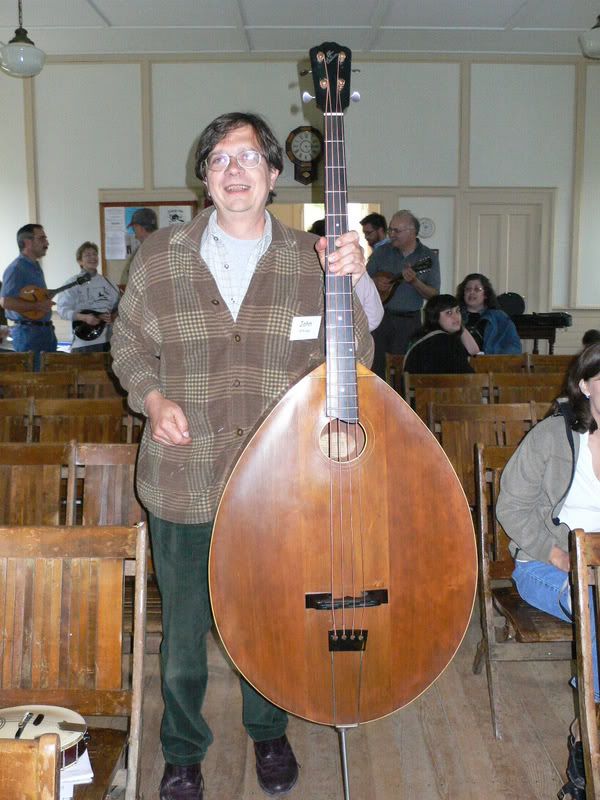
If a player’s good enough, I think many instruments fit in well in an ITM session.
Eric
Yes, 'twas he I was thinking of. And I know who has his Sobell cittern if he ever wants it back. 
I have played in house sessions (in my house, even) with a cello player, and it was lovely. She’s mainly a player of Scottish music, but what she was doing fit fine with the ITM the rest of us were playing. There really are lots more similarities than there are differences between the trad musics of Ireland and Scotland, you know.
It seems to me that the the less “traditional” the instrument, the better the player must be to convince others that they can contribute. Would that be a fair statement? Granted, in something like fife and drum, you will never have more than a few choices.
I’d agree with that.
I do draw the line at noseflutes, though. If someone can do a proper roll on a noseflute they probably have a medical condition that would lead me to not want to sit next to them, and lets not even talk about sliding notes on a noseflute.
Eric
In contrast to Jayhawk (but with a nod), I’ll take up the curmudgeon’s staff and say: No, not really. In ITM terms, at least, I see three issues: ability (yes), genre familiarity (absolutely), and the instrument itself (depends up to a point on the first two).
What I have seen is that the less traditional (and that means background OR instrument), the better they have to be to convince themselves that they can contribute. We tend to keep a wait-and-see attitude. And that is in spite of all, for seldom are our fears unrealised: you can be the likes of Louis Armstrong, but if you don’t know the music and the community’s expectations, and I mean capital Kay Enn Oh Doubleyoo, it just ain’t gonna happen. Period. People really hate it when they hear that, but it’s true. I’ve seen the truth of it a gazillion times. The path to the ITM session is littered with the bones of the willfully blind.
If you know the music, you can lug a bleedin’ flugelhorn to the session if you like. But played well or no, it’s not going to sound right. That counts. At least a cello stands a chance. And so does a khaen, for that matter. But they’ll always be novelties. Well, maybe give 'em a century or so to see how they’re accepted into the fold.