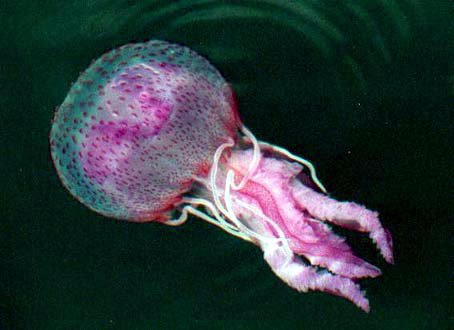
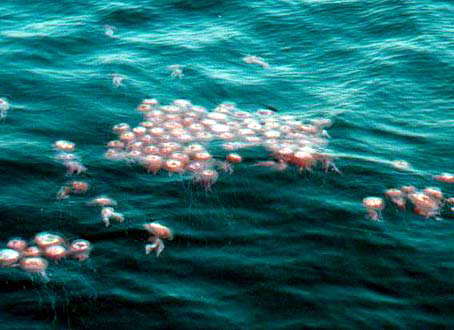
DUBLIN, Ireland – The only salmon farm in Northern Ireland has lost its entire population of more than 100,000 fish, worth $2 million, to a spectacular jellyfish attack, its owners said Wednesday.
We represent the Jellyfish Guild,
The Jellyfish Guild, the Jellyfish Guild.
And in the name of the Jellyfish Guild
We wish to say, “So long, and thanks for the fish.”
They say the oceans won’t die; they’ll just change life forms. We could end up with jellyfish from shore to shore replacing much of the diversity we’re used to.
On the upside, jellyfish are good to eat. Start downloading your jellyfish recipes now.
I have heard this about jellyfish, too. I hope all the plastic trash in the ocean doesn’t finish them off too or else the ocean will become a giant empty wasteland of bacteria.
I feel sorry for the salmon farm in question, but truly I’d like to see an end to the farming of fish. It is a major cause of ocean pollution and disease among fish stocks, and, not least, the fish it produces is rubbish. It’s cheap but it’s rubbish. Supermarket salmon is, well, just not salmon.
But at least it’s sustainable. Farmed fish may be inferior but it also helps the long term survival of salmon, trout and other fish which may otherwise be threatened by overfishing (as we’re seeing with Cod).
It may be sustainable in terms of conserving wild stocks (as long as unnatural concentrations of fish in farms doesn’t cause a build-up of disease that then affects wild stocks, which is a worry), but fish farms are highly-polluting, and by its nature the pollution is hard to control.
Actually, North Sea cod stocks are recovering but are still hit hard by trawling that is ostensibly taking place to catch other fish. EU quota limits means that most cod caught this way, perfectly good fish, have to be thrown back. Dead.
Do you really think that farmed salmon and trout are worth eating? The last time I had trout, the little row of sliced almonds on top was by far the most interesting aspect of the dish. I’d much rather have a nice piece of sea bream or brill, or, best of all, line-caught sea bass. They’re even talking about farming that now. Heaven forfend, say I!
I’d have to go with Steve on this. These net-penned fish farms leave long streaks of a thick black goo of rotting feed on the ocean floor that nothing else will go near. This is the pollution legacy that has so many people up in arms against fish farming (as practised today). Also, as the target fish grow, they are fed (surprise!) fish; fish that are already contaminated with lead, mercury, etc. So what you end up with is higher concentrations of toxins in farmed fish. In fact farmed fish are considered to be so toxic that our federal health ministry is warning adults not to have it more than once a week.
Fish farming only makes sense today if it can be done on the cheap so it can compete with wild-caught fish. It’s just like any other business. Once wild stocks are so depleted that they are no longer part of the market, the fish farming business can re-adjust prices so that fish will become a luxury food. When competition consists of farm versus farm, only then will it make sense to modify farming practises to more healthful and ecologically sound methods.
North Sea fishing is in the news every day here (NE Scotland houses Europe’s biggest white fish port in Peterhead and the largest shellfish port in Fraserburgh) so I hear a lot about it. Cod stocks are increasing but it’s only been a small increase and lots still need to be done to conserve them. They’ve already mothballed a huge number of boats and introduced crippling quotas. I think lots more people around here will lose their jobs before cod gets back to a truly healthy level.
I understand that fish farms as they currently operate result in pollution, disease and high levels of mercury. However if the alternative is decimating wild populations of fish that are otherwise farmed just now then perhaps a better solution is to improve farming methods to reduce pollution, disease and toxin levels rather than scrap farming altogether.
djm, what’s your view on all this wild Alaskan salmon we get in tins here? I mean, it’s not fresh fish by a long chalk but it makes a nice salmon and mayo butty. Is it sustainable?
No absolutely. We should all eat a more diverse variety of fish and start eating more pollock and other “lesser” fish.
Dunno about eating less fish in general though. Most people, myself included, don’t eat enough. Mainly because the supermarket fish counter is closed in the evenings and I can never be bothered buying the packs of 2 or more fish when I’m just cooking for myself.

 I’d much rather have a nice piece of sea bream or brill, or, best of all, line-caught sea bass. They’re even talking about farming that now. Heaven forfend, say I!