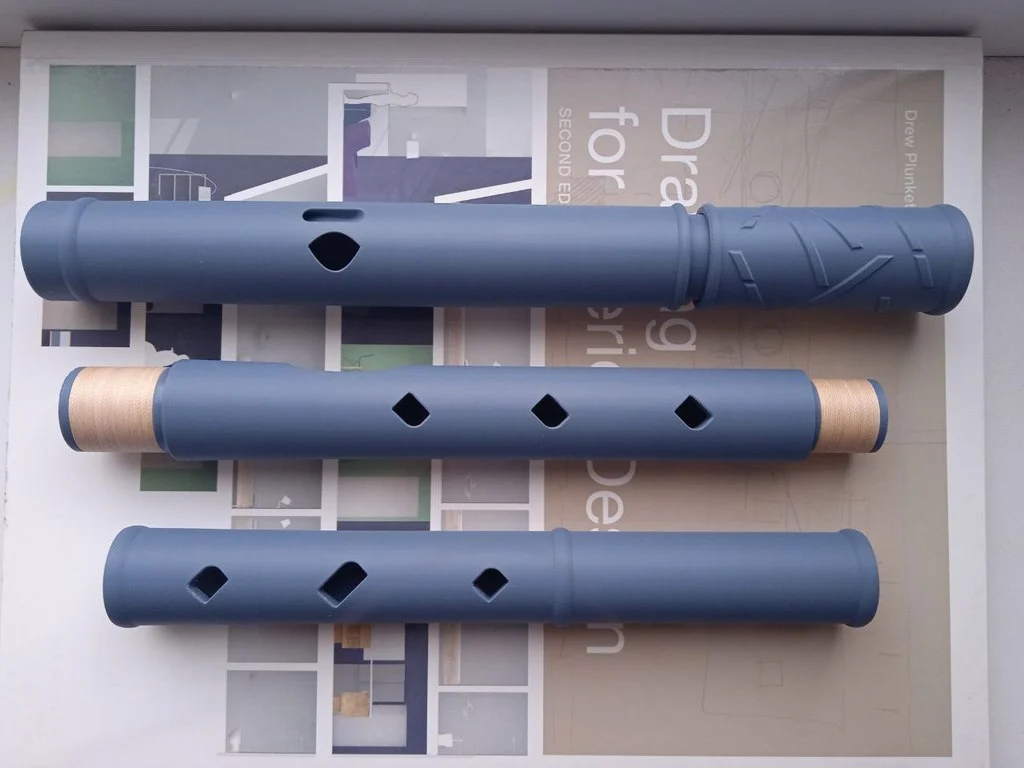
I mainly play end-blown flutes, but I’ve printed this Irish flute by Marat Axianoff and I have a few questions for the experts here about its construction
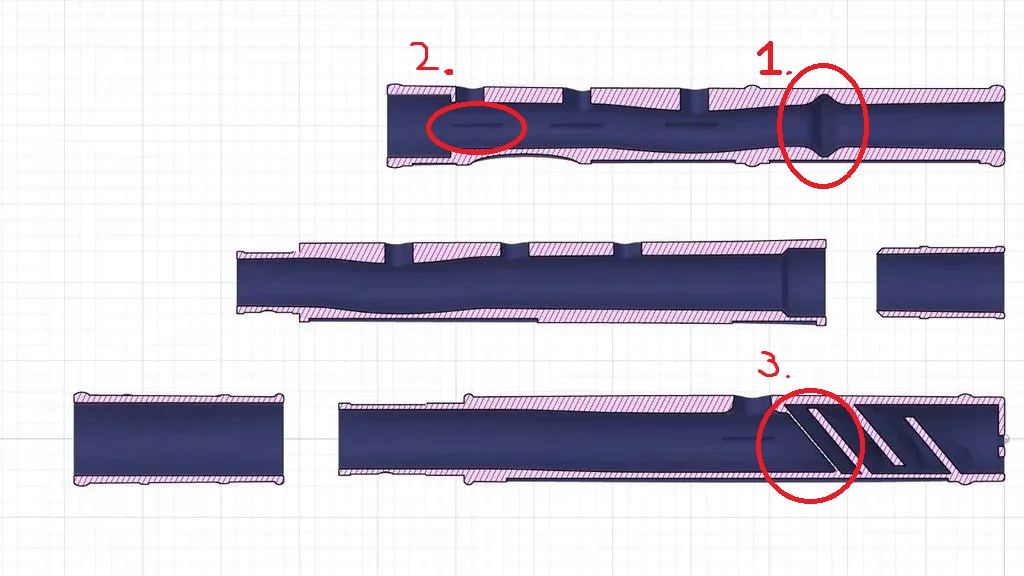
Between the last tone hole and the end of the foot there is a section that flares out and back in, what is the purpose of this section and it is traditional in irish flutes?
Each tone hole and the mouthpiece has a channel in the wall of the bore to help the tone holes print better. Will these have any real effect on the tone and tuning?
Does the angled stopper have any beneficial effect on the flute?
There is a small slot cut behind the mouthpiece. The maker claims this is a “resonance chamber” but I can’t find any more details about what that means or its effect on the tone of the flute. The makers piccolo has a similar feature. Any ideas?
As a new user I can only add one picture, but follow the link to see the other features
The slots near for the toneholes are (supposedly) specifically to aid in the manufacturing. I may fill them in with wax, polyurethane or something similar as a test.
The angled stopper membrane is because of the manufacturing method. Having a 90 degree overhang is very difficult for a 3d printer. a 45 degree angle is much easier. I didn’t recognize the entire “stopper” as a folded tube so good call out there. In comments this must be what the designer calls an acoustic transformer. I may experiment with filling in the folded transformer and noting any differences too.
By “the slot behind the mouthpiece” I mean the external feature past the blowing edge of the embouchure hole.
As far as function, I don’t play Irish flute or any transverse flutes really so I’m not the best to judge. But when I pick it up on occasion it plays well, is in tune, and sounds good. I’ve tested a lot of other end-blown 3d printed designs and this Irish flute has an unmatched attention to detail. From what I understand the designer, Marat Axianoff, is a professional flutemaker in Russia.
Make sure to tell us all what you find. These are ideas I’ve certainly not had to consider before!
Interesting! The usual stopper creates a Helmholtz resonator between embouchure hole and stopper. It is set by moving the stopper to a frequency that assists the flute resonance by aligning the “partials” up more accurately into being harmonic.
This acoustic transformer appears to aim to gradually diminish the energy coming through the diaphragm. Note how the passages get wider and the gaps between them get larger. Contrast the cap end cavity with one behind the stopper. Anyone ever come across such a system elsewhere?
Ah, thanks for that image, I now see the slot in question. Again, never saw such a thing before. We went through a period some years back where makers experimented with cutting away some of the timber beyond the embouchure “edge”. But you don’t seem to see that these days.
The holes are the other amazing aspect visible in your new image. Woah!
This might tell us that flute makers using 3D printing methods face a whole new set of challenges and are coming up with whole new approaches to deal with them. And that old-fashioned traditional flute makers like me should butt out and wait till all is revealed!
It really would be great to hear a direct one-to-one comparison by an experienced player between a flute like this and a well respected traditionally made flute. I guess that will happen!
Hi, I’m the guy who reposted Marat’s model on Printables. I’m not a flute player, but I’m very interested in 3D printable instruments. Copying Marat’s piccolo, in particular, seemed like an approachable way to start figuring things out.
I feel like I should have qualified my glowing review of the full instrument with “for $5 worth of plastic”, haha. I’ve made dozens of these things now, and while they’re all playable with no additional work after printing, the quality is all over the place. I’m coming to understand that the smoothness of the inner bore is far and away the most important factor in how playable these flutes are, and controlling for that on a 3D printer is pretty tricky. Shiny plastics like “silk PLA” perform best so far, but also leave little stringy bits all over the place.
I’ve made a total of one (1) of these that has a nicely voiced low D. Everything else is varying degrees of work for me, a pretty awful flautist, to get that low D to sound. A friend in my session has compared prints of Marat’s flutes to Doug Tipple’s PVC flutes, but has also had trouble hitting that low D on some of them. Corespondence with Marat led me initially to focus on the joint seals, but I currently suspect my problem is bore smoothness. I’ll spare the thread further detailed thoughts on this topic, unless someone is interested
Regarding the funky toneholes: my understanding is that those help make a cleaner print. They are for sure a distinctive design element! I have made Uillean bagpipe chanters (my passion) with both types of toneholes and can’t hear any difference in how they sound. The OpenSCAD code involved in getting these “Axianov toneholes” is complex, so lately I’ve just been using circles in my prototypes. Once I get the rest of the chanter dialled in, I will probably go back to the Axianov holes, both for the striking look, and for the cleanliness of the print. I can try to get close-up photos of why the circles don’t print as cleanly, if anybody’s interested.
PS: here is a video of a Russian flautist talking about, showing the details of, and playing Marat’s full-size flute and piccolo: https://www.youtube.com/watch?v=5jGYwOuCNCc
Marat, who is trying to avoid spending tons of time on social media (a laudable goal, in my opinion) has this to say:
“Between the last tone hole and the end of the foot there is a section that flares out and back in, what is the purpose of this section and it is traditional in irish flutes?” — This was found through experimentation, and according to the musicians who have played this flute, it strengthens the low D.
“Each tone hole and the mouthpiece has a channel in the wall of the bore to help the tone holes print better. Will these have any real effect on the tone and tuning?” — This doesn’t affect the sound, but the holes print cleaner.
“Does the angled stopper have any beneficial effect on the flute?” — This was done to accommodate the entrance to an acoustic chamber which provides a slight reverberation. I thought that since the space was unused, I could fill it with a small acoustic device. Only the volume of the chamber matters, not its shape. This is why, for example, Tornado Boosters don’t work. The fact that it has a thin wall is a result of tuning. Initially, the wall was thicker, but I had to “move” the stopper, and I simply forgot to make it thicker on the other side. But there are two or three layers of plastic there, and that’s sufficient.
There are small indentations on the tenons. This was done to hide the thread knot there.
The holes are designed for clean printing. For future flutes, I’ve come up with a different hole shape, but I don’t know if I’ll be working on other flutes.
As a benchmark for evaluation, I would take the flute that Alexander is playing in the video. It was printed cleanly and Alexander plays it well.
He also commented “It was nice to see Terry in the discussion. He is the master from whom I learned a great deal when I was making Delrin flutes.”
Thanks a ton for getting these answered! I still would really like to know what effect the slot behind the blowing edge of the mouthpiece has on the flute.
In the compartment where the stopper is usually located, in the case of my flute, there are partitions and chambers. This system can be conventionally called an acoustic maze. The slot next to the mouthpiece is the entrance to the acoustic maze and this entrance captures the sound. Now I would have made this entrance differently, so that more sound would get into the chambers, and the exit from the maze would be free, without a partition. This system adds spectral coloring and micro-delay to the sound. This is not classical reverberation and the effect is very small due to the size, but you can better understand the effect if you turn on the music on your phone and bring the speaker to the entrance to the maze.
In another topic, you asked about the shape of the tone holes. I would try the Reuleaux triangle.
I would also like to add that the position of the stopper wall inside the channel is visually misleading. It may seem like the stopper is closer to the embouchure hole than it should be. The flute is shown in cross-section, but this sectional view does not accurately represent the true wall inclination along different axes. However, the actual volume of the space between the blowing hole and the stopper wall is identical to that in classical flutes. The only difference is that this space has a different geometry.
I get it now, i didn’t realize the slot had an opening to the acoustic maze. Makes complete sense and yes holding a speaker up to the entrance helps make the effect more apparent. Thank you!
Marat, I wonder if you could give me some advice. A chap in Sydney (Australia) has made me a copy of the Axionov flute which he 3D printed using a filament that incorporates cherry. But he had to leave the flute pieces unfinished, as he has had to fly out to Europe for a month. I thought I should be able to get them going, but I’ve run into strange problems.
I thought I’d work on the body sections first, and couple them with a wooden head and barrel that I made. The odd thing is I can get it to play down to about f# in both octaves, but the E notes are really weak, and the D notes almost non existent.
I’ve checked very thoroughly for leaks, so we can rule that out.
I am pretty convinced the problem is bore finish, because it doesn’t look good, even after I tried sanding it in the lathe. Also, if I run water through the foot and try again, suddenly I can get the D notes. Still not strong, but at least they sound.
Sanding the bore is not easy, due to all the undulations in it, and the bulge just below the 6th finger hole.
Do you have any suggestions about better ways to smooth it? Or what other issue that could be fooling me?
Another thought. Is it possible that this flute was accidentally printed at a setting other than 100% infill? Can anyone who has printed this flute tell us what the finished weight should be? This one weighs about 170gms, whereas I’d expect a wooden flute to weigh more like 300gms.
It’s difficult to say for sure. If the filament isn’t PLA but PETG or some other type, the flute might not play properly because of that. It could also be due to incomplete infill. Another possibility is poor print quality, and sanding might not fix the issue. If you incorporated undercuts, that could also have a negative effect (on this particular flute, undercuts on the tone holes don’t work, even though I know how beneficial they are for classical flutes). People often have issues with airtightness, but I’m sure you’ve accounted for that. And now, venturing into the realm of strange assumptions — it’s possible that the embouchure hole on the wooden headjoint isn’t suited for this flute, although I can’t quite imagine how that could be.
If I remember correctly, the Delrin flute was about a hundred grams heavier. The Delrin one weighed around 350 grams, and the printed one, accordingly, 250 grams.
I also used a printing method where the filament was laid down in a continuous spiral on each layer. I don’t know if it’s denser than the standard grid infill, but it resulted in a better surface finish and allowed for smoother, more precise printer operation.
You used vase mode to print your flutes? I was under the impression that vase mode can only be used with models one wall thick?
I printing mine using regular PLA and had no issues, the more is very smooth but not glossy. No issues with seals with Ptfe tape and all the notes play strong.
@Terry_McGee It’s possible the wood filled filament you used wasn’t a good material for the flute but that’s just a thought. What did you use to seal the tennons?
This isn’t the vase mode. I haven’t printed in a long time, but I remember that Cura has a setting that allows printing objects in such a way that the filament is laid down continuously in a spiral within each layer. The best approach is from the inner wall to the outer wall, with the z-hop then performed on the outer wall along that longitudinal groove you can see at the bottom of my flute.