Has anyone ever tried a Siccama flute for Irish trad? I haven’t, but can see the potential limits (no slides on certain notes covered with siccama keys, and difficult ornementation). Any opinions? I see too that Terry McGee makes a Siccama model flute, and I wonder for what kind of music, if Irish is difficult on it? Penny whistle for your thoughts. Shane
Paddy Carty played a Radcliffe system.
siccama’s are terrific flutes for irish music, most especially for small hands that have difficulty with the ring-finger reach. You lose the ability to “slide” notes (from D to E and from G to A) but that’s little different than anyone playing a Boehm system (such as Ms. Madden) for trad.
The Siccama flutes are strong and powerful of tone, and it’s no wonder. John Hudson (the original constructor for Mr. Siccama) was the maker and developer of the Pratten’s Perfected flute. Again, it’s no wonder since Mr. Pratten performed on the Siccama before his own model appeared and enlisted the only maker he obviously associated closely with: Mr. Hudson.
Abel Siccama got a bum rap from Mr. Rockstro, who was probably very jealous of his success. Note that the Siccama model makes the low E very strong of tone, a common problem for some simple system flutes, which oft suffered from a “choked” sound.
But then again, this is all just my own uneducated, inexperienced and personal opinion and assessment. I’d seek out THE expert on this, whomever the heck that might be today. 
Hope this helps ya. I guess I just can’t resist.
Thanks David! Now, now, I had nothing to do with the previous discussion! 
Please keep up your contributions, David Migoya!
But then again, this is all just my own uneducated, inexperienced and personal opinion and assessment. I’d seek out THE expert on this, whomever the heck that might be today. >
And good on ya for doing so!
Bob
Yes I’ve got one. Made by Metzler (end cap is not original.)
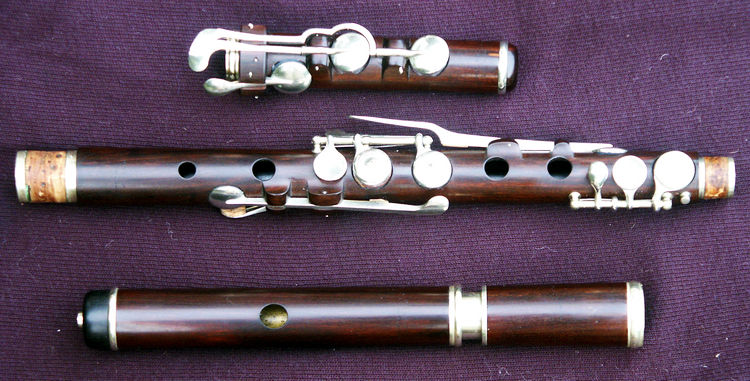
Works well, as David said it would be ideal for someone with small hands or old hands as the finger stretch is reduced. My daughter used it for ITM for a few years but it’s now not being used and I could probably be talked into selling it …
Cheers
Graeme
I know a guy with a (quite early) Wilkes 8-key who had Chris make him (retrofit) a Siccama key for R3 (i.e. on a normal Rudall E-hole) because he has an arthritic problem affecting his span. It does the job just fine, with the limitations David outlined.
Bloody Wilkes again!
Rob
I believe you can can hear some Siccama clacking on Matt Molloy’s Bb flute on his earlier albums.
There is a funny passage in Ciaran Carson’s Last Nights Fun book which I don’t have a copy of anymore but he says
something along the lines of: about then you get a Hawkes Siccama flute that sounds like a trumpet compared to the genteel
quiet of the Barret (his first flute) until you realize the keys for the E and A don’t really respond to ornmentation the way it should.
I think I’m only remembering the trumpet and the genteel quiet part correctly but fudging the rest but I did read the book enough times that I should remeber it by heart.
I think one should work well if you recognize it may have some limitations and learn to use those limitations effectively in your music.
Maybe some one with a copy of the book could find the real passage (I hope I have the right book).
Perhaps the clacky keys could be a nice effect and all of us would love to have the sound of Paddy Carty on the Radcliffe.
Patrick
Presumably, the great advantage of Siccama is that the switch from simple system/whistlefingering is seamless.
I’m not positive but I would think the original design was to get the holes in the acoustically correct postion for all reaches rather than just small reaches. I would think because of the new position they would not be reachable even by large hands. The holes are still huge, so less to do with small hands and more to do with the correct positioning of the holes. There was one or is one on ebay for a reasonable buy it now. Though don’t know if the mechanism is in good shape.
Other than slides, I can’t think of any ornament that would suffer.
I had occassion to play a McGee Bb Siccama that was here in the store for a while (not early long enough IMO!). It was sure nice on the hands and the “E” note was great.
I would think a Siccama would be great for IrTrad for someone that didn’t want to manage the stretch of a large-hole flute.
Doc
an older discussion:
https://forums.chiffandfipple.com/t/siccama-flutes-are-they-for-small-hands-only/24697/1
and the ebay Siccama
http://shop.ebay.com/i.html?_nkw=siccama&_sacat=0&_odkw=siccama&_osacat=0&_trksid=p3286.c0.m270.l1313
but why is it listed twice or am I confused
Also didn’t some very good player play an antique maybe Chappell Siccama
I thought maybe Turlach Boylan but can’t find any info on his flute and a few
pictures seem to not show siccama keys on the flute.
any guesses?
The balance point is a bit different since the there’s a lot more typewriter keys. L3 and R3 get tired more easily (a and e rolls take more effort). Some may not like the single piece middle section. Spectacles take a bit of getting used to. Yes you will want to bend those notes but you can’t.
But OTOH if you want a fully keyed flute, fairly powerful tone at a good price, then it is excellent value.
Yeah. Bloody Wilkes! Anyone would think he was an expert or something.

Turlach indeed played a Chappell ebonite flute from late 19C, but I don’t have any details as to the configuration.
If you say so. In this case only indirectly. As best I recall I met the flute in question and its owner (from Chester) the best part of 20 years ago, not very long after moving to N.E. Wales, before I’d ever met Chris. The flute was already several years old then.
I think what is normally understood these days (and maybe always since its introduction) to be THE Siccama flute is his initial, basic design as seen in the current/recent Hudson-made eBay example and Terry’s picture:

- a normal 8-key Simple System in most respects, save that it has the better (acoustically) placed 3rd-finger tone-holes with open-standing extension keys to permit their operation by a normal hand. No “typewriter” keys (by which I take it you mean longitudinally mounted rod-axle mechanisms). Properly set up, the springs on the extension keys are supposed to be very light - there really shouldn’t be any significant stress or effort (or loss of speed) in using them for taps and rolls once accustomed to them, though of course the immediacy of sensation one gets from open holes would be lost.
Later there were many additions and “improvements” some actually by Siccama, others not but using the same principles, and the ideas were also applied to Bohm tubes and made use of rod axles. There certainly were later “Siccama” flutes that had fully covered mechanisms using rod-axles and platter (“typewriter”) keys but preserving the underlying 8-key configuration with additions(as in this picture, also borrowed from Terry):
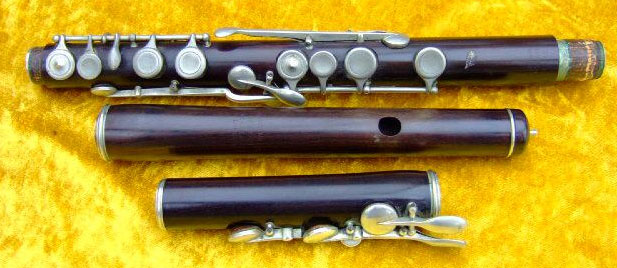
These assorted hybrids were often termed “Siccama flutes” by their makers, though they did not necessarily have Siccama’s involvement or licence. See Rockstro’s Treatise for a full (if biased) account) and Terry’s excellent examination of Siccama. But I think even then the term was really centred on the design’s use of offset 3rd-finger holes with extension keys as the fundamental “Siccama” feature - brilles (“spectacles”/“lunettes”) and other additions weren’t perhaps though of as essentially Siccama…
But for sure, this current/recent eBay flute should be an excellent one, apparently playable at 440 (has the right sounding length) and in good condition - just looks to need a clean and overhaul. It would be ideal for anyone who has 3rd-finger extension problems on a normal 8-keyer, though as the other holes are still large and normally spaced, it probably wouldn’t suit someone with overall small hands issues. I’d buy it if I could!
The other current eBay one by Riviere & Hawkes/(duplicate listing) is a more dubious option - the extra pictures in the second listing do suggest it is conoid, but at the given sounding length (and period of manufacture) it will probably be on the High Pitch side (if it was on Bohm body it would be waaaayyyy HP!). It will likely still need a fair slide extension to bring it down to 440, maybe with intonation issues ensuing (given that on standard conoid bodies with sounding lengths in the average range of 575-580 we tend to pull out the slide from 5-15mm depending on our embouchures…). I’d want more information to ascertain its design pitch before getting seriously interested if I was going to bid.
Here is the old post and some others at the time that made me think Turlach played a Siccama
but some other posts about his flute don’t mention Siccama keys so I have no idea
https://forums.chiffandfipple.com/t/how-to-make-a-thread-bookmark/61/1
From Cathy Wilde:
Had a neat experience myself recently where I was blessed to sit with Turlach Boylan plus a couple of accordions, a banjo, a guitar or two and a couple of fiddlers at a house party. At one point I got up to let the dogs out of the car for a few minutes and suddenly found myself awestruck on the lawn, transfixed by how clearly Turlach’s flute (a turn-of-the-century Chappell (thanks to Andrew, I’m pretty sure it was a Siccama) not only rang through the other instruments, but a housefull of very festive Irish horsepeople as well. It was absoutely spectacular – under the stars, the dogs ranging about, and hearing the most lovely music washing out of the brightly-lit house, the flute just riding over the top of it all, but blending perfectly, too …
here is Turlach playing but can’t see the keys on the flute. He is a really nice palyer if you don’t know him:
http://www.youtube.com/watch?v=OoN627wKnUU
No one here have a copy of Ciaran Carson? I am curious if I remember the bits nearly right. WIsh I hadn’t given my copies away? I love that book
on p. 55 of the book , Ciaran talks of the Hawkes Siccama flute he had purchased.
of course, that’s merely my layman’s opinion, having read it only three or four times.
surely there’s an expert out there who will quote the passage.
I never liked them, though I admire the lovely work on the better keyed ones. I have owned two or three of them.
There’s a reason why they are cheaper to buy than the traditional timber flute. Players don’t like them as well. I haven’t ever met anybody who played one in sessions. I find them clunky, not just clacky. Inelegant. You aren’t just covering a hole, you are pressing down a key that is sprung to resist the pressure you exert on it.
If that was all I could afford to spend, I’d prefer to spend it on a simple system flute and make do with fewer keys.
Most people who say they like Siccama flutes own one and are trying to sell it.
DM, at this point you are flogging a dead horse. Move on. It’s getting embarrassing.