Another strangled flute

I presume the red bit above was meant to be read as “wet”, and I’ll run with that.

No, it wouldn’t shrink when wet. If anything, it would when wet become more able to stretch, but any shrinkage would happen upon drying. The degree of it also has to do with how it was wetted, and how it was dried. Consider unprewashed cotton denim blue jeans: if you soak them in cold water and line dry them, initially at least you will have less if any shrinkage than if you machine washed them in hot water and tumble dried them at high heat as well.

Reminds me of the old jailbird trick of bending old bars with a moistened bedsheet. Dry sheets would shred before bending the iron.

Do tell! This could come in handy. Details, man, details.

Umm … read directly past the section you quoted, I go on to give three specific reasons why I don’t believe it’s possible, is that backup?

Here they are again -

  1. String snaps at 1.5lbs of tension, if the tension increases with each loop why doesn’t the string snap going on after the 1st loop? So then if that’s not the case,
  2. I gave a relavent example of why I didn’t think the force multiplies, push against your leg with one taut string, then with ten. It feels like the same pressure.
  3. A string wrap with no tension at all in it (one that spins around a tenon) looks exactly like a normal one.

Politely, but excuse me! After every time I voice my “incredulity” I go on to say why I think it’s the case. There’s some combination of you not reading past the incredulity, ignoring any justifications that you don’t agree with and/or shutting off your reading comprehension. Whatever it is I notice it’s also when you start to tell me I “have a lack of understanding”, or I’m “unable to wrap my head around it” or just call me “mate”, mate =p

As for considering your cracked tenon example. I don’t think it’s a relavent comparison to this strangulation question specifically because -

  1. You’d use much thicker/stronger thread that you couldn’t physically break by hand.
  2. It’s extremely hard to use and maintain a lot of pressure with your bare hands. Especially holding a flute body with one hand and the thread with the other pulling against each other. I’d probably attach the ends of the thread to wooden handles so I could use more pressure comfortably without hurting myself. That’s not what you’d normally do thread wrapping a tenon.

consider the following, corrections welcomed:

a. a socket could be capable of withstanding pressure where a tenon is prone to “flexing in” under joint tension and this tension is less than the tension required to split the socket. do not these 2 conditions appear present with our flute in question? ( note: undamaged socket, collapsed tenon, and compacted thread on the tenons (implying tension was present at some point)).

b. i suspect thread to be pretty much inelastic after its inital application. a tenon that was subsequenlty forced to reduce its diameter (from joint tension and/or shrinkage) immediatley loses surface tension from the surrounding thread. this makes the act of constriction by thread over time seem a bit too much of a stretch for me. any tension needed to cause and hold the reduced tenon in its smaller diameter (assuming against its wishes) would not be coming from the thread directly, but more likely from the socket compacting the thread and compressing the tenon.

so once thread is applied,… over time, does it maintain strong elasticity or is it pretty much inelastic ? i understand it depends on the fiber material but let’s assume cotton/polyester common to wrapping tenons…

Whew, this thread is moving fast - excuse me if I can’t keep up!

Like Rob, I thought to ask someone whose grasp of physics is just a little better than mine. Professor Neville Fletcher, Research school of Physics and Engineering at the Australian National University in Canberra. Neville’s also a flute player. You can meet him at Contact us. I’ll relay his response in full with comments from me in [square brackets].


Hi Terry

Fortunately those questions are fairly easy to answer. [Whew, I had feared the worst, calculus!]

If you tie a string around a tube of radius R with string tension T, then the inwards radial force on the tube is T/R per unit length of string. So if the tension is 700g (I presume you mean grammes weight) [yep, sloppy me!] and the tube radius is 1 cm, this gives 700g per cm length of string. [And since there are 2pi radius-lengths of string around the tube, that will mean our 700gm tension actually applies a force of 4.4KG inwards. Gasp, it’s worse than we thought!]

This can’t be readily converted to a pressure, since the string is very narrow – it would be easier with a ribbon.

[Fair point about calculating the pressure, as a single string, being theoretically round, will only make a theoretical single infinitely-thin line-of-contact with the tenon, and therefore any force at all on the string will produce an infinite pressure. We know of course that the string will flatten out, but the amount it will flatten out and spread the force around is hard to determine. Back to Neville…]

If you put 150 turns side-by-side with the same tension then you get 150 times the inwards force, but it is presumably spread over 150 times the area. [I.E. the force goes up, but the pressure remains the same.] Similarly 13 layers on top of one another adds to nearly 13 times the force, except that you now need to use a slightly larger average radius in the calculation. [And this time the pressure will also go up 13 times, as the area hasn’t been increased.]

[I don’t think we need to calculate the force, other than to recognise that, unless we wrap very lightly indeed, it is going to be very high. This next bit is interesting …]

Where distortion of the tube is considered, you are both distorting the local radius and also the longitudinal shape. [Someone asked sometime back, had the tenon shortened? The answer is probably - it’s about a mm short of the socket depth. But of course, we have no way of knowing how close they were originally.] The force per unit area [pressure] is probably what matters in the first case [compressing the diameter], and the total force in the second [shortening the tenon], since you are bending the wall of the tube as well as compressing it.

I hope this helps.

All the best for the New Year.

Neville

Certainly helps, but makes it even scarier!

Terry
Hmmm, I was nervous about artificial aging:

But relying on time alone is not realistic either, is it? Nobody buys a flute to leave in its case. So, rather than accelerated aging, we should look at simulating reality. We could put some wet sponge into the tenons for one hour a day (simulating an hour of practice per day), and, if you like, for three hours on Sunday (simulating the weekly session).

We could also do a tenon with cork as a comparison. For that to have any outcome, but also to be consistent, the outside of the three test tenons should be constrained by nicely fitting sockets, as it seems unlikely that the cork would apply any significant restraining effect by itself.

Terry

You might also experiment with drying the flute out. What I’m thinking of is the scenario, which does seem to be the case with a lot of old, damaged flutes, where it’s been left neglected in a cold dry place - an attic? - for a long time.

Good man, Terry. I had a conversation with my materials science buddy that ran along the same lines.

George, your theory’s done, son. But I knew that already.


Rob

The brackets are you commenting right?

So the force applied to the tenon = tension/radius

Tension = 700g
Radius = 1cm

700/1 = 700

Why are you combining the string’s force from both radii lengths … isn’t it an even 700g all around the tube?

So then 700g*13=9,100g

9,100g = 20lbs

Well at least we aren’t talking about 1.5 tons anymore … 700g is more than generous as a starting point. I tied a piece of thread I use on my flute to a can (full of black beans, yum) weighing 425g and it felt about ready to snap and did when I jostled it a tiny bit. No way I’d use even close to 425g of force just because I wouldn’t want to snap the string as I was wrapping it. That’s cutting the force in the initial application at least in half right there.

Going back to the start of this discussion we were talking about how the string will stretch and compress. Also it’s not a perfect system, the thread isn’t permanently (totally un-moveably) anchored on either end and we don’t keep a mechanically constant pressure while wrapping. I still maintain it’d be very hard to get or keep any large amount of force with one of our thread wraps.

Looks like I was wrong about the thread multiplying it’s force with each wrap in theory, but when you or I are wrapping a tenon in real life that is not happening.

Saints preserve us! Why not?

That is EXACTLY what’s happening. Can you tell me why the excellent treatise above doesn’t apply to a practical example?


Rob

My theory has been from the beginning that a normal thread wrap doesn’t put much pressure on a tenon nor deform it.

You started out agreeing that it would deform it,
Changing part way to saying a properly wrapped one wouldn’t warp one
Then getting vague and calling me “mate” again =)
Then asking me why I was doubting the physics of a wrap exerting 1.5tons or 580lbs on a tenon when you know now it’s no where close to that

You’ve been all over the map!

And my theory’s done … =p

If it turns out to be 10 or 20lbs before a wrap settles and gets even weaker that’s like a 1/4 to nearly an 1/9 of a “very poor” rating for a male’s performance on a handgrip test here - http://www.topendsports.com/testing/tests/handgrip.htm

How’s your handgrip? Mine’s just dandy.

This is why I don’t think you read my posts or you just ignore the bits until you get to something you disagree with. The paragraph before the sentence you quoted.

I’m saying we’re losing a lot of the energy being put into a wrap.

In fairness, I’m not going to be drawn into some sort of weird, revisionist analysis of this whole thread. Suffice it to say that it would be intellectually dishonest to maintain that I’ve changed my position at all.

In short, my position is that it’s POSSIBLE to apply thread in such a way as to distort a tenon, not that bringing thread anywhere near one will result in damage. It should be obvious that it’s possible to correctly apply thread, judging by all of the undamaged flutes out in the world.

And yes, your theory’s dead as a dodo as of Terry’s magnum post.


Rob

http://mythbustersresults.com/episode26

A urine-soaked silk shirt is strong enough to bend the bars of a prison cell when wrapped around them and twisted, as seen in the film Shanghai Noon.

busted

Adam tested this myth after he gave up on his salsa/alternating current escape plan. The bars proved too strong for the wet silk, tearing the fabric apart instead of bending under it.

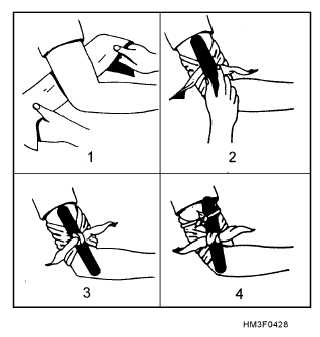
Imagine a wet field tourniquet and how it produces pressure when you twist the rod.

I have used this method as a temporary clamp in the past (without liquid).

Mate :wink: I don’t disagree with that and haven’t this whole thread … I’ve been saying a normally wrapped tenon doesn’t have enough force to cause warpage. Aren’t those statements totally compatible?


Okay Mr. 1.5 tons of pressure =) … seriously if it turns out to be 10lbs (nearly an 1/9 of a “very poor” rating for a male’s performance on a handgrip test “http://www.topendsports.com/testing/tests/handgrip.htm”) I bet that feels like a really weak handshake and is exactly what I’ve been saying this whole time.

No, no, no.


Time to give someone else a turn. Over and out.

Rob

:laughing: bit slow today, ain’t ya! :laughing:

Another thing to think about as far as the cause. Maybe the thread has nothing to do with it.

Some woods simply shrink with age, especially if still somewhat wet while turned. Maybe a thinner walled tenon will shrink in diameter a lot more than the adjacent thicker walled body of the flute. The thicker the wall, the less the wood is able to deform and shrink. An analogy is a 2 X 4 piece of lumber (thick walled) is less likely to warp than a 1/4" thick board made from the same material.

I’ll turn a cylinder of somewhat wet boxwood tomorrow with a 3/4" bore, and a wall thickness of around what I see on old flutes, and wrapped one end. I’ll do the same with some bone dry boxwood, aged 30 years. We’ll see what happens over time.

Casey

I think you will find that I, a lightweight contributor here, have agreed with this line of thought.

Otherwise why have bansuris and other bamboo flutes of the East had thread bindings in a tradition of flute making going back thousands of years?

I dare Terry to wrap a thread as tightly as he wants on a wooden tube without any joins in it (in contrast to tenons in sockets) etc. Moisten it as much as you want - get your scientific contacts to simulate 20, 30 or 40 years of moisturising if they have the techno knowhow. I betcha you’ll be surprised.

Its my hunch that its the moisture that gets in in a tenon/socket situation - getting in from the rim end that makes the ground for the the thread pressure or even the socket pressure to have an effect.

Otherwise you will need to get your scientist friends to explain why one doesn’t see this with unjointed wooden tube with thread (my presumption) or with bamboo with thread (real).