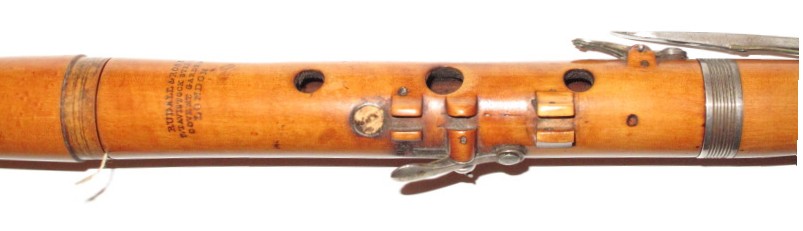
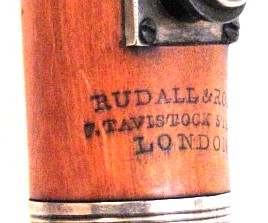
We usually associate flutes with pewter plugs on every key with the Potter family makers Richard and William Henry. But here’s a flute stamped with the Rudall 1 Tavistock address with all pewter plugs.
It would be interesting to see if his or other pewter plug Rudalls share any of the other characteristics of this one - no serial number and extra guide block.
I did wonder if the flute had been bought in from Potters and rebadged, hence no serial number. But the holes are far bigger than a Potter’s. Potters didn’t use the extra guide block, or have the reinforcing pins either.
On another matter, the number 1 of the address looks more like a 7 to me. I know 1 used to have a bigger and floppier hat than it has now, and I’m not sure how they differentiated 1 and 7 in the early 19th century London. Anyone? I think David had a theory on the 1, 7 or 11 Tavistock question - can you remind us David?
Is it in any way possible that this is a flute from before the first serial numbers were noted, # 437, perhaps explaining the lack of a serial number? The makers mark looks original, unlike my Rudail fake: http://www.mcgee-flutes.com/RR_fake.htm
Is the face a roman or an italic? And do any of the numbers have descenders like the tails of small letters that go below the baseline, or do they rest on the baseline like capital letters?
If they’re using a lower case or ‘text’ face, a one will have a serif and stop at the baseline, while a seven will descend.
*The other kind of number is called a ‘display’ face. It’s intended to blend with capital or block letters, whereas a text face is designed to blend with ordinary lower case text. Typewriters wiped out the distinction for a while but computer typesetting is beginning to bring this distinction back.
Very interesting Terry.
I have a D’Almaine that has the pewter keys, and it has a additional block on the Cnat key also, must have to do with alignment of the pewter.
Looks like a 7 to me too…
On my brief trip to London a couple of weeks back, my son and I went up to Covent Garden with my sister’s partner (he wanted to visit the rock/guitar/percussion shops in the area for percussion cases…) and had a browse around. We had a coffee opposite the former site of the low odd numbers of Tavistock St (now a modern tower block there…) and mused a little. There are still some Victorian or earlier buildings on the street (in the higher even numbers) that must have been there in R&Rs’ day, but not a lot! We also had a look at the frontage of Wylde’s old address at 25 Villiers St - down the side of Charing Cross Station (we came up from New Cross Gate on the train to Ch X) and possibly still a building from the C19th.
I think that is conclusively a 7, BTW. Any ambiguity in the other stamps on the instrument will probably be down to the (seeming) usual laxity in doing the stamps neatly and with even pressures and good alignment - I’m still constantly amazed with R&R’s output how, after all the care and craftsmanship they put in to the instruments, the stamps seem to have been slapped on drunkenly as an afterthought and left to a junior apprentice or something, often marring the overall presentation!
Terry, I have encountered a couple of what you’d probably term “odd” Rudalls - will send you bumf (that I sent to David Migoya back when the flutes in question passed my way). There was that rather optimistically over-priced cylindrical RC 8-key on eBay recently too, that was discussed here. (The pictures are still on-line at time of writing if you want to “harvest” them.)
I have a little speculative hypothesis to posit regarding apparently French style keys on late (C20th) Rudall Carte simple system flutes… You’ll recall that Hawkes Crown AZ band flutes, or at least later ones, had French style keys (pin mounted, French type G# design and maybe long C, general style of actual metalwork…). I’ve speculated before that they were either employing ex-pat French key makers or out-sourcing the keys from Paris or even the entire flutes… And some of the later pre-merger Boosey flutes are similarly equipped… they certainly went for the Bohm design rod-axle foot joint set up. After the merger, who else did they take over in due course…? See my drift? or maybe there was just a 2nd 1/4 C20th trend for London flute makers offering by-now-out-dated simple system flutes to buy in from France? (Didn’t we discuss a Boosey earlier this year that was actually stamped “Made in France”?) Either that or they were just tacitly admitting the superiority of the French design…
it is indeed 7, terry
the first of the addresses.
the mailing addresses changed and 7 thus became No. 1 Tavistock
The 7s had only a few serial numbers before the address changed, and those predating it have none.
This is only the second of those flutes that I’ve seen with the 7 and with no serial number. Note how there is a “.” after the 7. Very important here.
I have the other, a near replica of the earliest John Mitchell Rose flute and which I believe to be the oldest of the known Rudall&Rose flutes, though this boxwood variety makes a good argument.
It’s not unusual that there would be a Potter-esque quality of this flute.
Can you share with me a complete set of photos, please? You have my email.
very good, Terry. Mystery solved.
the double-guide isn’t all that irregular.
My own #3* has it in ebony.
The other boxwood rudalls of the 7Tavistock address has them, too. #454 has it. It’s in the library of congress.
The pewter plugs, too, were common in the early serial numbers that exist for all the keys. #437-454 have them (there are three located, so it’s by inference we can say they were all that way, assuming the same manufacturer/craftsman, which might well have been Rose himself at the time)
the curved address stamp actually changes at #458…and then reverts later.
#509 shows the single shoulder guide for the C key, so it seems to have been an early option.
I should note that the Rose flute in the Oxford collection does not have the double guide for the C and the one in the Bate collection has no C key at all.
Do note, however, that the Geo. Rudall flutes of Willis did indeed have the double guide, though not all of them.
So…I’d have to say the flute is likely from that batch in the 437 range…
I’ve still yet to locate one like my #3* which is made of ebony.
The pewter plugs, too, were common in the early serial numbers that exist for all the keys.
Just to mention that Jimmy’s flute with pewter-plug keys has a serial number, as I recall, in the 3xxx and dated from the 1830’s. It’s been a while since I’ve seen it but it’s roughly contemporaneous with a similar boxwood flute that I sold him with a 15, Piazza, Covent Garden address.
Hello,
This raise’s a major question with me, George Rudall as teacher and dealer supplied flutes made by John Willis, and of course he also sampled flutes made by WILLIAM Henry POTTER and other great makers. Now these flutes Stamped “George Rudall, Willis Fecit, London” were numbered,
so when George Rudall took John Rose as partner, why would he have flutes built with the name Rudall & Rose without serial numbers??? what was his idea???
We know that for all the great flute makers back then there flutes were often faked, and sometimes some of these fakes were very well made,
We can only learn from what was written and recorded on these early flute makers, things happened in the early 19th century that leave us without a complete record and we can only guess at best.
Potters flutes and some Clementi’s had the extra guide for the C key and plugs, so I could believe that a flute marked “George Rudall” could have that extra guide and pewter plugs,
but flutes marked Rudall & Rose with plugs and extra guide??? I have studied those flutes for many years, and have had many, and some of my friends in the UK have their collections of these flutes.
We can convince ourself’s as much as we want to, but the big question will always be there,
I am not saying either way
Were Geo Rudall Willis Fecit flutes numbered? Mine doesn’t appear to be. It does have the extra C guide, close to the pad as the Rudall & Rose above has.
Numbering flutes wasn’t that common in the first half 19th century. Clementi “Nicholson Improved” flutes were numbered. I imagine that that was to keep track of Nicholson’s rights. Clementi also made flutes that were not improved and were not numbered.
Rudall & Rose seemed to start late, or start at a number that perhaps represented the sum of flutes that Rudall had had made by Willis and those previously made by Rose? It might alternatively have been part of their response to fakes.
Not much work seems to have gone into documenting fakes - my Rudail & Rose is the only one I can remember seeing; if anyone has seen any fakes in museums or has a few up their sleeve, I’d be keen to see them.
Not all Potters had the extra C block - I have a Richard Potter here that doesn’t (boxwood, pewter plugs throughout). Also, my William Potter has the third guide, but below the hinge block, so at the other end of the key. It’s really part of the G# turning, separated during the carving process.
Hello old friend, Glinjack.
Glad to see you’re still with us, John!
I must say I’ve yet to see a Geo.Rudall flute with a serial number and about 25 or so have come by me. I don’t believe he had many made as, I believe, they were not for the commercial sale, rather for his pupils. AGain, just a consideration.
Nevertheless, the numbering of teh Rudall flutes has always been a mystery since others with numbers, too, start late. Is it to accommodate those already made? I suspect that makes the most sense. Others say it was to make it appear that the manufacturer was already legitimate, but in light of now 2 Rudalls with the 7.Tavistock address and no serial number, I think it’s the former rather than the latter.
I believe the numbering began with Monzani…followed by Clementi and then Rudall/Rose.
Siccama took it up, too, but to a more sophisticated level: each part was eventually stamped with the serial number. This was taken up by the Hudson-Pratten flutes and then, finally, Boosey’s Pratten. All, of course, by John Hudson.