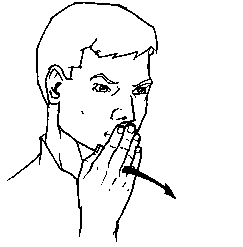
The lady who sits next to me in my Bible class is almost completely deaf and signs. She also reads lips, but I want to learn some basic signing to communicate better.
I have little knowledge on ASL, but I’m looking for website or book (especially books, I learn better from books) reccomendation(s).
I know that the people here know everything, so don’t disappoint me.
http://www.amazon.com/exec/obidos/tg/detail/-/0679780114/qid=1106784832/sr=1-6/ref=sr_1_6/103-9648494-8189431?v=glance&s=books
Might as well get a dictionary so you can learn signs to use with her. Looks like there’s also a DVD available. They only had video tape when I was learning.
Facial expressions are very important with sign language; they kind of provide the punctuation. A lot of conjuctions go out the door. Instead of “Nice to meet you”, you’d sign “nice meet you”. Probably the best thing to do is to start learning to recognize the letters (alphabet). If you don’t have your dictionary along, you end up spelling out a lot of things. I found that signing the letters was one thing; learning to recognize them as they go flying past is another…
First, find out what kind of sign language she speaks there are several different forms spoken in America. SEE, ASL, Etc. The differences may be small at times, but it may help you with communicating efficiently. (Most likely, she speaks American Sign Language, but Sign Exact English has its users)
Learning any language from a book is difficult. If you are interested in the language, it may be worth your time to look for a local sign language club in the area. Clubs are important because they help you to learn the local vocabulary. I have seen at least 4 different ways of saying “birth day” and Wisconsin uses the common signs for when and where differently than they do here.
Unfortunately, my signing was only used for classes, and is way out of practice, so try to find some one that is currently using the language on a regular basis in your area.
PS My favorite sign is turtle, the Canadian version (although the us version is also cute)
However, you will become more proficient if you interact with deaf people or other signers. You should look into classes in your area; sign language is like anything else: if you don’t use it, you will lose it. Does the deaf woman you spoke of know you’re trying to learn? She’d probably be very helpful! Don’t be discouraged if it’s a lot of work at first…it takes a long time to become fluent! It took me 3.5-4 years before I could say I was fluent in it. I’ve been signing ASL for 10 years now, but have recently moved to London…so BSL is my object now!
Tell her you want to learn - I bet she’d be happy to help teach you. Look up the ASL signs for “I”, “want”, “learn”, and “sign language” and use them, and see what happens.
I is easy, point to yourself with your index finger on your chest.
Want, if I recall correctly, is a motion with both hands, palms upraised and fingers curled as if holding something. Hold them in front of you about a foot away and bring them toward your chest.
Learn, I think is holding your left hand flat in front of you, palm up, and bringing your pinched fingers of your right hand from your left to your forehead. The idea is bringing knowledge from a book to your mind.
I can’t remember the sign for sign language, unfortunately.
Double check these before you use them!
I used to work with a deaf guy at RIT in the cafeteria and for a while I knew all the words for the vegetables on the salad bar!
Bingo!
Write your request on a piece of paper if you need to.
And, I.D.10-t is correct that there are many forms of sign used in America. You’d want to use what ever she uses.
Here’s something to keep in mind though, if she’s Deaf deaf chances are she’ll not sign deep ASL with you. She’ll sign in a language that most resembles English to her.
Its a Deaf cultural rule to simplify language to what ever one thinks the receiver can understand
and there’s a tendency for Deaf deaf people to sign more English than ASL when chatting with Hearings to appear more literate.
Since your friend lip reads, don’t forget to at least be mouthing words along with any signs she shows you even if she doesn’t.
Not only will she be able to figure out better if you’re using a wrong sign for something but it will help keep you from using inappropriate or blank facial expressions.
If you finger spell any thing, say the word you’re spelling and not the letter you used to spell it.
What ever!
But it does give me an opportunity to mention that there’s a humungous cultural difference between people who grow up Deaf and people who become deaf and its going to effect which sign language you’d need to learn
or if you’re going to want to even learn sign language.
Many adults who become deafened or extremely hard of hearing are usually so overwhelmed by the adventure that they never self identify as Deaf or even deafened.
Unless you’re born into the Deaf cultural experience (many born deafened people never get the hang of sign language themselves if they grow up mainstreamed into Hearing culture) its much MUCH easier for a person who can still hear to learn any form of sign language
and we’ve had a good example here with some of our forum members how far that usually gets.
Myself?
I was not only fortunate to live in an area where I had access to college level interpreter for the Deaf programs and extensive sign language classes that fed into those programs, I also lived in a large metropolis area that has a huge (hundreds and thousands when you include their families) of culturally Deaf to hang out with.
I also supplemented my working with Deafs all day, 4 evenings a week classes and two days every week end Deaf experiences with a couple weeks “vacation” doing summer school program at Gallaudet.
Without all that, for me, learning how to receive and give communication using sign language might have been a bit like trying to learn fiddle and specifically Irish fiddle styles of fiddle playing from a book.