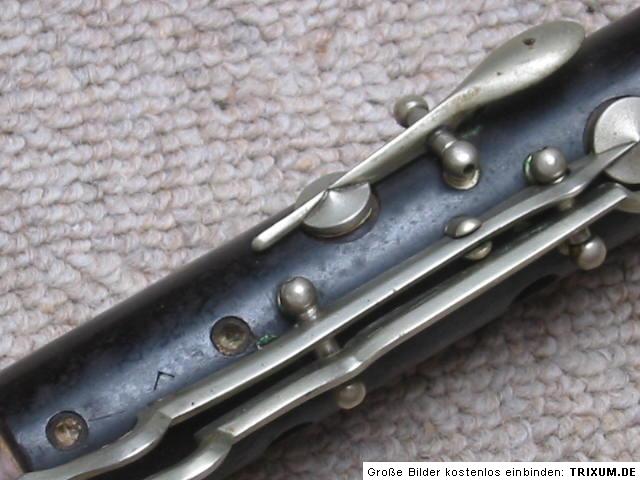
So, I’ve noticed a lot of older flutes popping up on eBay lately and some of them have got me wondering - “How hard is it to find someone to restore a cracked flute, and how expensive would it be?”. Obviously there is a case by case element to cost so exact figured would not be easily thrown out, but general guidelines would be interesting. Basically if initial cost + repair cost = less than new/modern equivalent it could very well be a wise purchase, but such a judgement is impossible to make if you have no idea what all is involved in flute restoration!
Here would be example A: A cracked Ivory headjoint - crack NOT through embouchure
Appears to possibly be an 8key Nach Meyer?
So for all those who have had similar flutes repaired, or even better, who repair flutes themselves (Jem ), what do ya think?
Like you say, each is individual. A simple crack repair may be quick, easy and may prove effective over time. Other cracks can reappear in a short time and prove obstinate. Restorations or repairs by makers take time out of their time-table for making new flutes so the cost of a repair must equate to the time taken their from flute making- hence quite expensive. Professional restorers will normally charge on a notional price of how much time they think it will take (it always takes longer than estimated), or now, they will consider the price of materials if silver is to be used to repair a key or ring etc. To complicate matters, the presented repair is rarely the only problem with the flute presented for repair, a restorer will always find; and internal crack that the owner was unaware, a leaking pads, uneven or unsatisfactory facings to the tone-holes… the list is endless.
A restoration by Bill McNaughton (a “special” for a friend) ; before,
was working on two of these 13 key flutes tonight, lots of buffing! One is so untouched, as to have 5 original extra pads in the flute case! Like was mentioned earlier, it is different with each flute. If the flute has metal work that needs to be done, the price goes up.
The cracked Ivory heads are a problem to repair, but not as bad when the crack is in the back. These German flutes can range from very nice players to junk, hard to say how it will be, until you play it. There are high pitch,(HP) 440 htz and low pitch (LP), 430 htz flutes out there. Some low pitch can still be played with the slide all the way in.
As you say, Sigurthr, one can’t give a reliable estimate before hands-on examination. But the work in a basic overhaul (clean, repad and relap, regulate keywork etc.) would, if only to justify the time it would take (on such a multi-keyed beast), be at least £100. I haven’t attempted to repair an ivory crack. It being well away from the embouchure in this case does simplify things somewhat. If it was wood and proved a straighforward fix with no complications cropping up, maybe £40-80 for that. (Straightforward-to-fix barrel cracks would be say £30-50-ish.) Open-endedly more if things prove tricky and time-consuming - and who knows with ivory? And then, who knows what hidden problems there might be - socket cracks etc.? I can see the short F touch seems to be snapped off and is presumably missing… Can’t see the keys for the L-hand little finger properly - are they all there? Replacing a missing low B lever would be a bit of a pain!
One would need more dimensions to be sure, but I’d be surprised if that example wasn’t Low Pitch - so maybe not worth a potentially £200+ repair/overhaul bill. But that would depend on what you paid for it and what your use-objectives were. If bought very cheaply (under say U$100/£65), best thing would be to have a go oneself, or if it turned out to be decently playable at 440, at such a low price the repair bill might be a sensible investment.
For the money, this looks like a better bet. Doesn’t say so (worth checking) but I think this one will be at 440. Pad job doesn’t look brilliant - may be why low B is dodgy, but they probably just need re-floating and the keys regulating a bit better…
By the way, Jem, there’s no link in your second post.
I really appreciate the approximate prices, I had no clue what even run of the mill repairs would be. I had assumed even small barrel cracks would be hundreds of dollars There is another eBay flute that has caught my eye as of late with one day left on it; an old low pitch 8key Huller with no cracks, but a broken off long F touch - something I can live without (I’ll just plug the hole with wax and remove the broken key). Exceptionally low starting price so would be a great investment if I can win the bidding war scramble without the price skyrocketing. I’m not too concerned with flutes being in 440, as I’m perfectly comfortable with 415 and 432 as well, but it’s always a bonus. I plan on bidding on it tomorrow unless something dire turns up. Comments and suggestions are always welcomed!
Ooops!
Now there is. Not that it’s much help really, being in GB and you in the States. Good luck with the Huller. It certainly ups your chances of getting a good player at a silly low price if you aren’t after 440 utility.
As for prices, I can’t say what anyone else might charge, and I’ve no idea what going rates may be from the likes of Jon, Terry, Hammy et al. However, it is easy enough to find out going rates for Bohm flute standard overhauls etc. Of course, they’re a lot fiddlier to repad etc, but fairly basic services seem to be from about £100. Straightforward head and barrel crack repairs aren’t actually all that much work, nor especially difficult, nor generally need special tooling, so long as the liners pull fairly readily and the wood hasn’t gone drastically out of shape. Socket cracks needing insertion of new wood etc. are much higher level jobs, though maybe smaller-looking. Cleaning and polishing the parts of a simple system flute isn’t generally at all difficult or necessarily requiring of special tools, materials, skills or knowledge - though like anything else, experience develops confidence and efficiency; but it is quite fiddly and time-consuming. You want me to spend say 8 hours doing a total clean, repad and adjust, I’ll charge you a fairly serious hourly rate, though probably not a proper professional one.
Thanks Jem! Holey Moley that is one hell of a flute you linked. I didn’t even know 14 key simple system flutes existed, look at all the RH1 touches . I’ll definitely keep it on my watch list, but I would think it would sell fast at that price, nice find. It didn’t turn up in my searches because it is listed as GB only - though the seller says he’ll ship internationally in his listing.
I totally support the prices you’ve listed off, and the reasoning behind them. I recently had my Böhm student flute adjusted, oiled, and cleaned (no pads changed or springs replaced, which it could have used since I’m still getting sticky pads) and it was $160.
In the event I do find myself a nice antique flute needing some minor servicing (say pads, cleaning, adjustment, and springs - no major stuff) I wouldn’t mind having you be the one to work on it as I’ve seen a lot of your work - great stuff! Are you still doing repair/service jobs? We can discuss it privately in the event I do find myself in such a situation so you can consider it properly of course. I just don’t want to be barking up the wrong tree if you’re no longer doing such repairs/servicing is all.
I’m still doing it, though struggling to fit it in with other stuff and with a backlog to clear (got two done last month! ) However, I’d be very dubious as to the good sense/viability of sending such a job across the Atlantic - return postal costs and the risks of Customs charges would be prohibitive, and anyway there are perfectly good folk to tackle such things in the USA - not least our own Jon C! Plus he can do loads of things (like lathe work, making complete new keys, rings etc.) that I can’t (yet). I’m not turning (a putative) it away, just pointing out best value… But if & when, sure, ask away.
Admittedly, I haven’t been around Chiffboard that long, and as such didn’t know of Jon C’s restoration work. Coincidently after you mentioned him he posted up three flutes he has restored for sale so it was easier than expected to check out his work as well as find his contact info . I only know he was an up-and-coming maker, not a full fledged restorer. - Mr. Jon C, I may have some work for you! I just won that Huller for $68! I was prepared to pay a lot more and just live with the broken Long F… now I think I’ll have it fully restored!
Non-sequitur: one the flute I saw on eBay today was 9+ keys and it had what looks like one of it’s keys removed, and then had more keys added on (this is just my best guess). Any idea what key was there? Here are the links Interesting Flute I was watching, Pic 1, Pic 2
And speaking of eBay flutes I was watching that caught my eye; now that my search is over I’ll post a few links here for anyone else who’s looking for an old flute: 1234
Maybe its the bushings making them look bigger or maybe it’s german made for the English market. I remember seeing a Prowse that looked similar mentioned by Sean Folsom and someone on that thread brought up this type of flute. I had a german looking flute made of cocus with medium holes that played really well with no markings. Though the one I had was padded {maybe reworked a little} by Dave Williams. When I got it I played it and thought wow this doesn’t play like it looks if you know what I mean.
Well, that was a sensible enough price on the Huller. It won’t “owe you anything”, whatever the upshot. It ought not to be to hard to find and adapt a replacement long F key for a German flute by cannibalisation off a “dead” one.
The missing key on the “Interesting Flute”! (which has been around on eBay for a while, and that seller always asks too much) is the alternate R hand Bb touch, in this case would have been mounted on a rod axle between the missing pillars, touch up by the other two and similar in design, a little lateral lug lifting the tongue on the Bb thumb key (as on No.2 in Sigurthr’s other links - which also has a duplicate G# for the thumb). Harder to find or make a replacement and its loss devalues the (already not high value) flute since it is not fully intact, but is not a playing problem as it isn’t necessary and doesn’t leave a hole or an unsprung key or any such issue.
Of the others, 2 & 4 are way overpriced for unrestored flutes. 4 is certainly Low Pitch, though decent looking. 2, well, insufficient info - dimensions needed to say anything useful. Quality-wise, it looks to be well made - the keys and timber aren’t at the crappy bottom end of the market and the (original) lack of spun metal end caps is not a bad sign. The metal-sheathed barrel looks a little incongrous - they usually (but not necessarily) went with a similarly sheathed head. I wouldn’t be put off by that per se. But no way would I pay £200 plus international postage for it. £60-ish (so c £100 total outlay with P&P and bank charges) as a restoration project, maybe.
1 is quite possibly 440-usable and looks OK, maybe not a bad price if it has been well fixed up. 3 should be fine and indeed the vendor (who is reputable) describes it as large holed. The bushes do have an optical illusion effect that makes them look larger than they are, and the holes are not enormous (on an R&R one might call them medium) but they are larger than the average German nach Meyer has. The starting price (though we don’t kow the reserve) is not unreasonable if it is as described - it could be a really decent example; there are such. But without playing it or at least hearing sound samples done by a competent player, there’s no certainty what its intonation or tone character would be. (Swansea is too far for me to go check it out!!!) It’s the kind of flute that, qualities proven to my own satisfaction, I would ask c £300-350 for. At that, if it is good, it would be a bargain 8-key starter flute. (N.B. I am in no way vouching for it!)
Would any long F key be able to be fitted as a donor or would I have to look for one from the same maker? Been thinking about grabbing a cheap pakistani table leg just for the key…
Edit: posted a reply detailing the condition of the Huller, but it isn’t showing up for me on the board, only on post history, no idea if y’all can see it.
Edit that post appears to have dissapeared (think about that phrase logically!) so I’ll condense and repost it inside this one:
Update; Got the Huller in this morning and the wood was shrunken so much that a ring fell off and there were two cracks - listing said there were none so I’m to believe it happened during shipment, though if that is the case… WOW.
Okay on to the cracks;
Both cracks occurred at tenons, the worst of which is at the “tuning slide” body tenon receiver (it isn’t a tuning slide at all, it is just made to look like one). The head is ebonite and fully lined, the liner extends throughout 75% of the “tuning slide”. The crack is all the way through the wood of the slide’s barrel (both length wise and thickness) but appears tight on the inside while being wide on the outside. The liner was not aligned with the embouchure when I received the flute but upon warming it up and rehydrating it the liner moved back into alignment (more accurately the wood moved around it). This crack leaks heavily but after I started rehydrating the flute it closed up quite a bit. I covered it with some scotch tape so I could test the flute, which has sealed it well temporarily. The second crack is just a hairline crack at the tenon of the lower body section (it has an integral foot) and it doesn’t seem to be leaking any air. I scotch taped this one as well for good measure.
All leaking holes and cracks taped up I was able to sound a weak low C - no doubt from old leaky pads which aren’t seated well. The cup for C# doesn’t open all the way due to a sticky mechanism and very swolen pad, so low D is veiled and weak, again a repadding would fix it.
All other keys (Cnat, Bb, short F, Eb, G#) work great even with terrible pads, and the flute plays chromatically from Eb’ to F#‘’’ very well considering it’s current state! It even plays at 440, which is very odd given it’s LP marking. If it wasn’t for the matching hardware I would suspect that this flute was modified to play at 440 by removing the tuning slide and fixing it at a certain point.
Update; Got the Huller in this morning and the wood was shrunken so much that a ring fell off and there were two cracks - listing said there were none so I’m to believe it happened during shipment.
Okay Cracks;
Both cracks occurred at tenons, the worst of which is at the “tuning slide” body tenon receiver (it isn’t a tuning slide at all, it is just made to look like one). The head is ebonite and fully lined, the liner extends throughout 75% of the “tuning slide”. The crack is all the way through the wood of the slide’s barrel (both length wise and thickness) but appears tight on the inside while being wide on the outside. The liner was not aligned with the embouchure when I received the flute but upon warming it up and rehydrating it the liner moved back into alignment (more accurately the wood moved around it). This crack leaks heavily but after I started rehydrating the flute it closed up quite a bit. I covered it with some scotch tape so I could test the flute, which has sealed it well temporarily. The second crack is just a hairline crack at the tenon of the lower body section (it has an integral foot) and it doesn’t seem to be leaking any air. I scotch taped this one as well for good measure.
All leaking holes and cracks taped up I was able to sound a weak low C - no doubt from old leaky pads which aren’t seated well. The cup for C# doesn’t open all the way due to a sticky mechanism and very swolen pad, so low D is veiled and weak, again a repadding would fix it.
All other keys (Cnat, Bb, short F, Eb, G#) work great even with terrible pads, and the flute plays chromatically from Eb’ to F#‘’’ very well considering it’s current state! It even plays at 440, which is very odd given it’s LP marking. If it wasn’t for the matching hardware I would suspect that this flute was modified to play at 440 by removing the tuning slide and fixing it at a certain point.
Pictures of cracks:
I decided to pass on the bruno because this one will be enough of a restoration/repair project! If this one had no cracks I would have bought the bruno as well.
Well… where to start…
Yes, that IS a real tuning slide - probably the head and barrel liner tubes have seized together. If you look into the barrel socket you should be able to see the ends of both tubes. Such seizure is not unusual - old grease/condensation emulsion and any dust etc. accumulated therein, plus any electrolytic metal corrosion products in that mixture from a long period of being laid up can easily almost weld the tubes together; they can and will have to be parted, but that may be tricky when the head liner is loose. Get the metal tubes out of both wooden sections and heat up the overlap and they should part, though you have to be careful not to squash/distort the tubes!
The long F key is not missing completely - it’s just the touch has snapped off at the pivot (common) and the cup part is still there. My inclination would be to make up a new touch from a nickel-silver fork or spoon and solder it on. This can be done pretty convincingly.
If the whole thing was missing, cannibalisation would be best, and of course remains an option, but not IMO the best one. A touch/arm rather than the whole key from cannibalisation is also a possible route, but probably more expensive than finding an old NS fork and using that. A hard solder join, done properly, will be very strong and perfectly tidy visually. How good a job can be achieved in making a tolerably well-matched replacement part by soldering parts together, hammering and filing to shape, depends on patience and a good eye.
If you do look for a scrap donor flute, forget the Pakistani ones as donors - their keys would be glaringly inappropriate - crude, lumpish, wrong style. Keys off French simple system flutes would also be noticeably different. Obviously different German makers’ keys were variable from each other, but even from the same maker (if you could find another Huller) there’s no guarantee their output was consistent and parts interchangeable. You might still have to adapt even an apparently matching key. Most of the German flutes have broadly similar keys, and whilst a key from a different maker would probably have to be adapted to fit (lengthen or shorten the arm between pivot and hole, lengthen or shorten the arm on the touch side to get the touch in the correct place, file it thinner to fit the guide stud if too thick, shorten or lengthen the pivot tube to fit between the pillars, etc.) you might get lucky and find one that fits well enough relatively unadapted… and although an exact visual style match is unlikely and the foreign key will probably be easily identifiable on close inspection, it should be possible to find one that isn’t glaringly obviously a replacement at a casual glance.
The barrel crack looks routine. The lower body socket crack looks long enough to require pinning but at least is not standing open. These have NOT happened in transit to you - they are clearly old and are classics of their kind. At the price you paid, I wouldn’t consider it worth hassling the vendor over them, though it might be worth a gentle correspondence before leaving eBay feedback!
“LP” on German flutes often does mean something close to modern pitch, by contrast with “HP” for English high pitch. But not necessarily.
Thanks Jem, your expertise is always very much appreciated!
So it is a real tuning slide, that’s good! I tried to forcibly (but not so hard as to cause any damage) wiggle the slide to see if it would show any sign of being able to move, but all it did was move the liner in the head, so I assumed it was a faux slide, especially since I can’t see any other metal tube inside other than the head liner. It must be obscured by old grease and dirt of which there is plenty of!
I contacted Cochran Flutes (Jon C.) last night and he has agreed to fully restore my flute for a very reasonable price! Total investment should remain under $400 (including shipping all three times, which is as much as the flute cost!), so I’m very happy with how this looks to turn out! Thank you very much for recommending him, Jem.
I ship it out to Jon tomorrow, then begins the waiting game!
 ), what do ya think?


 . I’ll definitely keep it on my watch list, but I would think it would sell fast at that price, nice find. It didn’t turn up in my searches because it is listed as GB only - though the seller says he’ll ship internationally in his listing.
 . I only know he was an up-and-coming maker, not a full fledged restorer. - Mr. Jon C, I may have some work for you! I just won that Huller for $68!