Yes. It’s all about the snoot!
Busted… I will get right on it…  [/quote]
Just because it doesn’t have a snooty Rudall name.
It’s a fine flute, good solid key work, plays great, almost finished! The best thing of all, is the beautifully figured Cocuswood!
It would have been a return trip, after dropping off the slaves, load up on logs for the return trip… I have seen a lot more American flutes made from the nice red Cocuswood, then the ebony look alike, but they were a lot closer to Cuba then Africa… The dull red black wood, I believe is. Brown ebony, maybe Madagascar grown? They were probably passing it off as “Coco wood”, I mean, it is brown wood… I have read some old text on the subject of good versus bad Cocuswood, but nothing is compiled.
I found it! http://www.thebagpipeplace.com/school/page10.htmlthetext is from1920, but explains about the wood used for Pipes?
Corrected Link:
Thanks, I am on a iPad, marginal at best…
So I found out where they got the imitation Cocuswood, it was called Kok-ra wood from India!
Said it was much used for the manufacture of flutes!
Latin name: Lepidostachys Roxburghii
Now I have a name for this imposter wood, that cracks at the least provocation… 
An entry from another book is quite revealing:
…should be ascertained if it is of equal quality as the East Indies variety… They thought it was the same tree. Little did they know, that it had poor quality for flutes! This makes sense, with England’s involvement with India. What do you think, Jem?
Got the flute in for restoration, and it is already finished!
The flute plays great! No tuning issues, plays at 440htz with the slide pulled out 17mm.
the foot pads are the Bohm type, so I have to get some of those.
The wood is beautiful Cuban Cocus, very red. It looks like the flute was only played a couple of times, I love this kind of restoration…


I could just imagine, the order coming in for one of those old conical flutes, the senior flute maker says, “sure I can still make one of those…”
Her is the flute in the Rudall Carte catalog, good price!
http://www.oldflutes.com/catalogs/RC/rc8.html
not exactly, Jon
the flute you worked on has a two-piece headjoint
the advertisement talks of the parabolic headjoint which even the drawing shows was one-piece and likely used the french slide.
still…it does show the modern foot was avail on the conoidal flute.
There is a choice of conical or cylindrical with a parabolic head. The former would probably have a conventional slide, since the one I restored has this…
The former would probably have …
Very dangerous assumption when dealing with historical research.
Bad to presume.
The ad says what it says. We shouldn’t presume what was lest we know for sure.
Otherwise we get to revise history…and I won’t even get into that one!
What is better evidence a flute in hand or an ad? Also why would a conical flute need a parabolic head?
The flute in the drawing is something like calum stewart’s with one piece head and no split in the middle ( i think).
The ad states that it is available with a conical bore, and the flute was made in the early 20th century by this company, so it is a fact, not a dangerous assumption…
I have to now figure out,the. Bohm keys on the foot, they use those new fangled Bohm style pads, little donuts…
My comment was directed at david. I agree the flute you had is what is listed there as the conical bore model. What better evidence than the flute. The ad should maybe read: conical bore, or cylindrical bore with parabolic head.
Not conical or cylindrical with parabolic head.
Hence my question to david why would a conical flute have a parabolic head.
I would assume the conical bore would have a two piece normal head.
If david is right we would need to find conical bore with french slide, at least thats how i,m reading his argument. So easy to misread however as you mistook me for disagreeing with you.
Clearly the flute in hand is better evidence for our assumption.
the flute in hand merely proves that particular flute was made with the two-piece head (again, we presume…there are no matching serial numbers to the head and body on Rudalls…that was a feature started by Siccama and followed wisely by Hudson-then-Boosey on the Prattens).
The ad is very clearly not noting this option.
The danger is in presuming ALL those flutes came that way in that late a period. There are several conoidal flutes made with the french/parabolic head.
it’s possible it was indeed that way…but lest we see them all that way (and the catalogue does not show this) or we see the ad specifically saying it, the presumption is just that … a guess.
I can see a french slide, but a parabolic head on a conical flute doesnt make sense does it or am i missing something? If they Were made, the flute would have two tapers one in the headjoint and one in the body? I thought the point of the parabolic head was to make up for the lack of taper in the cylindrical body. Am I missing something. i read boehm,s book but it was years ago.
I believe the ad simply doesn,t show a picture of the conical, only the cylinder flute.
I think there’s some unnecessary confusion going on here. Indubitably the catalogue image is of a cylindrical-with-“parabolic”-head, single-body-joint 8-key flute like Calum Stewart’s (#7548) and several HP ones we know of. That’s straightforward.

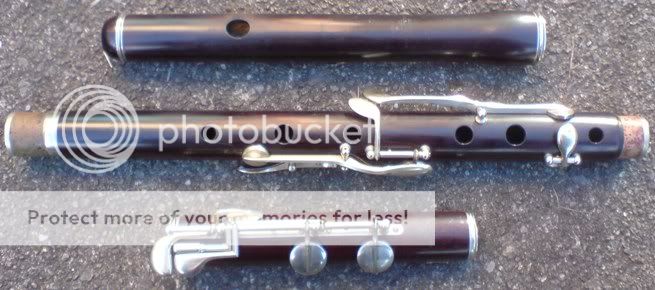
I don’t recall seeing one personally either in the flesh or images, but I can quite believe that Rudall Carte may have made similar instruments in conoid-body form with cylindrical heads with “French” slides. #7232 which Jon has just overhauled for Dave Ogden is clearly an intermediate design (regardless of when it may have been made - I guess Robert Bigio can date it from the workbooks if asked) in that it retains two body joints and the old style two part head with tuning slide & barrel, yet has similar post-mounted GS keys to other simple system flutes the firm were making in the 1st half C20th, including a Bohm-style rod-axle foot mechanism. Such is not pictured in the catalogue, though one may surmise a flute like #7232 was what was intended by the wording. It would be wrong to interpret the catalogue wording (in conjunction with the image) as implying you could have bought a conoid body with a “parabolic” head.
I am quite sure RC&Co. never made a flute with both “parabolic” head and conoid body, though if they made a conoid body with a French slide type upper tenon, it is conceivable that someone might later mistakenly put one of their “parabolic” heads onto it as very likely the fittings would be compatible.
Beyond the realm of RC&Co. there is nothing unusual about one-piece cylindrical head with French slides - they were pretty common on later French-made conoid flutes, including from makers who also made Bohm cylinder-body-with-“parabolic”-head instruments. I’ve seen them on English branded flutes (probably made by French expat craftsmen) from other London houses.