Well, I said a couple of weeks ago I’d start a general thread on F flutes, so yur tis. I intend in due course to post some technical data about F flutes and maybe find and post links to relevant past threads. Feel free to add links, pictures etc. and to discuss anything to do specifically with flutes in F.
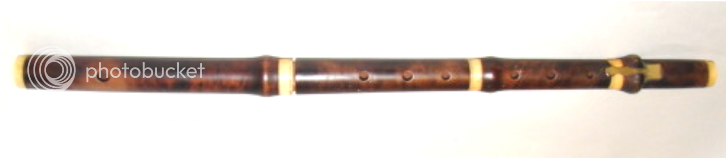
In the mean time, here’s a nice example currently on eBay that might interest a certain Mr McGee as it’s vaguely in his neck of the woods… Apparently it has an overall length of 51cm. In the other pictures on eBay one can see it is stamped with a “3” - presumably denoting that it is a “third flute” - i.e. pitched a minor third above a standard concert flute in D.
The eBay blurb contains the following information:
This timber & ivory flute was made between 1837 and 1840 by Hermann Wrede when his business was located at 35 Lower White Cross St Cripplegate. In 1837 he was listed as a Mus.Wind Inst.& Pft & Importer. His trade mark was a Unicorn Head. The pouch that it is in appears to be the original. It is in great overall condition for the age of the flute. The only blemish is a very small as seen in the photos. The length is 51cm …which would make it a flute (in spectacular condition, mind you), keyed in F.
Almost certainly. I have (I seem to recall) seen some references to F flutes being called for in orchestral scores (maybe Verdi opera?) as, in effect, a special effect, but otherwise, so far as I know, they were most used in military bands in consort with treble Bbs at least, if not other members of the extended band flute family. The only other likely use would have been as a child’s starter instrument until their hands grew sufficiently to cope with a D flute. The latter is something not unheard of in today’s ITM and even Baroque flute circles! cf Claire Soubeyran’s F version of a traverso.
BTW, clearly, from its date, the Wrede flute above is not, despite its then old-fashioned boxwood/ivory/1square key design, a “Baroque” flute. The embouchure and tone-holes are typical mid C19th.
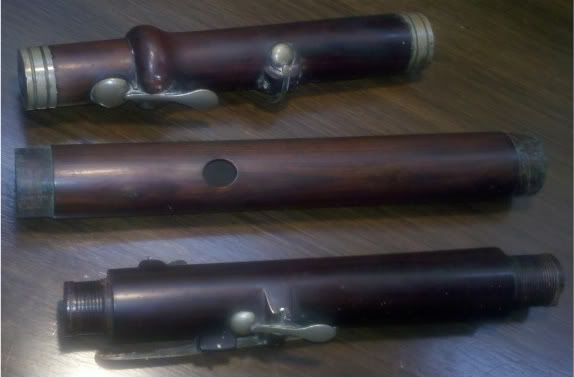
Not sure if this one classifies as a band flute, but here is my latest flute renovation project. Sorry for the lousy photo, but it was the best my phone could handle. Here I have the rings off the headjoint to prepare to seal up the three hairline cracks the unlined headjoint sported (guess it isn’t just the flute shrinking over the liner that can crack that…). You can also see where the short A (normally F) key block is cracked and needs repair. I’ve since fixed the cracks, cleaned up the (5) keys, and rethreaded the tennons. Still need to repad the keys, but couldn’t help the urge to try it out, so I plugged the various holes and gave it a go. Seems to speak well, somewhere in F, but I’m not sure if it is at A 440 yet. Fun to play such a small flute, a real change from a D.
Flute is not labeled with a maker, but if I had to guess I’d assume that it is a mid 19th century English flute. If anyone is interested I can post some dimensions later today.
Having some trouble coming up with the small, thin pads required to finalize, so if anyone has a suggestion I would appreciate it.
I’ve got an F flute much like that and I’ve been trying the silicone sealant approach to making pads (as described by somebody here a year or so ago). Not a roaring success as yet, but I may get there eventually.
Thanks for the tip. I’ve thought about using the silicone also, but will have to do some research on the technique. Might also look into making some out of closed cell foam sheet, as I’ve read some makers/renovators do these days as well.
@ Jack re: band flutes in mixed instrument military bands - I have no idea in terms of firm evidence whether F flutes would ever have been used in mixed instrument or predominantly brass bands, but I suspect not from the general impression (it is no more than that) I have developed from reading over the years. Their normal use was in the “corps of drums” and the related flute marching bands. Flute-use in military wind bands was probably mostly somewhat later in the C19th into the C20th and they would primarily have used flutes and piccolos in Eb (“Db”), not the F and Bb trebles.
@ Latticino - yes, that certainly is an F band flute and I agree it looks likely to be mid-late C19th English. Please do post overall, sounding and C#-Eb dimensions.
For your pads, I can tell you I have recently experimented with closed cell neoprene foam, and although I may not have obtained the correct type, my experience of it is that it isn’t a good choice. I was working on a flute for a vegan customer and ended up facing a neoprene foam backing with thin silicone rubber cut from one of those temporary sink plug rubber discs (like this, except I found a black one…). That works well (so far), but isn’t preferable to leather. A young friend of mine has a Tom Aebi flute which, when acquired, had (Tom’s original) neoprene foam pads - and I really was not impressed by them. I’d suggest using clarinet pads but, if necessary, thinning them (there are instructions on Terry McGee’s website somewhere, or I’m sure I’ve described the process before here on C&F). Those key-cups don’t look ultra-shallow and, if you get the right size pads, you probably ought not to need to thin them. If you can’t try out pads with the help of a friendly wind tech who has stock, you’ll just have to order in the size you think from measuring the inner diameter of the key cups plus the next size down. They come in 0.5mm gradations down to considerably smaller diameters than you’ll need. My experience is that you sometimes also need to be prepared to adjust the key action and rise and cup/shank angle by bending the key itself - they are often relatively crudely made and were never set up as carefully as they might have been originally! Floating and re-floating the newly fitted pads and repeated leak testing is also usually necessary - you can’t just glue 'em in and assume they’ll be OK! Oh, and remember to check the state of the key-beds - the wood around the tone-holes.
Here are some links to recent related threads. If I can find time, I may go trawling for older ones. If anyone else (Denny???) fancies relieving me of that task, please do find and post!
The F flute in a Corps of Drums or marching flute band is used primarily to play a counter melody, when the B Flat is used to play the main melody. In Larger bands sometimes their will be a F Part 1 and F part 2.
Their are many f flutes about, most marching bands played in High Pitch but in the 70’s onwards a lot went to 440 concert pitch most military flutes with a nato number will play at 440.
This link will show how marching flute band/Corps of drum music was set out 1st b flat 2nd b flat 3rd b flat, F, Eb, Bb Bass and Eb piccolo
Slightly off topic, I know, but I wanted to mention the way I’ve been replacing pads. After removing the key and then the old grunge in the cup and cleaning/polishing the key, I do the following: 1 - push the cup against some simulated felt (I got it at a craft store) to make a dent in the shape of the pad; 2 - cut out the pad; 3 - drip some hot glue (my wife does crafts) into the cup; 4 - carefully place the pad on top of the hot glue and wait a couple of minutes; 5 - replace the key. So far, after about 5 -10 flutes, there are no leaks.
The way i do it is to get amber Shellac if the pads are orange, or white shellac if the pads are white. I remove all gunk from cup melt some shellac into the cup then i put the pad underneath the cup and remelt the shellac with a flamless torch as their are no carbon deposits on the key.
We still don’t have a good idea from anything in this thread of what kind of music would have played on this instrument when it was made. The arrangements on the Yorkshire Corps of Drums site are a genre that dates from far later.
I don’t get how you manage to get the pad in the right plane using shellac or hot glue. If you put the pad on when the key is off the instrument, isn’t the alignment pure guesswork? (I’ve considered Gorilla Glue for this - it sets as hard as shellac but you’ve got an hour’s setting time so you can put the key back on the flute and press it into position).
Jack, with reference to the Wrede flute in the early posts of the thread, yes, you are right about the music that might have played in its own time not being what David has linked, though I suspect the type/style of use was not hugely different, just the repertory.
As for pads and shellac, you fit the pad into the key off the flute, put the key back in place on the flute and then carefully heat the outside of the key-cup up again, holding the key open and avoiding scorching the flute itself (not at all difficult), which softens the shellac. You then close the key and the pad will bed into place. You may need to press the key closed harder than the spring will achieve. If the pad doesn’t settle in the right place first time and there is a leak, you can re-melt more-or-less as many times as necessary. It isn’t too messy (any excess shellac sets very fast and can just be flaked off with a finger-nail), you can use a tool to push the pad around if need be while the shellac is still molten… all of which can’t be done so readily with a relatively slow-drying glue nor so cleanly with hot gun glue. That is what “floating a pad” means. This is a clear and genuine case of “the old way is best” - shellac (or sealing wax) and leather covered pads.
I don’t have a heat source that could do that without the risk of setting the flute on fire, except maybe an underpowered soldering iron. The next step up in power I have in my shed is a weedburning torch.
I just noticed an oddity with my F flute (which I have in front of me, with one key off and another layer of silicone sealant hardening). It has two little nicks cut into the soundhole, with tiny grooves leading away from it. I seem to have read here that that is some kind of performance tweak people have mixed opinions about. But on this flute they’re on the BACK of the soundhole. It looks as if some previous owner played it left-handed and ignored the keywork, which goes some way to explaining why the pads were in such an awful state when I got it.
It occurs to me that one of the purposes we could give to this thread would be to compile a record of eBay (etc.) F flute sales which would come to constitute some sort of a price guide… Obviously the eBay images/listing won’t be accessible indefinitely and I’m not going to harvest and rehost all the images, but as well as the links we should post (written) basic details of the flute (maker, design specs etc.), any dimensions given and the price achieved. For this purpose I suggest we stick to completed sales and don’t link in still active items, for eBay at any rate.
To kick off, here’s one which sold very recently:
Old Hawkes & Son Rosewood F Flute with 4 Keys, no tuning slide, cocus with GS fittings, no dimensions/pitch info given, fully refurbished by Miller Wicks. Sold for £150.00 (11:6:2011)
Jack, re: re-melting shellac - just buy/acquire a cheap fag-lighter (if you haven’t one knocking about), or (better) one of those zappers for gas hobs which is effectively a glorified fag-lighter. Or you can do it over the chimney of a small oil-lamp - again a cheap enough thing to acquire. I find it easy enough to hold the flute at such an angle that I can heat the key-cup with the flame of a zapper without even scorching the edges of the pad, let alone the flute. Just think about how heat rises. The tropical hardwoods our kind of flutes are made from are in any case pretty heat resistant/tolerant and not at all easy to set fire to in the kind of circumstances envisaged here. No need to pussy-foot.
Without seeing a picture, I can’t say much about your embouchure grooves… is there any chance they are pressure scars left by a now-vanished “cheater” having been clamped on?