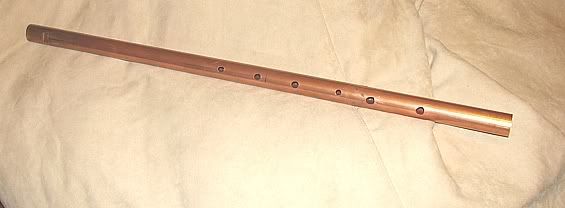
Not sure if this is the right place for this question, or not. So here goes…
I am in the process of making a whistle. As cut, the tubing actually plays a C. I haven’t drilled any finger holes, yet. I have made a couple of whistles in D. I have a chart for hole placement based on a D whistle, which gives the positioning by a percentage of the length of the pipe from lip to the end. Can I use the same percentages for a C whistle? If not, what should I be using? If so, what notes will those percentages give me?
I’d appreciate any help I can get.
Most of my experience is with Native American flutes, rather than whistles, so I am new to this.
the percentages will get you very close to the positioning of the holes. if you start each hole by drilling small and then bringing them all “in” gradually you shouldn’t have too many problems.
good luck.
be well,
jim
oh.. the notes of the C major scale are:
xxx/xxx C
xxx/xxo D
xxx/xoo E
xxx/ooo F
xxo/ooo G
xoo/ooo A
ooo/ooo B
The percentage/length calculation should be just fine for whatever key of whistle you make. I have used the one formula for years and made many different keys of whistle, I’ve never had any problems.
How do you tune your Cnat on your whistles? I first of all get the C# in tune then finger the Cnat thus: oxxooo. I then use a ‘Dremel’ tool and a small round file to take away, bit by bit, pieces from the middle and lower edges (that is, the edge that is nearest to the foot of the whistle) until the Cnat sounds in tune. Of course I use a tuner while doing this as well as using my ear. I like to tune all my whistles with the same fingering for Cnat rather than having to cross fingering that note.
I’m trying to work out the details of your mouthpiece, how did you shape it? It’s a bit hard to tell from the angle of the pic.
It looks like you have pushed the blade down into the whistle so that it lines up with the windway, am I correct?