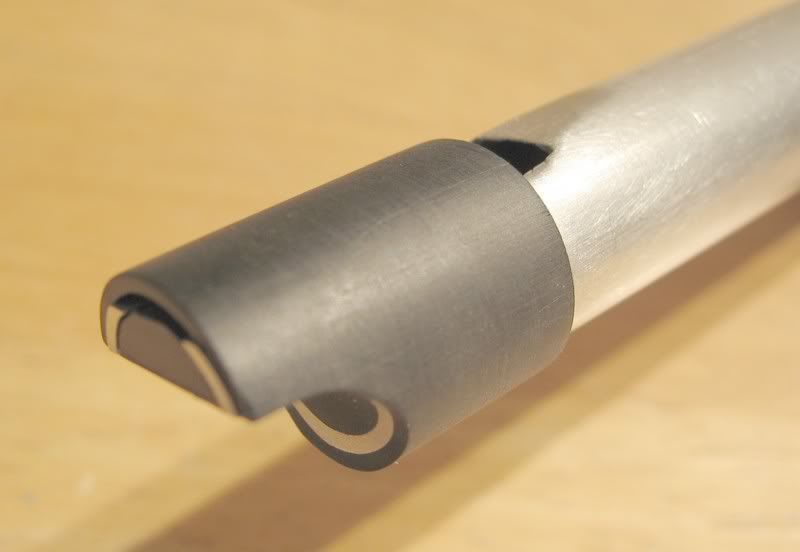
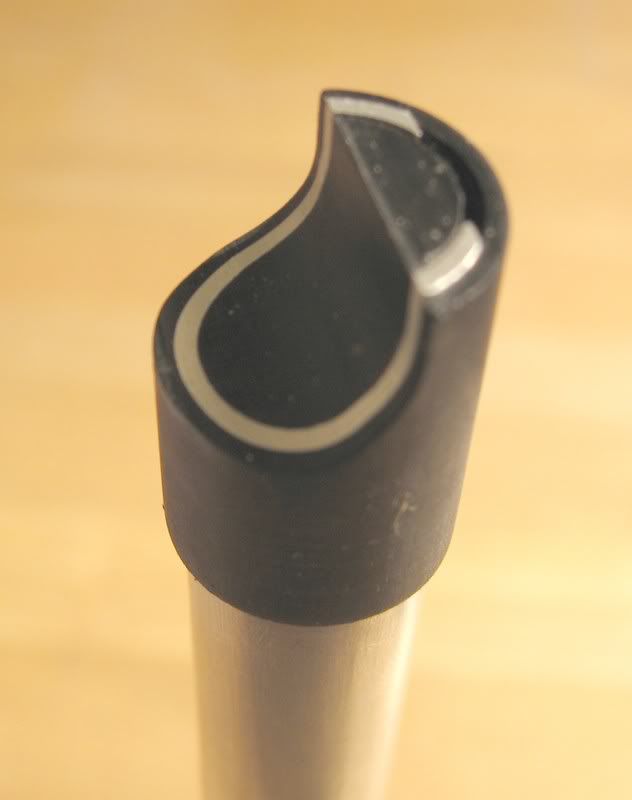
I have been building a whistle at school for quite a while now. After many hold ups due to me having to learn how to use all the machines, it is nearly finished. Only the holes need drilling now. Here are a couple of pictures:
I would appreciate any comments, and suggestions as to how a MkII could be improved!
Wow! This looks pretty cool! Is this a shop class project?
As far as making it better… practice will help there. The little gap between the fipple and the left edge of the windway, file marks, and other “craftsman” aspects of the project get better as you develop more skill.
Look around on the site about different tweaks and ramp designs and you’ll find some stuff that you can use to “voice” your whistle(s) in different fashion to make them louder/softer, more or less chiffy, etc.
Make sure you find the “flut-o-matic” or whatever tone hole calculator site to get the positioning and size of the finger holes just right. You’ll be surprised how narrow the tollerances are for this to get the whistle perfectly in tune.
So far it looks like fine work! Let us know how it finally turns out.
Good effort. If you want some advice: Either make the windway completely flat, or curved, and then make the blade exactly match the configuration of the windway. Or vice versa.
Right now it looks like the blade is flat, and the windway isn’t completely flat.
What Loren said, curved windway/curved blade, flat windway/flat blade. I’m not so sure about the windway sides either, you might try making them l l rather than - -.
However, I would take these windway-blade shape relation hints with a grain of salt. It is not so crucial that the shapes match exactly, think about Clarke original and the likes! They are classics and the blade shape is no way near the shape of the windway.
Also I have constructed succesful whistles with curved windway, flat(tish) blade or with flattish blade and a windway that is curved on the upper side and has a flat bottom. Anything that works is just fine, think about the shape of the Alba blade. Would they have ever come up with that design, had they done everything “by the book”?
All these combinations have an effect on the sound and playability, but there are no strict rules. Do what you want to do, after all even the finest whistle is merely an attempt to build a perfect whistle! The perfect whistle is impossible to make, but we can always try.
That’s the go! I’ve never tried the - - style of windway, but intuitively the l l makes better sense for defining the airflow through the airway. Of course there are many ways to skin a cat, and if you find yourself on a good thing, stick to it!
Thanks for all the replies. In fact I was aiming for a conventional vertical sided windway! I forgot to check which cutter was in the milling machine, and used a cutter that was too wide. By the time I realised, I thought I may as well just go with it. The three notes it can play without holes still sound ok to me.
When I do drill the holes, I plan to use large diameters. Going down the whistle I shall use 10mm, 9mm, 9mm, 6mm, 9mm, 9mm. Will these be too large to cover? I think large holes should result in a better tone. Is this right?
The free program I used included a lot of things I didn’t understand, however it seemed to suggest that a good tone comes from the harmonics produced above the basic frequency of a note, and that bigger holes allowed more harmonics. Even if they are larger than conventional designs, would it still be playable with the tips of the fingers?
If the tone holes are too large, too much of the finger pad will be dangling into the whistle which will affect the tuning and weaken the note. Also, with a top hole that large, it will be difficult or impossible to cross finger a C natural.
My experience leads me to believe that larger holes will produce more volume. (to a point) The harmonic overtone of each note on the whistle should be considered as a ratio of the fundamental pitch of each note (as it relates to the fundamental pitch of the whistle itself). Basically, big whistles get big holes, little whistles get little holes. I think you’ll be affecting the pitch more than the tone of each note by adjusting the hole size. Haveing a really big C# hole means it will want to play flat so you will have to position the hole closer to the blade for it to be in tune. This could result in a strange finger stretch for a standard High D whistle.
Give it a shot. Good judgment comes from knowledge, knowledge comes from experience, experience comes from failure, failure comes from bad judgment. Not that you are showing bad judgment, but hey, what have you got to lose?
Take some careful measurements of some whistles you know play well, there is nothing wrong with going with a proven technique.


 Not that you are showing bad judgment, but hey, what have you got to lose?

