I thought maybe this X-Ray view of an intact Rudall and Rose Patent Head might also shed some light on its workings. Image courtesy of Gerry Strong.

Kevin Krell
I thought maybe this X-Ray view of an intact Rudall and Rose Patent Head might also shed some light on its workings. Image courtesy of Gerry Strong.
Kevin Krell
I’d mentioned off-line to Jem at the time that I had a PH repair coming up and that I’d take that opportunity to look further into the mechanism and prepare some maintenance notes. That time is now upon us. But I’ve got a question for a start. The PH on this one is missing its face, and from memory, I think that’s not uncommon. So it would be good to confirm and record for posterity these things (for a start):
What is the material of the face? (silver?)
What is its thickness? (the drawing below suggests about 0.4mm)
Or the overall length of the stopper, including the face? (the stopper without face is just under 19mm front to back)
What is the diameter of the face? (presumably just a little shy of the bore diameter)
How was it originally attached? (obviously, not quite well enough!)
The face is clearly shown in the patent document:
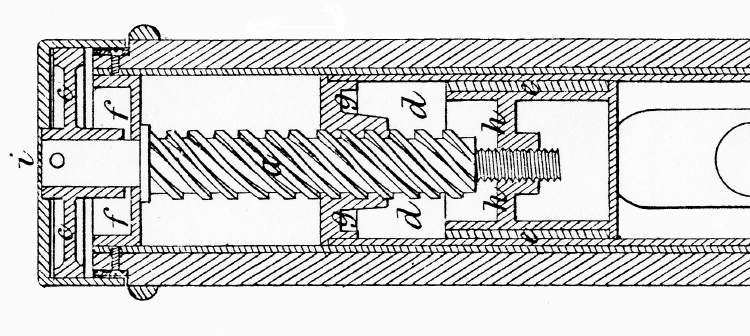
and appears integral with the stopper body there, but that is clearly not the case.
Looking to the future:
What are our current best options for reattachment? (E.g. can we afford to solder or glue it on securely or is there likely to be any need for access to this point?
Anyone have a stopper with original face in place that could supply this info?
Terry
I think I recall (not in a position to check just now) that someone (maybe Chris Wilkes, or was it Jon C?) Who has been able to examine an intact one told me the silver disc was soft-soldered onto the stopper-runner (and I think I found traces of solder residue on mine) and also which side. Soldering a new one on would entail renewing the cork lapping, of course, even if it was otherwise intact. Didn’t this get mentioned up-thread, or in a previous one about calibrating the stopper?
I don’t think a fairly permanent re-affixation would pose any future access problems as it would not affect either full or (“my”) partial disassembly.
I have one with the original face plate in place. But I’m too scared to take it apart to figure out how it’s attached.
Lads, further to the question of sealing lubricants, what is a good choice to seal between the tubes?
Rob
When Chris had mine apart he slathered it liberally from a large tub of grease of some kind, but I don’t know what it was specifically - medium consistency, opaque, colourless, very slippy but not so thin/runny as to dissipate too quickly nor so thick/stiff as to solidify… I have also used “superslick slide grease” from Windcraft, which looks similar but is bit thinner and not ideal, but serves well enough. I think these may be silicone greases. Vaseline would probably be fine, or even some lighter engineering greases. R&R probably used something whale based originally. I wouldn’t think beeswax would be at all sensible, even blended with a softener. Cork grease would be ok failing anything better.
Thread resuscitation alert!
I know it’s nearly 14 years since anything was added to this thread, but I think I have some useful material to contribute. In the intervening period I have accumulated some more experience with R&R Patent Heads and this seems the most appropriate place on C&F to add it.
I have now twice succesfully soldered on new face-plates to PH stopper-travellers, once to my own old R&R#4683 and now newly to the PH belonging to a Böhm 1832 System flute, #109 (separate serial number sequence) from the later 1840s. In between I have also stripped down and worked on the PH R&R #3819 and examined but not worked on that of #3103.
These activities further confirm the efficacy of my accidentally discovered diassembly method. They also confirm absolutely that the shallow end of the stopper faces up-tube and the deeper end has the face-plate attached, as per the Patent drawing. I didn’t measure the thickness of the extant face plate on #3819, but it is visibly less than 1mm - about 0.5mm as Terry guessed up-thread. I have used 1mm thick, 18mm diameter silver discs on the two examples I’ve repaired because that’s what I had available. I rather doubt 0.5mm will significantly upset tuning calibration!
I used silicone grease (like this: 200g pure silicone grease, O ring lubrication, rubber, latex, dielectric paste | eBay UK) to lubricate #109’s tubes and mechanism with good results.
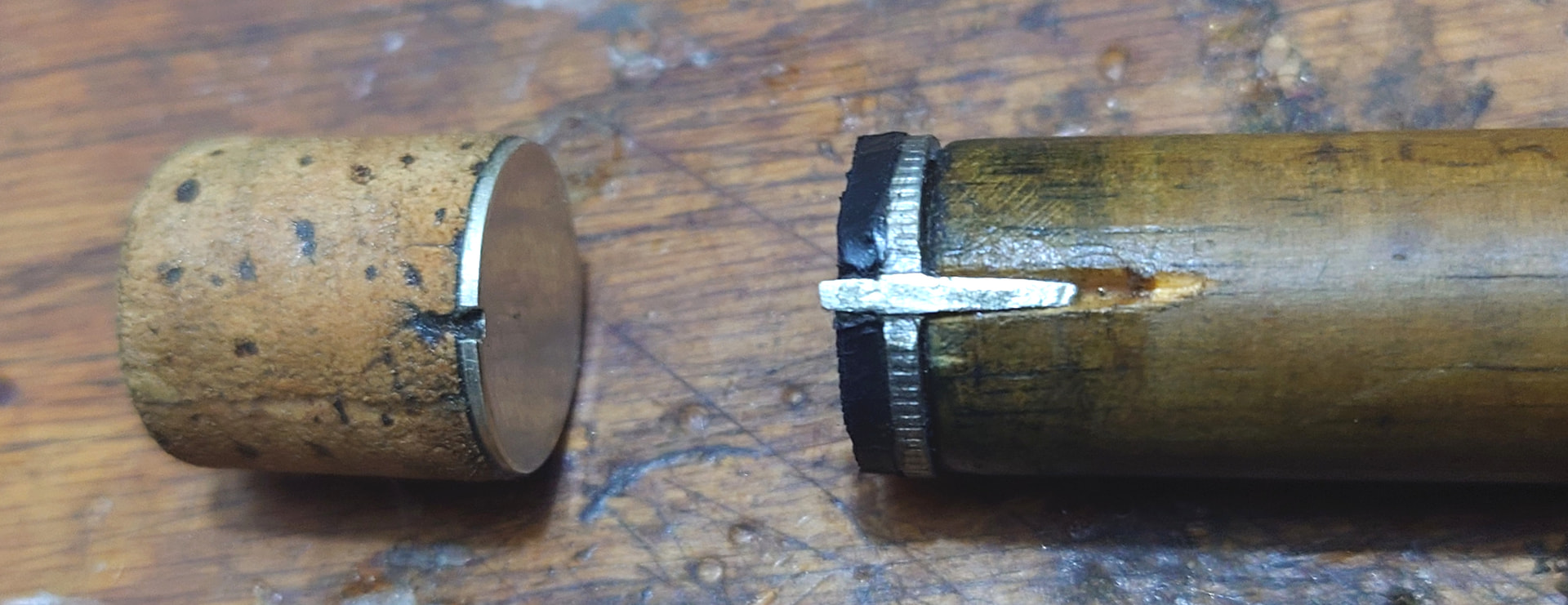
#109 clearly showed that the face-plates were originally attached with soft solder. I have used a modern medium hardness/temperature silver solder paste ( Silver Solder Paste 5g Medium Syringe - cooksongold.com ) to neatly and cleanly solder on the new silver discs after cleaning away all residue of the old soft solder.
For this most recent job on Böhm #109, I decided to cut a small slot in the side of the new face-plate and to make a tool to fit it, improving on the previous method of stopper extraction/refitting/calibration with a rubber disc on the end of a half-inch dowel. I soldered a small piece of nickel-silver fork tine to the side of a 5p coin, filed the resulting spur to the dimensions I wanted, glued the coin to my dowel and glued a neoprene rubber disc to the face of the coin - so still using the old method in part but improving traction. Obviously one can only do this when fitting a new face-plate - it would perhaps be inappropriate to modify an original face-plate.
Re-corking the stoppers requires fine adjustment - not tight enough in the inner tube and the stopper will rotate as the mechanism is operated (not news - we knew that), taking it out of calibration and potentially detaching from the drive spindle; too tight in the tube and the stopper will bulge the thin copper tube, wedging it against the outer tube and making operation of the mechanism very stiff and difficult.
The fancy 4-start drive spindle screw thread and its counterpart in the drive disc in the end of the inner tube are not necessarily perfectly engineered! In #109 the spindle would only operate properly and freely for the full distance of travel in one out of the four potential rotational settings! In the other three it simply jammed within a turn or two of the crown/outer drive disc. This possibility necessitates care in reassembling and testing the mechanism if the spindle is extracted and would make it wise to make a note of/mark the original insertion orientation before extraction if possible.
The Patent Heads found with the early conical Böhm system flutes are (like the standard tuning slide heads for those flutes) made to different dimensions (bore diameter and length) than the equivalents for standard 8-key flutes. The Böhm heads are shorter overall and slightly narrower bored. This means that heads made for normal 8-key flutes are not really usably interchangeable with ones made for a Böhm 1832 flute (or other R&R/RC flutes made on Böhm conical tubes) even if they would fit on the upper body tenons. The bore length ratios of cylinder:cone are very different - the Böhm examples have less cylinder and more cone than normal simple system R&Rs. 8-key flute heads would be way too long on Böhm bodies and Böhm heads too short on 8-key bodies, regardless of any tuning niceties with tuning slide and stopper position adjustments.
I’m afraid that my full accounts of and photos for all of the above are published on Facebook - in my photo albums (all set to Public, so viewable with anyone’s FB account) and there are useful links and discussions in the private Group Flute History Channel of which one has to be a member to see content. (If you go visit, use the in-group search tool on “patent head” to find useful/interesting posts from Hammy Hamilton and Jon Cornia, among others.). Here are the links to the three currently relevant albums - it’s worth reading both the album blurbs and the individual photo captions.
Album about R&R Böhm 1832 System #109: https://www.facebook.com/media/set/?set=a.10164784333764271
Album about R&R #3819: https://www.facebook.com/media/set/?set=a.10160274877639271
Album illustrating R&R #3103: https://www.facebook.com/media/set/?set=a.10157388666379271