Hello! I’ve been leanring to play the Susato high D. From other posts, in seems that this whistle is known as a loud whistle. I find the upper register unpleasantly harsh, almost piercingly loud, above F#, and it takes a lot of breath to reach these notes.
Could this be my technique or is this the character of the whislte? If the whistle, I’d be interested seeing how a quieter whistle would play that takes less effort on the higher register high notes. Suggestions? Thanks and best regards.
Quite right (I would hesitate to use the term “embouchure” for it, but there probably isn’t a better term in general use). Tongue position (shape of the oral cavity) is critical to tone production in fipple flutes; if you just put them in your mouth and blow, you can get all the notes, but without any refinement of tone.
Recorder players use (unvocalised) vowel sounds to play notes in different registers, from “o” for the bottom notes through “er” to a tight “ee” or even “u umlaut” (the tightest) for the very highest notes. The same considerations apply to whistles, athough they’re seldom given much weight.
If you watch top recorder players on youtube, you’ll see their jaws and lips changing position continually as they play. It’s something I need to work on a lot more myself, at my very intermediate level.
Well, you can purse your lips and pucker up tight, like whistling, and really narrow the airstream. Which counts as true embouchure. Of course, the tongue position / oral cavity variations you describe can also be a part of it.
OK - I see we were on slightly different tracks there. I’ll have to practice it - it seems to cause some turbulence in the air flow and increase breathiness.
Since we’re on the subject - one trick for reducing volume is to nearly close the teeth in front of the windway entrance while blowing through them. It makes for a less focussed tone, and you have to use alternate fingerings, but it has the advantage of being more controllable than simply blowing softer. With a whistle you could just push the slide in a bit if you wanted to play like that for the whole piece.
Sure, that’s part of what you’re going for. Whistles are breathy.
Interesting, that teeth thing sounds like a fussy recorder trick.
The classical approach tends to treat each note like a little gem to be shaped and polished correctly, with just the right tone. Trad whistling is just not like that, it’s a different mentality. The important thing is the flow, the pulse, the overall phrasing. A little roughness is good. I can always tell a classically trained player trying to play trad without unlearning what they think they know. They sound like … a classical player trying to play trad.
But basically I think you shouldn’t fuss too much about it. On a Susato, tighten up when you go up high, and loosen up when you come back down. If someone is working a whistle the way you described, they’re probably working too hard!
A Whistle that is shrill in the upper notes suffers from high airstream velocity due to lack of backpressure. There are 2 possible tweaks you may wish to try…
Roll a 1/2 inch wide strip of paper into a cylinder, the way you would roll up a map, until the thickness is 1mm or so. Insert this “tube” into the headjoint until it is halfway between the voicing and the tennon joint. This will provide more backpressure and reduce the amount of breath/wind velocity needed to sound the high notes. The thickness and placement can be adjusted until you get the best results for your style of playing. Example (scroll to diagram)… http://www.asahi-net.or.jp/~DL1S-YMGC/nohkan-e.htm
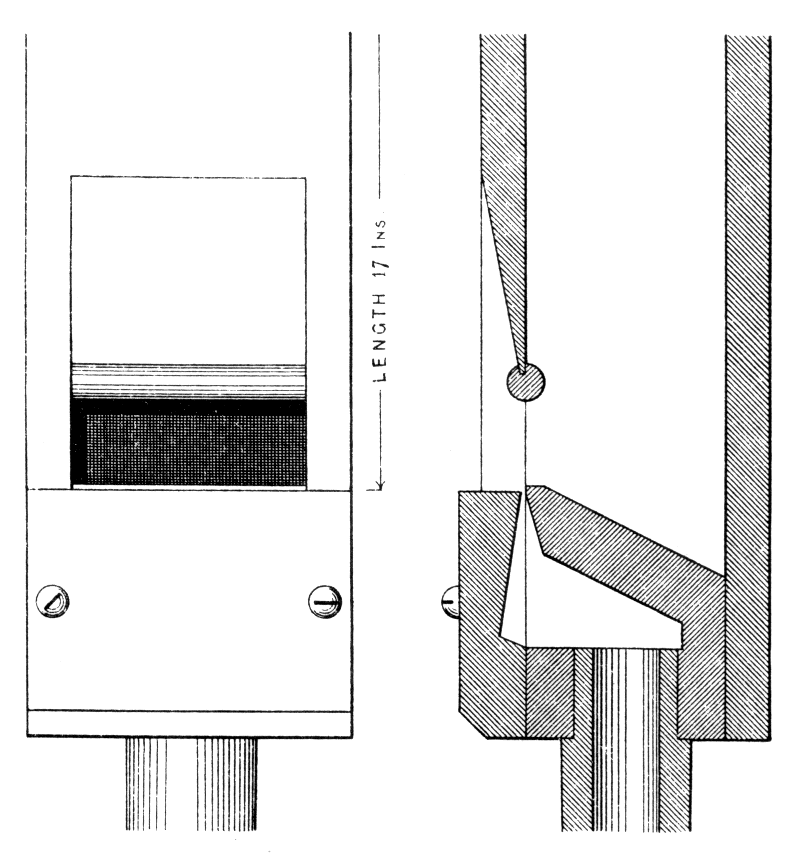
The addition of a more blunt or rounded leading edge on the Labium Ramp will cause the instrument to respond faster at lower breath pressure, thus reducing the velocity and shrillness. The problem is, most people are loathe to file on their prize whistle for fear of irreversible damage. I suggest application of a fine bead of rubber cement applied with a small paint brush. If this works to solve your problem, you can easily remove the rubber cement and apply a more permanent bead of fingernail polish. Dont worry about adding too much, you can slowly remove the polish to the proper size by rubbing with a Q-tip soaked in polish remover(acetone). Here is a diagram of a time proven voicing with this feature… http://www.organstops.org/f/FlautoDolce.gif
There are other things to try, so don’t give up on your whistle if these (and other tweaks) don’t work for you.
Guys, I’m sure you’re 100% sincere in trying to help. But really, neither special recorder techniques nor physical modifications to the instrument should be necessary.
I’ve been playing Susatos and ITM long enough to recognize the OP’s question as a typical problem of beginner’s whistle technique and expectations on the part of someone who’s been playing the whistle for only a few weeks. And with a fairly known quantity like a Susato D, the first place to look is to the player, not a problem with the instrument. That’s perfectly normal.
The O-ring tweak has a track record at this point, so that’s an easy fix. Beyond that, the breath techniques are straightforward, and may take time and practice to control. The large windway can be a challenge for a beginner, and the Susato is a fairly loud whistle. But there are plenty of whistlers in Ireland and elsewhere playing off-the-shelf Susatos with standard whistle technique and sounding just lovely.
Of course, the cyber-separation here on the board is frustrating. I’m sure I could sit down with Mike in person and have him and his Susato as right as rain in a few minutes. Sound clips in an appropriate style can definitely help - either for diagnosing a problem, or for demonstrating a solution. Then people can judge for themselves. But I know some are reluctant to put their own playing forward. So all one can do here is describe and suggest. Ah well …
Hello! The B, C#, and D take a lot of pressure to jump the octave. The loudness was driving my wife out of the house! [Not my playing, of course! ]
I’ve ordered a Freeman tweaked Generation to see how that feels/sounds when I play it.
I’ll see about getting a recording of me playing both whistes posted in the future. Best regards.
That’d be super, but if you’re a beginner, perhaps stick to playing one whistle at a time rather than both together, unless they are perfectly in tune and you have four hands or have perfected the playing-with-your-toes method (in which case we need a picture as well as a sound clip for the files).
Hello! Still working with the Susato high D. Notes above high G seem to require a lot of pressure or air velocity compared to lower notes, and each high note seems to require more air/velocity at the high end than the previous note (A more than G, B more than A, etc.). This change in air pressure/velocity requirements becomes noticeable to me a high G and makes me change my pressure/air stream when I try to play a high A and above.
Tightening my embochure does not seem to make a big difference, so I increase air velocity and that makes a loud upper register. Its not a problem per se; it requires muscle memory to remember the air requirement.
I’m curious, how does the air pressure and/or air velocity need of the Susato high D high notes compare to the high notes of other high D’s? Best regards.
Since you’ve tried the o-ring and embrouchre suggestions and the Susato is still not
giving you what you want then maybe its time for a quiter/easier whistle?
Consider getting a clark sweetone. Cheap, easy to play, and possibly the other end of the whistle spectrum from the susato. Plays fairly quiet, nice and clear in the second octave. I have two, actually one is the ‘celtic’, but there’s not much different between the two. Nicer paint job, maybe a little more stable going between the first and second octave.