Strange $4,500 Low D Whistle

I visited the NAMM Show yesterday. For those who don’t know, NAMM is the National Association of Music Merchants and it’s a massive Trade Show. The “general public” isn’t allowed in, the concept being that the attendees are music retailers and others in the music business who come to see the booths and pavilions of the manufacturers.

So there are tons of instrument, accessory, electronics, software etc makers from all over the world hawking their wares.

Among these are numerous booths of makers who have come up with electronic wind instruments, things you can finger like a sax, flute, or clarinet.

I was attracted to one booth where a guy was playing what looked like one of these things, it was a short fat black plastic thing with rectangular touches, and the flute sounds the guy was getting were amazing. I spoke to the rep “that sounds fantastic. It’s a MIDI controller?”

“No, it’s acoustic. It’s a flute. It’s 3D printed.”

He hands me one of the things and to my utter surprise it’s a fipple-flute, like a Recorder or a Low D Whistle, but like none I’d ever seen.

For one thing the windway, which was curved, was really wide, wider than I’d ever seen on anything, around half the circumference. It had an extremely low windway height, like a really narrow Colin Goldie.

For another thing the bore was huge, much larger than the 22mm which is sort of standard among Low D Whistles.

The fingering layout was chromatic, sort of like a Kaval or Xiao but having 10 holes like a 10-hole fife.

The finger-holes were rectangular and put in odd places, making it difficult for me to seal.

So my take was that it was a 3D printed novelty, simple, no moving parts, basically a chromatic Low D Whistle, and it probably cost a couple hundred dollars.

So imagine how dumbfounded I was to go to their website and discover that it’s $4,500. What?!? For a 3D printed plastic Low Whistle thing?

The RolBec Flute – RolBec Instruments

I thought it strange that the guy at the booth didn’t let me or anybody else try the instrument. That’s what the NAMM show is, people all over the place trying out all the maker’s instruments.

Stranger yet was when I searched their website and Youtube for videos of anybody playing one of these things and couldn’t find any. From the website it seems like you’re just supposed to pony up thousands of dollars without hearing what the thing sounds like.

Near that booth, by the way, was the booth of a guy from India or Pakistan with tons of wooden flutes and wooden and metal Irish whistles.

He had a bunch of brass & delrin Sindt knockoffs from High D to Mezzo A. Some of these played OK, some were bad.

He had fully-keyed blackwood Irish flutes. I didn’t even bother.

Lastly he had several Low D whistles, each one a different sort of construction. There were ones in the style of Alba whistles and one sort of in between the style of Burke and Sindt whistles. This one was the best player by far, it was a decent Low D. It was stamped “Wild”.

‘Wild’ is one of the brands sold by McNeela. I suppose an attempt, one of many, to associate with the Wild Atlantic Way. They are all over the music shops. I never bothered, tbh.

Richard,

Novel indeed . . .

  1. Low-but-wide windway entrance: total area matters. Can’t help but wonder if the low height triggers more viscous (boundary-layer) influence.

  2. Bent neck: certainly appealing for comfort + ergonomics.

  3. Rectangular holes: wtf ? Novelty for novelty’s sake ?

Your remark " . . . flute sounds the guy was getting were amazing. . ." really catches my attention. He must be doing something right. Maybe something new.

A few questions:

Did you get any sense of total volume compared to, say, an MK ?

Did you get any sense of the 1st/2nd octave volume difference ?

Did you get a peek inside ? Any perturbations visible ?

Agreed: $4k without being able to test-play seems rather much.

Also: the website is rather sparse, with an emphasis on colorful lighting and ethereal vocabulary. Makes me suspicious.

But: “ . . . flute sounds the guy was getting were amazing. . . .”

I am intrigued.

According to the website the black and black with gold trim will set you back 5000 and 6500 respectively

You’d almost expect, almost, it will come with a free copy of John Coltrane’s Penny whistle tapes.

:face_with_thermometer:

1 Like

More Roland Kirk than Coltrane…the stuff the guy was doing was along these lines…

Ain’t No Sunshine - Rahsaan Roland Kirk

The guy was getting those flutey multiphonics, playing up in the 3rd register, etc.

About volume, the guy was playing into a mic so I have no clue.

About the rectangular holes, the idea might be that they’re easier to “scoop” by withdrawing your finger across, and certainly easier to half-hole.

I would have loved to have been able to play the thing and discover how it works. Does that super-wide super-low curved windway allow you to get a fat sound in the low octave yet easily play into the 3rd register with a bore that big?

I know with Low D Whistles the Burke’s bore is only a couple millimeters wider than standard yet already you’re getting a bit harsh and finnicky on 2nd register B, so how is this thing going wider yet and still easily playing nearly three octaves?

Hopefully there’s a whistle maker who has tried a windway like that who can chime in.

A couple thoughts. One is that the two founders seem to be saxophonists (among other instruments) coming out of the jazz and classical worlds, at least in training. And in those worlds, $4,500 for an instrument can actually be a pretty good deal, comparatively!

I’ve talked to makers of Irish whistles and flutes who complain that whistles can take quite a bit of work, but that the expected price of a whistle just doesn’t budge. So, why spend so much time making a whistle that you can only sell for maybe $200-300, when you can make a flute that might not take that much more time but will sell for $900-1,500? It’s not a function of the actual effort that goes in as much as it is the expectations of the market. If the expected price goes up, as would be the case for people willing to spend $1,000 on a saxophone mouthpiece, then it makes sense from a business perspective to charge the price you think you can get. It seems quite a lot next to even the most expensive low whistles (I guess an auction-bought Copeland would be the top end pricewise?), but maybe that’s not their reference. And maybe Colin Goldie et al. should really be charging a lot more!

The other thing I noticed is that at least one of the founders seems quite heavily into New Age-y things, healing music and meditation music and stuff like that. There is all kinds of flowery language used in those realms and claims about the power of music to do this and that. I wouldn’t be surprised if the marketing of this ends up leaning that way in some way, because again, people seem to be willing to pay.

Cool. I respect your history with music & ITM, therefore your comments are interesting. Shame that he wouldn’t let you play it, as that would give you some more insight.

Yeah, and Rahsaan Roland Kirk is the best. “Case of the 5,000 pound Man” is my favorite all-time album… well, that and Miles Davis/John Coltrane “Kind of Blue”.

Thank you for the comparative sound sample and explaining about the mic.

“. . . might be that they’re easier to “scoop” by withdrawing your finger across, and certainly easier to half-hole. . . “

Wow ! Never would have thought of that. Some method to the madness after all. Makes sense.

Thank you for explaining their backgrounds.

“. . . not a function of the actual effort that goes in as much as it is the expectations of the market. . . “

Very interesting. Totally plausible.

I think we whistle players were spoilt in terms of cost expectations from the very start. It was a penny whistle.

So even today, if you can still buy a mass produced treble D whistle for just over $10, it’s a big ask to convince the public they should shell out hundreds of dollars for a hand-made product. Let alone the prices being asked here!

About the money thing, working around professional “legit” musicians for so many years yes the price expectations of professional sax players, flute players, etc are on a different level.

And having been in the Musician’s Union and making most of my income from music for a couple years I discovered the joys of being able to write off instrument purchases as “business expenses”, which is part of the equation.

This is why these people will turn up their nose at a great-playing cheap Generation whistle, but won’t hesitate to pay $800 or more for a fancy-looking whistle made from exotic hardwood and Sterling Silver which doesn’t play as well.

Not that it matters; as I’ve mentioned I’ve been in musicians’ homes where they have one of these “Barbie whistles” sitting on a shelf. When I inquire I find out that they’ve never actually spent any time playing it.

The professional Studio Musicians, on the other hand, will show up with tons of cheap whistles and cheap bamboo flutes etc which they actually play- to them instruments are tools to do a job, not Art Objects.

Art objects can be fun, but I get it. When I go into a studio I bring a Burke A, Susato D, and a beautiful Generation Bb. I have whistles I like more, are better for playing in groups, are prettier, whatever. I used to bring a Freeman mellow dog, but for some reason the Susato just goes on tape better.

For saxes I have a 1963 Buffet that feels like I’m breathing the very history of jazz. But I bring the Yamaha. The tape doesn’t care about vibes.

Ha!

I have pro sax friends and they say if you want a sax where everything works the way it’s supposed to, get a Yamaha.

(But they all play vintage Selmer Mark VI’s.)

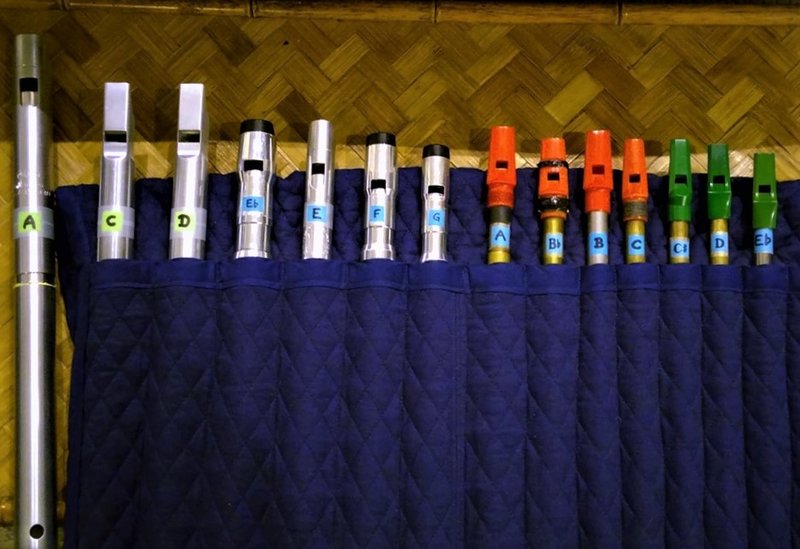
About whistles, here’s my roll that gets taken to gigs. (The Bass A doesn’t fit.)

And what they sound like Irish whistle demo high, mezzo, low, bass

Ah the venerable Mark VI. In the hands of a newbie the intonation issues are cringy!

Lovely stable of whistles. How many cave you culled over the years to arrive at that, I wonder? (I’m due for a cull for sure).

Like most players I’m forever searching for that Holy Grail whistle for each key.

For the high keys (A up to Eb) it’s vintage Generations and Feadoga, often with Jerry Freeman’s, or my own, modifications.

For Low C and Low D it’s Goldies.

The mezzo keys have had the biggest turnover. As you see there I was using Burkes but they’re all gone. I have a Low E from Alba, a Mezzo F from Goldie (which is amazing) and I’ve not found a great solution for mezzo G. I’m currently switching between a Jerry Freeman Generation mezzo G and an early Susato mezzo G (machined from brown PVC with a cedar block). The Freeman has a bore too small and the Susato has a bore too big but they both play perfectly in tune.

I’ve been lurking on this forum for a couple years, but when I saw the fingering chart (in the “Media” section on that site) for this thing I had to register to comment: It has two thumb holes, and B is played with no thumbs or fingers. That seems… awkward?

Yeah, this is a classic problem with people trying to create chromatic flutes or whistles: the obsessive desire to reinvent the wheel, rather than keeping the instrument basically diatonic.

The simple fact is that nearly every woodwind in existence uses a similar fingering pattern, where 6 fingers are the most active, and lifting those fingers (roughly) sequentially plays a diatonic scale. The other fingers only factor in to play certain extra notes/accidentals or to change registers. There’s a reason we’ve used this for so long: it makes logical sense.

The whole “lift all 10 fingers sequentially to play a chromatic scale” that we see pop up from time to time may look neat and simple on paper, but it just isn’t going to be as good. It ends up making almost every key extremely difficult to play in. With the 6-fingers-most-of-the-time approach, some keys are easy and some are difficult. With the 10-fingers-all-the-time approach, every key is equally difficult. There’s more finger movement for more keys, and no real advantage.

And it also creates ergonomic problems like the one you’ve identified: now you have a ton of notes that, for example, require you to have the right-hand thumb hole uncovered. What use is that? Now you’ll just have more difficulty holding the instrument while you’re playing those notes. If you’re going to use the right thumb, it makes way more sense to use it for one note (e.g., Fnat) rather than a bunch of notes.

Anyway, that’s my rant. As I’ve opined before, the sopilka/10-hole-fife system is the absolute best keyless chromatic system that anyone has come up with. And the recorder’s system is a close second.

Right, I had the loan of a very nice 10-hole Fife for a while and it was easier than I thought to adapt to the Open G# fingering system, which by the way was part of the original Boehm design. (That fingering was perhaps the first to suffer from Boehm flute reformers resurrecting Simple System fingerings.)

About the Sopilka I don’t know but I played Bulgarian Kaval for several years and that gives you a convenient chromatic scale without having to employ the upper-hand little finger or the lower-hand thumb, the only downside being a gap (a few missing notes) between the Kaba and the beginning of the normal range.

The way the sopilka and 10-hole fife handle G# is actually my least favorite thing about them. I’d prefer having a G# hole that is always closed by the pinky, unless you’re playing G#. Again, that means less finger movement for most keys.

I’m trying to convince Colin Goldie to make me a whistle like this. :slight_smile:

I’m such a tinkerer I’d probably drill the G# hole myself and hope for the best, probably doing an initial test using a Susato.