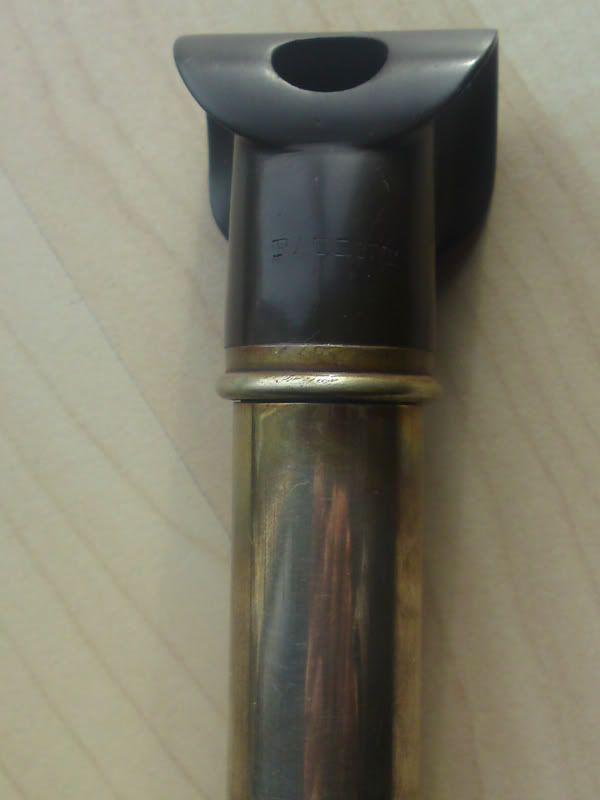
No, I don’t think a neck strap would help. Little curved crooks for one or both thumbs and R4 would probably do the trick, but actually, I think a slightly wider and dished Giorgi lip plate with the embouchure hole set in it at an angle that would let you hold the tube at about 45 degrees out from perpendicular would give you adequate control and security once you got used to it.
See these video clips (BTW, you’ll have to download them from BoxNet - I’m NOT putting these on YouTube!):
painful(!), but I think they illustrate the difficulties. My problems that are evident are almost all to do with support. However, I also think they’re not too bad given I’m not using purpose designed and adjusted body tubes, don’t have the embouchures at ideal angles, and am not accustomed to the whole shebang. What do folks reckon? Of course, Kena and Kaval players face similar support problems, so it can certainly be done.
I’m not planning on spending any time on R&D on these, but I think I’ve shown it is very feasible to come up with something workable if one has an incentive. As previously mentioned, the main such incentives might be a disability making transverse flutes impractical or trying to find ways around the intonation problems of an all-cylinder transverse bore.
Nice to hear from you on this one Mr. Tipple! That sounds like a peachy idea.
What do you think of the intonation issue? I have a hunch that an upright headjoint would merely have to be slid in and out of the flute body a little to find the correct distance and the intonation would be as good as with the regular headjoint. In other words, it would play as correctly as the rest of the flute allows.
Ergonomics: Here’s another fellow who makes vertical headjoints for Boehm flutes, and he’s designed it all so the flute is held at an angle of 86 degrees rather than 90 – “to reduce extreme pronation of the right wrist.” (Also see his thumb and finger supports.)
Similarly, the Wesley headjoints I mentioned before are angled a little to produce the most natural playing position. In fact here’s a Youtube clip of what seems to be a Wesley being played in a jazz performance (let it load then move it along to about 0:58 for the flute solo). It looks VERY comfortable.
Right guys, seriously seriously now, for a minute (at most), sorry to spoil the retro fun, but I’ve now sorted out the video clips I made on my monstrosities this afternoon and put them up in the post above where I flagged them as pending - off you go… you’ll soon be falling about laughing again!
(Just as well I had a haircut yesterday!)
WimPlayah, re: intonation, I’ve already alluded to this - a Giorgi style head where the embouchure hole is effectively the top end of the tube does not have the same acoustics as a normal transverse head with its space up-stream of the embouchure. That space is a significant part of the reason why a transverse flute needs either a conoid body or a Boehm’s parabolic head to correct the intonation. The Giorgi works more comparably to a whistle, where the window forms a terminal top-end vent. There are of course issues of intonation between the octaves and over a scale within an octave on whistles too, but they are different to those of a transverse flute. Giorgi flutes would be similar but not identical to whistles, but certainly different from either type of transverse flute. Most of the bent heads you have found for Boehm flutes are just that - normal Boehm’s parabolic ones twisted around - which will necessitate some tweaking of their length and taper configuration, maybe, but they still have that crucial space beyond the embouchure to compensate for. If you really want to understand this better, you need to start with Boehm’s own Treatise. Sure, these bent Boehm heads can just be plugged onto an existing Boehm body and they should have normal intonation. Whether a Giorgi head or a Shakuhachi head would do so is another question - they would probably work tolerably as is, but might (and I mean “might” - I don’t know) need the scaling of the body and toneholes adjusting to have intonation as good as a normal Boehm flute. The same principles would of course apply to using such heads on my simple diatonic cylindrical tubes or on a conoid body as you originally proposed.
I am just watching your videos. Please forgive this childish expression, but
YOU ROCK.
Really. I am impressed in many different ways, and most excited about the Giorgi style instrument. It sounds very well in tune indeed; do you think it’s as in-tune as when you play with your whistle head? I suspect it is. And it looks as though it would be a relatively simple matter for a craftsman like yourself to make this Giorgi-style head go on the tube at any angle you please. I didn’t know you could bend PVC so easily with a bit of heat! I wonder if the bending affects the intonation at all.
Another mad idea – one could add a top thumb hole like a pipes chanter, couldn’t one, just for experimentation; if it didn’t work out, seal it shut again.
I’ve just been playing a few tunes from the old days on the only flute I have at the moment – a transverse PVC D flute I made myself – and I want a vertical flute more than ever. I’m out of practice and flute position is UNCOMFORTABLE to me now; I feel fine playing my tin whistle (not a low whistle, which I don’t have) but I want to play the flute, dammit.
The intonation with that particular body tube is decent, but not perfect - and bear in mind that one can (and I am) making embouchure corrections - “lipping in” some notes. The intonation of that tube is definitely better with the whistle head. Thumb holes are, of course, a possibility - I’m not sure that a chanter (or kena or recorder) style one to act as an octave speaker would be necessary - more likely one would opt for a C natural tone-hole. Again, have you read up properly on Giorgi? There’s stuff online if you Google him - on Terry McGee’s site and elsewhere. He devised a fully chromatic schema utilising both thumbs.
If you’re really interested, don’t want to try making your own and don’t mind something that is just modified in the obvious ways we have been discussing from my prototype, not necessarily “perfected” with a lot of R&D, I’m willing to make one (a low D) for you - for an appropriate consideration. I could even do it with alternate whistle and transverse heads and alternate other key finger tubes if you wanted to pay the extra. Say £60 including postage (where are you?) for just a tube with the Giorgi head, £35 extra for a whistle head and £15 extra for a transverse flute head (those are dead easy to make). Not sure how quickly I could deliver - would try to do it forthwith, but might have to be late summer as most of August is pretty busy for me. PM me if interested. Bear in mind I’m not going to guarantee the intonation, though I’d get it as good as I could for the Giorgi head. You could always make more bodies yourself, of course.
Re: bending conduit tube - according to Guido Gonzato, the type of tube he uses in Italy can’t be manipulated whilst heat softened as can the British product I have used for these things. I just carefully warm it up with a paint-stripper hot air gun and then manipulate it, preferably over a form/mandrel of some kind, then let it cool into the new set shape. It’s not difficult, but can go wrong! It doesn’t usually have to get too hot to handle with caution and/or a cloth/gloves. Whether it can be done does seem to depend on the compositon of the tube you use.
Hello,
I’m really doing some spring cleaning at the moment, and I’m selling my Giorgi head joint :
For anyone interested in playing vertically, for physical reasons / as a practice tool / or simply for a different sound altogether …with either conical or cylindrical (Rudall & Rose / Pratten or modern classical Boehm system) bores, the head joint works on all. I had the original (still with the fragment of body as I bought it), made to fit a Rudall and Rose design flute, but it also fits my cylindrical bore Rudall Carte too.
It produces a very direct sound, breathy & open yet capable of very powerful ‘flutey’ sounds with a little time spent on embouchure. Comes with the original body part, the new lining to enable use on other flutes (inserted into the barell) and quick interchange, and a cover for the lining.
Sale due to spring cleaning at the moment, and just putting money back into my concert flute. I bought the fragment for £100 a few years ago, and had it modified by Holmes & McNaughton flutes, so my price of £150 is simply to find the money spent on the item, and I’d like it to be played rather than gather dust. I’ll be putting the item on e-bay, along with a few other items, so with a slightly higher cost to cover the e-bay fees.
Very interesting thread. Several folks brought up the feeling of insecurity when holding and playing the Giorgi style flute. When I was looking back at the original thread, I noticed that the keys are set up in a “Siccama” style, designed to be closed under finger pressure. As well, at least one of the thumb keys has a marked crescent shape to the touch that looks like it is designed to help retain the instrument in a vertical position.