I just purchased a Jon C. Pratten in Mopane. WOW! It took a few days to get used to the Pratten feel and the Mopane feel as well. Once I began to get the hang of it I didn’t want to put it down for too long. After a week of playing it exclusively I bought it. Now, when I play my other flutes, none a full blown Pratten, they seem “weeney” to me in tone and feel. Is it just me? Is it the “Pratten thing”? Is it Mopane? Is it a Jon C?
Well, I don’t have a Pratten in D (yet) but I have a Pratten style in F and I can say that I have noticed something similar when going back to my other Flutes. Of course what I experience is also due to pitch difference as the others are all in D, but the F seems so much more powerful than any of my other 3 conical Flutes (this is not including PVC Flutes) of course all the others are Rudall types. Of course I can tell a huge difference between the Rudall styles as one is Large holed, one is medium, and one is small and suprisingly the small holed one can give the most power.
It probably has to do with the Pratten style and the embochure cut, which makes a huge difference.
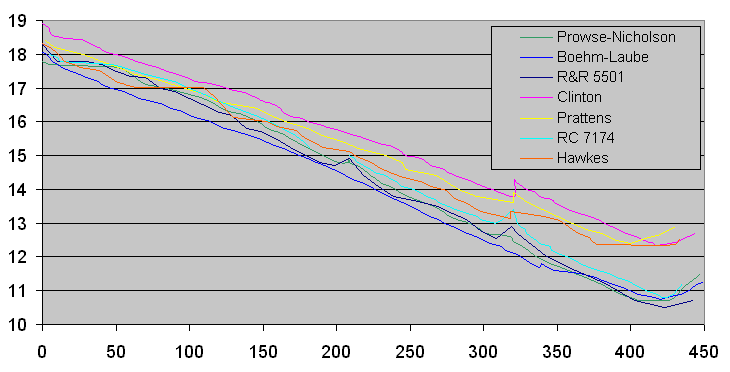
It’s Pratten’s big bore. The largest hole Rudalls have holes not much less than the Prattens, yet still don’t have that “real big” feeling. See here:
The Prattens is in yellow, a typical large bore Rudall is shown in aqua. We’re just looking at the body and foot, highly exaggerated, with diameters on the vertical.
Notice the only thing I have found bigger than a Prattens is the Clinton (and approximately the same bore used for a few conical multikey Rudall Carte’s).
I have made both a Pratten model and two “regular” medium-hole, large-bore flutes.
There is certainly a feeling of power in the loudness of the Pratten. It is also one flute later, and I’m still learning, so it’s probably better in several ways not having to do with Pratten-ness. It is also, accidentally, pitched a little high.
After playing the Pratten for a while, on the other flutes I go for that huge tone full of overtones and don’t get it. However, it’s a little easier to play quietly. And most of the time you don’t need to wake the dead.
For a session with an accordian and two sets of pipes I would really like the Pratten. The rest of time it’s not such a big deal. Playing with a mic, you don’t even want it.
Right, it’s the Pratten. But narrower bores, like Rudalls,
have a more focused sound. And the difference tween
them drives me a bit nuts, cause I can’t figure out
which I prefer–yet. However I’m listing toward the Rudall.
Sometimes Prattens seem like rough beasts by
comparison, just as Rudalls seem weeny by comparison.
Terry - where does your “Rudall Perfected” fit into the mix in terms of bore sizes?
In terms of the “Rudall” vs. “Pratten” sounds, I still don’t have my head firmly fixed around a clear “sound image” for each style. If anybody would be willing to donate some flutes to a worthy cause, I’d be willing to sacrifice my time for this nob;e scientific pursuit.
I think the best way to describe a Pratten sound is “open.” I mean it is less focused and not as reedy as a Rudall. of course it is all up to the player on how they play, the tighter embochure the more focus.
There are Pratten people and Rudall people. There’s a certain presence to a traditional Pratten like a Hammy, but I still feel like I can get more sound, especially at the bottom end, out of a Rudall-type flute. I’ve put a lot of time into trying to learn the ins and outs of the Hammy, but just haven’t mastered it, while I have confidence I’ll be able to go the other way, i. e., to the Baroque flute.
Good Rudalls and Prattens, they’re good, but very different beasts.
Hi
i have a Hawkes large bore and large tone-holes, now and againn i take it to
sessions where we also have a Boosey- Pratten flute player, (i think his flute is from around 1870 or there abouts, there is no way his flute would come
close to my Hawkes either in volume or tone, and the interesting part is my Hawkes is far easier to play, The Pratten style flutes are great flutes and are more powerful than the Rudall flutes and others, but when it comes to the Hawkes flute its a different story,
Also if you compare the placement of the keys and toneholes on the Hawkes
and the one piece body etc i believe it is the closest style to the Boosey Pratten of all other flutes.
It looks like the Clinton wins hands down for size, where can I get one? I hear that they also stand up to bad weather.
Edit, Oops wrong Clinton flute. He is talking about the 1951 model.
Realistically, since most of these flutes are only played in the lower two octaves, and the lowest one is the one that suffers when the bore is narrow, wouldn’t the widest bore be most suitable fore today’s music? Is any ITM flute player really concerned about the third octave suffering in quality? Or is it that the larger bores are already starting to effect the second octave?
I guess that leads me to the question what range did the flutes use to get put through when they were used for classical music before the Boehm flute replaced them?
I don’t rightly know the answer to your question, but Chris Norman gets a uniform sound out of his Rudall up to the G in the third octave on recordings, and I’ve heard him go up to at least the A and sound pretty good. I don’t think I’ve even seen fingering charts that go above A, but I’m sure they exist, and I’d be interested to try, even if just to mess with the cats.
Yes, Chris gets well up there; he’s playing a Rudall,
I believe, which may have something to do with it,
though I suppose he could do it on a curtain rod.
We’ve had a lot of discussion about the low notes
on Rudalls, which are supposed to be there pretty strong but
achieved somewhat differently than on a Pratten.
I’m still trying to get them on my Rudall.
However there is a lovely focused quality to
the Rudall sound that certainly is suited to
ITM.
The wider bore on the Pratten doesn’t affect the second
octave, in that the notes are all there alright.
The second octave on a Rudall tends to be more
sweet.
Unfortunately, the Clinton is a fully keyed instrument, so may not meet your needs! Magnificent tone though (being conical and fully vented) and uses the fingering we know and love! Maybe the conical taste is genetic (Clinton was born in Dublin).
Two points on the bad weather. Clinton made a metal conical for use in India. He is also reputed to have made an “umbrella flute” for use in London. If anyone can find one, I’m in the market! (not that it rains here much!)
Realistically, since most of these flutes are only played in the lower two octaves, and the lowest one is the one that suffers when the bore is narrow, wouldn’t the widest bore be most suitable fore today’s music? Is any ITM flute player really concerned about the third octave suffering in quality? Or is it that the larger bores are already starting to effect the second octave?
No, the Clinton can easily do three full octaves, indeed, Clinton gives a fingering for 4th octave C.
I think the issue relates more to tone colour than third octave. The big bore flutes have a distinctly “big” sound, narrow bore flutes are much reedier. Both suit some people! That’s why I make 5 regular models - the small-holed, small bored GLP, a medium-holed small bore Rudall, a large-holed small bore Rudall, a large-holed large bore Rudall, and the Prattens. (And a Siccama and an “old-system” Boehm bore cylinder!)
I guess that leads me to the question what range did the flutes use to get put through when they were used for classical music before the Boehm flute replaced them?
At the start of the 19th century, getting up to g3 would be plenty. By the middle it was creeping up towards c4.
It’s an extremely similar bore to the RC 7174 (in aqua). That’s Rudalls large-hole, large-bore.
I forgot to point out the other Rudall bore on that graph, in the very dark trace, which is an example of Rudall’s small bore. That’s the style of bore they used for Chris Norman’s original (and I use for my Rudall Refined). You can see it has a lot in common with Nicholson’s bore.
They also used it with bigger holes, eg my 5088 model. Clearly they were concerned to cover a range of needs and tastes too.
The other thing you can see from the graph is how small was the bore for Boehm’s 1832 conical. No wonder it didn’t sell all that well in England. Great tuning, but complex, expensive, multi-keyed and weak. In the land of the great Nicholson, never!
Check out the various fingering charts on my site. The Prattens chart and the Modern Irish flute chart go to C4 (C7 in International-speak). If you really want to bug the bats, go for the Charanga chart, but be prepared to move your stopper in to about 13mm to get into the 4th octave. To make C4 easier on the other charts, try moving your stopper in to about 16mm.
I’ll leave a window open so I can hear how you’re going …
Rudall and Rose were the most renowned London makers in the 2nd quarter of the 19th century. Nicholson had introduced the large holed conical flute, but they made an art-form of it. Their flutes are still in the greatest demand, and most modern makers of Irish flutes would offer at least one Rudall-inspired model.
Pratten was a well-known professional flute player in London around the middle of the 19th century. He updated a flute design by Siccama, bringing it up in pitch to suit other professional players and titling it the Pratten’s Perfected. Again a very popular flute today, particularly in the US, mostly in the form of modern copies.
A feature of the Rudall design is that they usually had separate left and right hand sections, whereas the Pratten has a single long body. More significant is that the Pratten bore is larger, favouring the fundamental, while the Rudall bores are narrower, favouring the harmonics and giving a reedier tone.