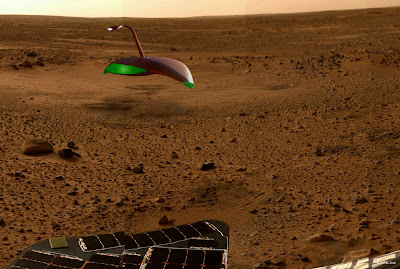
Tonight is a landing attempt on Mars: 10:31pm PDT.
The rover being delivered is named “Curiosity”.
It’s the size/weight of a small car.
See ustream.tv for feeds from 8:30 - 11pm PDT (tonight).
Being a geek-wannabe, I’m totally impressed by what NASA+JPL are attempting.
Below are a few notes culled from a NASA news conference.
(see http://www.ustream.tv/recorded/24467433).
During EDL (entry, descent, and landing), there will be 4 signal paths:
a. 1 direct from the vehicle to earth
(x-band, to DSN = Deep Space Network = giant dish antennae on Earth)
b. 3 relay satellites orbiting Mars (uhf)
The 3 relay satellites are:
a. Mars Reconnaissance Orbiter (MRO)
b. Odyssey
c. European Mars Express
During descent, there will be two data streams
a. x-band status “tones” emitted by the vehicle,
indicating vehicle status + mission sequence progress
b. uhf data sets of altitude, velocity, and position
(a “richer” data set)
The satellites give intermittent windows of communication.
(about 10min every 12 hours)
The satellite orbits are tweaked so that 2 (MRO, Odyssey) will have
visibility during EDL.
First day events:
a. 2-5min post landing (L): engineering data, maybe some images
b. L+2hrs odyssey overflight (~10min)
c. L+13hrs " + MRO overflight
d. L+19h Rover->DSN beep
Next few days:
Aug 6 first B+W low res Hazcam images first 50px, then 512px, High Gain Antenna Deploy
Aug 7 first thumbnails (from descent?), Mast Deploy
Aug 8 first color images, Instrument Aliveness, Acquire Panorama
Aug 9 Quiet Day (Panorama Data Return)
Longer perspective:
Aug (early): First Images, Engineering Checkouts
Aug (later): Payload Checkouts
Sept (early): First Drive
Sept (later): First Scoop
Oct: First Drill Sample
Reminds me of the Apollo days… landing on the moon… happier times.
The whole Mars thing would be a whole lot more interesting if SOMETHING happened. Some sign of life, preferably living right now, that speaks American English. Maybe the Monkey Face on Mars could speak to us, again in plain old American English.
When I was in grade school, the nuns would drag a TV into the classroom and we’d get to watch a rocket launch. Seen one launch, seen them all. Now if the nuns would have let us watch Lost in Space, that would have been something. Danger Will Robinson.
What NASA will never show you are the tiny little Martians running for their lives in sheer terror while our gigantic machines crush their tiny little houses underwheel and shoot laser death rays all over the place. That would grab Mute’s attention. War of the Worlds indeed.
My favorite detail is the tread pattern that leaves behind a trail of “.— .–. .-..” (JPL) embossed in the Martian soil.
I would like to avoid a war. Now if Martians had a cure for cancer or a new Italian pasta dish or would be willing to trade me sparkly stuff for the junk in my bottom desk drawer, then that would be must see TV.
“The image was taken while MRO was 211 miles (340 kilometers) away from the parachuting rover.”
“If HiRISE took the image one second before or one second after, we probably would be looking at an empty Martian landscape,” said Sarah Milkovich, HiRISE investigation scientist at NASA’s Jet Propulsion Laboratory in Pasadena, Calif.
("..the inset image is a cutout of the rover stretched to avoid saturation. ").
You’re obviously of an age - like me - to have been taught long-scale numbers. But, really, it’s a mistake to think of long-scale numbers and short-scale numbers as English and American. Here in the UK, we’ve vacillated over them in the past, just as others have, and we formally adopted short-scale numbers as far back as 1974, and have kept with them ever since.