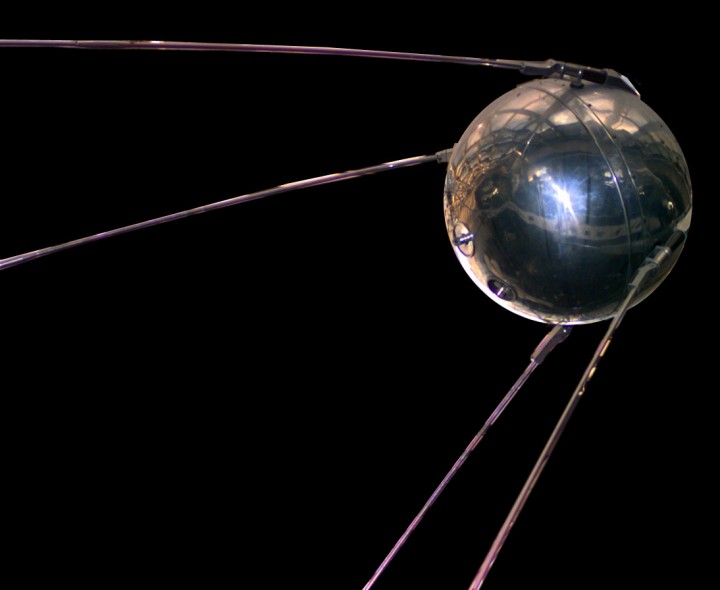
Half-Baked Spudnik:

“Travelling Companion”??!!?!?! 
“Fellow Traveller”, surely!
What amazes me is a world could be distracted from its game of nuclear chicken by an eighty-three kilogram metal sphere that carried no weapons and had, in fact, turned an instrument of destruction (a modified R-7, the word’s first ICBM) into something for science. While we think of the first decade or so of spaceflight as “the space race,” one can still see peace in it. It is unfortunate, though, that it did have to be a “race” at first.
It makes me wonder what the next fifty will hold.
Who will be the Korolevs and von Brauns of the next half century?
Where will they take us?
“Space for science, only for peaceful purposes, for the benefit of a man relentlessly perceiving the innermost mysteries of nature…this is how space studies are developed and performed.”
–Sergei Pavlovich Korolev
What I find interesting is the constant string of testimonials of spinoffs of the space program; things I wouldn’t have suspected were ever related. In a newspaper article on Sputnik’s fiftieth bd they mentioned “advancements in computer engineering and mechanical miniaturization. And Earth-orbiting satellites made possible an almost instantaneous communications network.”
-
having the gov’t pay for upfront r&d resulted in technologies that most people can now afford, e.g. satellite telephones, satellite television and satellite radio, satellite-based GPS (Global Positioning System)
-
satellite images of a huge chunk of the planet - possibly your own backyard
-
micromachines - developed to monitor the health of lab animals sent to space (Sputnik 2 sent up a dog) - the small size of the subjects forced a revolution in medical monitoring devices
-
cordless power tools - Black & Decker won the contract for lunar hand tools, and we are getting the benefits of the technologies they invented
-
trying to get satellites and robotic missions to send back pictures required too much power, so JPL created the digitzing of images, which we now see as the World Wide Web, satellite tv, digital cameras, etc.
Neat-o!
djm
… and let’s not forget all the R&D that went into finding the correct tool to write in space. Standard ink pens wouldn’t work in zero-G.
Dunno how much money we (U.S.) spent trying to figure it out, but the Russians had us beat there, too. They used a pencil.</urban legend>

The BBC’s (Radio 4) Book of the Week is currently “Red Moon Rising” by Matthew Brzezinski. I heard a passage the other day - it was about the chief designer getting the go-ahead to put up Sputnik. If you are interested, that’s a book for you.
I read something similar in a Science-fiction collection, that was about the Chief Designer, as well. All good stuff.
(Edited to say)
The Mammoth Book of Science Fiction 15
had a story called “The Chief Designer” by Andy Duncan. And that was the one.
And remember Vanguard- the US answer to Sputnik. The rocket made about 3-4 feet off the pad and came crashing down. A truly memorable crash since the world was watching. I can’t rmember the launch vehicle, but that’s what wiki is for.
If you are interested in S P Korolev, I would highly recomend Korolev: How One Man Masterminded the Soviet Drive to Beat America to the Moon by James Harford and, for a more general view of the Soviet/Russian and American space programs, Leaving Earth (I don’t have the book with me, but hte author’s last name starts with a Z…sorry) and Two Sides of the Moon by Alexei Leonov and David Scott. Sergei Khrushchev’s biography of Nikita Khrushchev also has some interesting stuff.
Reasonable grounds for taking a page out of the Soviet book and not making a public deal about something that might get screwed up until it works.

In retrospect, having worked in the industry for 30 years, its getting to do all your testing and risk mitigation done ahead of time and not have the schedule drive it. I think there was such a push to get into space -2nd to sputnik, 2nd to the one with the dog/chimp, that we had to rush to get things done and took a calculated risk that it would be OK.
But that’s all hindsight. I would have loved to be in the mission room when some one said, “Let’s go!”.