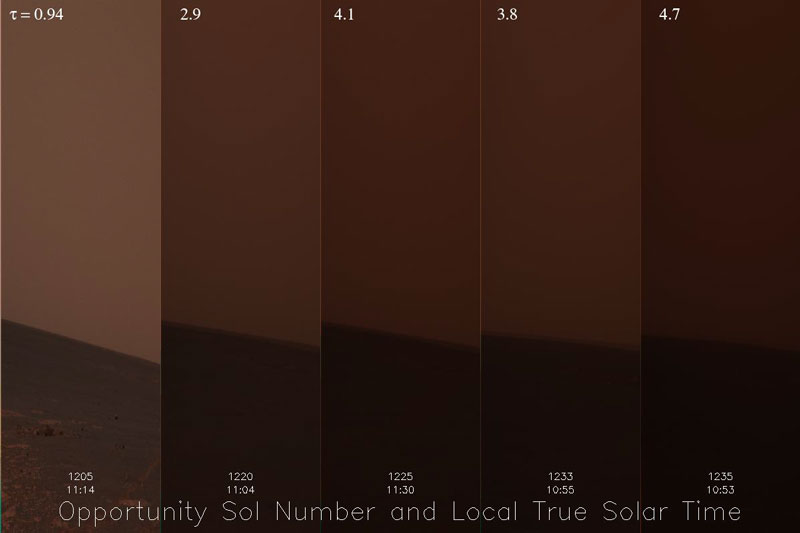
Is it just me, or are the numbers for Sol and local Solar just a tad out of whack?
1205 / 11:14
1220 / 11:04 
1225 / 11:30
1233 / 11:55
1235 / 11:53
djm
The Sol numbers shown are a count of Martian solar days since the rover landed, not time-of-day. (The average solar day on Mars is 24 hr 39 min 35.244 sec.)
As I suspected. Its just me … and numbers - bad combination. Thx.
djm
what!!!
35.244 sec and no deviation???
slacker! 
I was just being mean.
Actually, that’s one possible translation of my surname. 
I had thought of starting the post with
“John dear,” 
…causing worry that the batteries might run out of energy before the storms end – which may be as long as weeks. …Earth controllers have programmed the rovers to restrict movements and to use as little power as possible…their immediate future is now uncertain.
[anthropomorphism] Poor things! They’re starving to death!!  [/anthropomorphism]
Hey, you try going through life with every letter you receive being a “Dear John” letter.
..rather prefer John Deere, eh!
Well considering they were only to trundle about a few months in the first place you can’t feel too bad.
We got our monies worth out of those two.
Lets hope the storm clears!
It always baffled me (doesn’t take much) why NASA didn’t first surround Mars with a ring of communications satellites. These would speed communications with surface vehicles, as well as provide a monitoring system to follow inbound craft. They might not have lost so many landers on Mars as they did, or would at least have learned from observed error, rather than always wonder what happened to the ones that vanished.
djm
Money most likely. Most of the orbiters that are sent are designed to act as relays for the various landers and I believe there is also international cooperation when it comes to standards. But, I could be wrong.
The unmanned exploration budget is a tiny port of the NASA budget, and the entire NASA budget itself isn’t that large compared to other parts of the US government.