Been a while since I posted an update… I humidified it and have been periodically oiling it, and playing it more and more. It still doesn’t really working out until I took it to a session last thursday and had a friend play it for me. I was shocked at how good the tone was, and very inspired. I took it home and repadded the last two keys, oiled it again, and started playing it more and more. My tone got better and better, but it was still really weak in the low end.
A few minutes ago, I finally decided to pull out the cork stopper and see what was up with it. It has an incredibly rusty screw stuck in it that connects it to the end piece, and it’s wrapped in gnarly old tape, and generally looks really gross. looking through my kitchen (thank gourd I don’t clean very often!) I found all the leftover corks I could find, and it turns out (FYI) that the cork from Warre’s Heritage Ruby Porto is just the right size for this flute. I greased it up and put it in, and poof! My flute has a nice solid low end now.
I’m starting to wonder if the cracks in the flute are leaking. The sound is still a little fuzzier and weaker on the low end than I would like. This may seem like a silly question, but is it safe to submerge the midjoint (with the cork) in water and look for airbubbles? Is there a better way to check for leaks without buying equipment?
I wouldn’t submerge it, the best way to check for leaks is the suck method but this is hard on the foot section. You have to close the C and C#, put the bottom of the flute against your leg or something and suck on the top of the joint while covering the open tone holes…this should create a vacuum you can feel on your finger tips and from the end of the flute. If not, you have a leak. It can help to have a friend cover the bottom, but you can do it yourself.
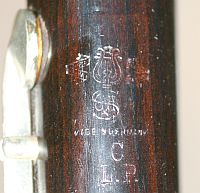
I have what I think is a Hüller fife, with a Nach Meyer head. The Lignum Vitae body has the Harp trademark and surrounding text. Perhaps the original head had the GS/H trademark.
Looks like you have a crack in the upper section? Or just a scratch? Maybe just superficial.
Until you have new pads, corks, cracks filled, it’s not much use attempting to suss out how good an old flute is. One thing I do is to cover a crack with plumber’s tape, then wrap plastic wrap over that. I don’t fill the crack with anything - it will have to be cleaned out when the cracks are filled in with epoxy.
[/img]
The mark is very similar to that, but is nearly worn off. From all I’ve read, that is from a later Huller. The markings on mine lead me to believe that it was made in about 1880.
I have repadded it, and the cork seems to be in good shape. It plays quite well and has a pretty strong tone when it and I are warmed up. There are cracks, but I am not sure if they go all the way through. I think it’s possible, though not really likely, but I would like to test it if I can.
I just played it at a session tonight. It seems I can get a much better and stronger tone out of it when I play at a session… Probably because I am less critical of my sound when I can’t hear myself. Then if I take it outside or get a chance to play alone, it sounds better than usual.
Blow some smoke through the flute for the best test. Wetting the outside works too. One of the old Pipers’ Reviews suggested using good Irish Whiskey. Tommy Creegan (Dublin/Seattle) said this won’t work, though, it evaporates too quickly and must be drank immediately.
OK, I’ve found the problem. I’ve been playing longer than usual today, and the previously-repaired crack in the barrel just started drooling all over my shirt! I wrapped the whole barrel in teflon tape as a temporary fix and the bottom end of the flute solidified immediately. Now I need to figure out how to repair it. Or maybe I’ll just keep it bandaged up…
Good that you found the problem…even if it’s a problem. It shouldn’t cost much to get a barrel crack repaired (and any competent woodwind repairman should be able to do that), or you could try the old think superglue trick where you run a thin line of the thin type of superglue into the crack.
Considering that I’ve done everything myself so far, I may try the superglue route.
I’m really amazed at how much this thing changed after wrapping it in tape. The first thing I noticed was that I could hit the low C# and C with the keys now without trouble, but after some more playing, I’ve found that I no longer have to hold back when I’m playing it… The normal tone has gone from fuzzy to velvety, and now it can bark in the low end if I want it to. Actually, it has 3rd octave notes now, too, which it didn’t before (bast the thigh D).
It looks like it’s had a trip to the high school nurse, though…