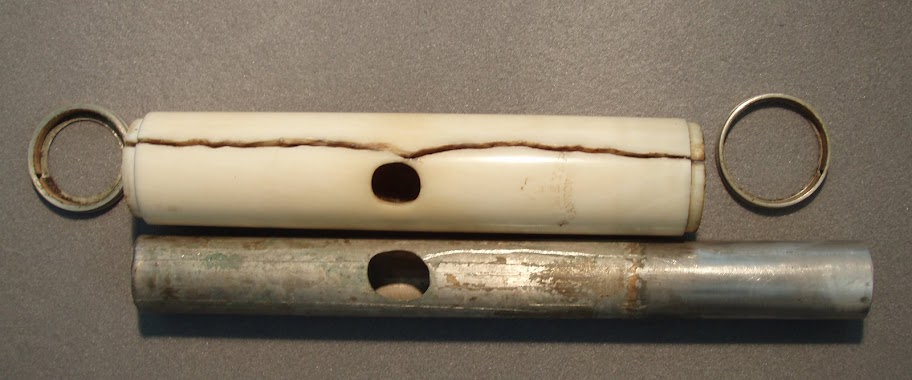
Well, I couldn’t resist. I spotted another old German flute (actually the last one ended up being Czech) to fix up. I hope I didn’t out-bid anyone here on E-bay. This one appears to be an actual Meyer as it is stamped H F Meyer Hannover (edit: used to say “Hamburg” but that was a brain-o) and it has evidence of the crown as well. The crown is not a real strong impression, but it’s there in the ivory.
The head and barrel are lined, so of course they are cracked. My plan is to just fill the cracks and make them pretty, not to worry about closing them and re-boring for a flute like this. The ivory crack runs thru the embouchure sadly, so i can even attempt to play it yet. But the joins and pads are rotten anyway so it would be pointless, other than to toot the head and see what I thought of the cut of the embouchure.
I note the embouchure is just about the same shape I ended up with after re-cutting the first one. That hole was pretty small and round before surgery.
the bore seems nice and smooth except where the cork has been, so it should clean up OK. It appears the key fulcrums are threaded. I’ve not got after them yet. Hopefully they will come out OK.
Let me know if you have any ideas that would help me date it.
Carey, IF it is a genuine Meyer it is worth considerably more than any Nach Meyer or other copy, and I agree, on the strength of the stamp, that its being genuine is a possibility. On that basis I very strongly advise you NOT to do anything drastic to it until you have sought authoritative opinion! Have a look at the Meyer page http://www.oldflutes.com/articles/meyer.htm on Rick Wilson’s website - he might be a good person to consult! However, going on diagnostic info on that webpage, the direct- rather than plate-mounted pillars, the extra trill keys and the profile of the barrel argue against it being genuine.
The odds are, then, probably that it isn’t genuine, but there is enough of a chance that it might be and therefore seriously valuable for it to be worth being patient and getting it checked. You may just have had a lucky strike! Even if it isn’t genuine, it looks as though it might be one of the good quality copies (threaded key pivot pins is suggestive!) and worth treating with care and repect, not just hacking about as a junk flute.
Have a look on Facebook and YouTube for Adrianne Greenbaum playing Klezmer music on Meyer (the facebook link) and other C19th German style flutes - a Hungarian made one and a couple of others on the YouTube clips. Impressive!
Hi,
Here is a couple of photos of my HF Meyers, and a good nach Meyers. The one on the right is the original, you will notice the shape of the end crown, the key plates, and the shape of the barrel. The one on the left is a Lyon & Healy. The Myers is made of Madagascar rosewood, stamped with the crown on all sections. Here is a photo of the stamp.
Your crown stamp looks like mine, but I don’ know about the rest of it. I think the keywork is a good indicator, if yours is a original or not. One thing I noticed on the original, the barrel ring is made of wood, and clad in nickel silver. You will also see a ring on the top of the upper section, next to the tenon. Also the shape of the barrel is unique on the originals.
One thing I notice, the short F on the original is quite different then yours.
Hope this helps.
I can send the original if you want to compare it…
Thanks Jon, I’ll study your photos in the morning. I’m thinking its possible the head is a Meyer and the body is someone else because there are no stamps on anything but the head. But the foot ring looks a lot like the one on yours. I would imagine there are differences between Meyers of different periods too.
(edit to add…)
Oh, and look at the layout of the key touches on the upper joint. Not parallel like yours. I think that’s the biggest clue. (The plot thickens.)
The barrel seems shaped like Jon’s Meyer. The head and barrel are lined with German silver not brass like my Czech nach. Anyone have insight on the lining materials?
(And I edited the brain-o where I said Hamburg to Hannover.)
I haven’t got the barrel ring off yet, but the inside of the ring on top of the bottom joint was wood colored, but when I scratched the inner face to see if it was wood I easily scratched down to metal. What would be the point of a wooden ring anyway? Seems odd to me.
And I quite agree the short F is very different from yours, but it looks a lot like the one in Peter Laban’s photo. I wish he had the extra keys on the top join as well for comparison. so I could see the D key between Cnat and the trill key.
Thanks a lot for that photo Peter. From what I can see of it, the posts appear to be mounted directly on the body. And you short F key looks the same shape as mine. Do you happen to know the ear of your flute? I have heard that early H F Meyer’s were mounted on plates but the later ones were direct on the body.
Apparently there are “Meyer” flutes, and apparently there also are numerous “Nach Meyer”, or copies of Meyer flutes.
The Meyer flute I have has post mounted keys, all ten of them mounted directly on the wood, and, from what I can see, is marked “H F Meyer, Hannover” in only one place, on its barrel. There is no serial number, and, from what I’ve been able to gather on this thread, apparently I have a later-made Meyer flute.
Therefore, and as my question, please, could I have an actual Meyer flute, or, could it be a knock off, of some kind?
Basically, I’m just curious, thank you.
BTW, although it leaks badly, it appears to more or less be “all there”, with good potential, and what scale I can get out of it isn’t all that bad.
As I understand it from my research on “This Old Flute #1” H F Meyer made flutes from something like 1848 thru the start of the 20th century. And lots of companies copied his flutes. I also understand that “nach” means “after the fashion” or something like that. Which makes me think that it’s possible “knock off” could have come from “nach of” ? Probably a big stretch.
Talking with others and seeing photographs of flutes that are deemed actual Meyer’s I’m starting to believe that the post-on-a-plate approach Rick mentions was not used later on in the Meyer work. But I’m far from expert at it.
Watching all the flutes pass thru e-bay I saw one that looks exactly like my nach Meyer, down to the smallet detail, but it had a makers stamp on it. That flute was made in the Czech Republic or someplace near there that kept changing hands after this or that war.
I did sharpen the nach Meyer up as it played A=435 or so when I got it. I shortened the head joint and that sorted the top hand pretty much, and I enlarged the bottom hand holes a LOT. But they were quite small so that’s OK too.
It took a lot of work to make metal clad wood rings! My thought on it was for weight, you can have a good thick rings and make them real light. I can’t see it being cheaper, as it was nickel silver. one of my Blackman flutes have metal clad wood rings also. They even rapped the metal all the way around the ring, so it was hard to tell.
I haven’t heard about later made Meyers flutes, having stright post mounts, but it makes sense.
Here is a photo of the one out of 9 Meyers flutes in the Dayton collection that doesn’t have plates to mount the key. Each section is stamped with the crown and makers mark. http://memory.loc.gov/cgi-bin/query/D?dcm:7:./temp/~ammem_iW2e::
Also, the key design and barrel shape is the same with all the other Meyers flutes in the Dayton collection. http://memory.loc.gov/cgi-bin/query
I went looking, and came up with this flute in the Dayton collection: DCM 0089: Heinrich Friedrich Meyer / Flute in C where the short F key touch matches the touch on mine, but these posts are on plates. A lot can change over 50 years, at least I hope so.
I think for the time being I’m going to say it “probably” is a Meyer, and keep an open mind and see what other evidence comes to light.
I’ll start cleaning it up and replace the corks. I think I might try and get the head lining out and see how closed the crack will go. There’s some stuff in there that looks like a past glue job. If I can get it to close up much at all I’ll glue it but not fill the crack all the way, then sand the ID out to fit the liner. (Thanks Jem.) That way I can reserve the dust to color match the glue at the top of the crack. Sounds good anyway.
I wasn’t sure whther to revive this thread or start a new one…
Anyway, this stunning beauty http://cgi.ebay.co.uk/ws/eBayISAPI.dll?ViewItem&item=330315487208 is currently on eBay - from the same eBay dealer in Sofia as I bought the Norton 1-key in my avatar picture a couple of years back - reputable IMO/experience. He doesn’t explain fully, but seems very certain this is a genuine Meyer despite the lack of stamps - mentions an interesting provenance story at any rate. It can be seen in the excellent photos that it is certainly a high quality flute, a cut or three above the general run of German C19th instruments. Nice bit of cocus too! Very reasonable asking price for what it is too - although it is at A=435…
At long last I got out the HF Meyer and had a go at the head.
I found a couple interesting things (interesting to me having never been here before. Others will have expected it.)
First, liner was at one time a flat piece of metal that was rolled and welded or soldered into a tube.
Second, the embouchure was drilled in the liner and the ivory separately. “Cut” might be a better word in the case of the liner.
Third, the “rings” are not rings at all, but formed metal around wood or maybe ivory rings.
Fourth, there’s “gunk” that may have been glue at one time holding it all together.
Fifth, it takes quite a bit of pressure to close the crack much at all. I’ve made a slotted PVC sleeve that fits over the ivory and I can apply pressure to the slotted sleeve to even out the pressure and avoid marking the ivory.
My current approach is to clean the gunk out of the crack and then close it up with pressure and glue it with CA glue. Then I’ll enlarge the ID so the liner fits, probably with sandpaper on a stick. I’ll save the sanding dust and try to cover up the crack with it.
So ar so good, Carey - and you’re right, none of your observations surprise me save the one about the rings - and I’m not entirely sure I understand you aright on those.
Two thoughts
If it takes a lot of pressure to close up the crack, no matter what glue you use it will likely tear open again in the short-to-medium term at best, or crack elsewhere. You’d probably need to pin or stitch it to reduce the chance of it re-opening, and that wouldn’t help at all with the risk of a new crack. You might actually be better off going the dental filler route if you can get it - unless your crack is through the embouchure - I can’t recall if it is? In wood the whole point in removing the liner and enlarging the bore is to remove stresses so that a new crack is less likely, which was always the problem with and argument against drawing cracks together around an in situ liner by force with pins or “stitching”. Pretty much the same applies to ivory, though with the caveat that we know that ivory tends to shrink more with time than even wood, seemingly (is why your crack won’t just close after liner removal). I wonder if there is any way you can soften the ivory to allow you to close the crack with less tension - steam perhaps, or some kind of oil bath? I’ve wondered a couple of times about trying that with wood - I know you’d have to let it dry out again pretty thoroughly before re-reaming or reassembly, but the drying out would be rather different in nature from the historic dehydration of the material’s own original moisture content. You wouldn’t want to rehydrate deeply or for the long term as that would only lead to a new cycle of hygroscopic expansion and shrinkage. If you could soften the material to press the crack closed with less stress and then let it dry and harden in the new shape, that would be a big step forward. On another tack, you could perhaps try using a very fine saw blade through the bore to make some longitudinal partial thickness radial cuts from the inside along the grain - those would allow slightly less stressful crack compression without any external cosmetic effects, though I suppose they might also create candidate sites for future cracking… (They’d be nicely filled up by Gorilla Gue if you use that for refixing the liner.)
Ultimately, if the crack is through the embouchure and won’t close without undue new stress, I’d suggest pinning the crack to draw it together just a little and make it stable without too much stress, doing the bore re-ream to refit the tube, but cutting a new embouchure in a different quadrant of the tube - then fit the liner so the holes match and refix it: then use the dental filler to fill the crack AND the old embouchure hole over the liner.
Anyone know of any manuals for working ivory?
If you want to reserve self-dust for crack dressing, don’t use sandpaper! You’ll get dust with sand in it, which will show in the surface finish if you use it for dressing! Sand away any glue residue you haven’t removed by other means from the bore, then, when you’re on clean ivory (or wood in other cases) use a fairly fine half-round engineering metal file and reserve pure dust!