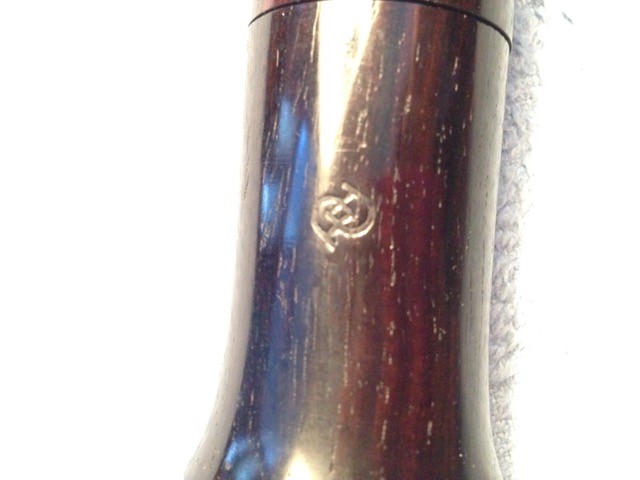
Someone wrote to me asking if I could identify the maker of a flute purchased in the late 1990s; her description says “It is a Blackwood 6-keyed flute with the stamp of D D (the second D is backwards and crosslinks with the first D).”
This sounds familiar to me but I can’t place it. Anyone know the maker who uses a stamp like that?
Dang it, that sounds very familiar to me too Brad, but I can’t bring the maker to mind Wish I could help here. No doubt Jon C. or someone else will recall and chime in soon.
Worse than an ear worm, this is gonna be bothering me all day
She contacted me too - asking if it was one of mine. It wasn’t. Here are some characteristics:
Block mounted, silver keys. G# key goes across the flute. The footjoint is turned with a big Potter-like swell for the Eb key. The bands are a little similar to mine as well as the turning on the barrel joint. However, the bead on one end of the band is significantly larger than the band on the other. The middle joints are 2 piece instead of one long piece. No bands or rings where the head joint and barrel joint separate.
Now that I’ve looked more closely, I don’t think French is even close to the mark; I’d say English or American. There are no modern makers with the initials “DD” or “D&D” that I’m aware of, so I’m assuming it’s a 19th century flute. But I haven’t seen any listings for makers with those initials in Britain or America either.
I’ve seen English band flutes in Eb and F that have similar features, although I have not seen this maker’s mark before.
For example, here is a Boosey & Hawkes F flute that shares some of the features. In this case it does not have block mounted keys or a separate foot, but it is easy to find examples that do, and they have the same large block turning for the foot key. This doesn’t help much in identifying the maker, but it seems that the maker may have taken design features and stylistic cues from 19C English band flutes.
Nice flute, the flare of the sockets remind me of the band flutes made by the Henry Potter form. The wide bands put me in mind of Joseph Wallis flutes. I do not know who made it, but as the flute is stamped with a monogram, I think it is more likely to be the work of a modern maker. The tuning slide is particularly unusual-never seen that one before.
I wonder how modern is “modern?” I’ve never seen a flute like that from a present-day maker, and there are no current flute makers I know of with the initials DD or D&D.
She also noted that there’s an American dime in the headjoint (I assume on the cork), but that’s likely something a previous owner put on to strengthen the tone.
Perhaps the initials on the flute are not in reference to its maker, but to its owner. As the mark is stamped and very well executed, possibly the maker put it on at the owner’s request?
There are no modern makers with the initials “DD” or “D&D” that I’m aware of, so I’m assuming it’s a 19th century flute. But I haven’t seen any listings for makers with those initials in Britain or America either.
Following up on the “DD” line of thought, Daniel Deitch is a flute maker (now retired, but still doing repairs) based in San Francisco. He used to make several models of baroque flutes and a variety of other instruments. I do not know what his maker’s mark looked like, but he has the right initials. Looking at the pictures, I see that this flute has an unusually small, baroque-like embouchure.
If I may take a shot in the dark, in India D flutes are often marked DD, to signify their
key. The flutes are basic six hole simple system. Well (continuing to free associate),
this may be taken from the Brits (many things musical in India are (e.g. the harmonium)).
So possibly the flute is British and DD marks the key.
It’s probably coincidence—but I just got a spam phone call from “DD” (according to my phone ID) at 510-319-8354. Perhaps everyone should call that number and ask “Who made the flute?” and then hang up.
 Wish I could help here. No doubt Jon C. or someone else will recall and chime in soon.