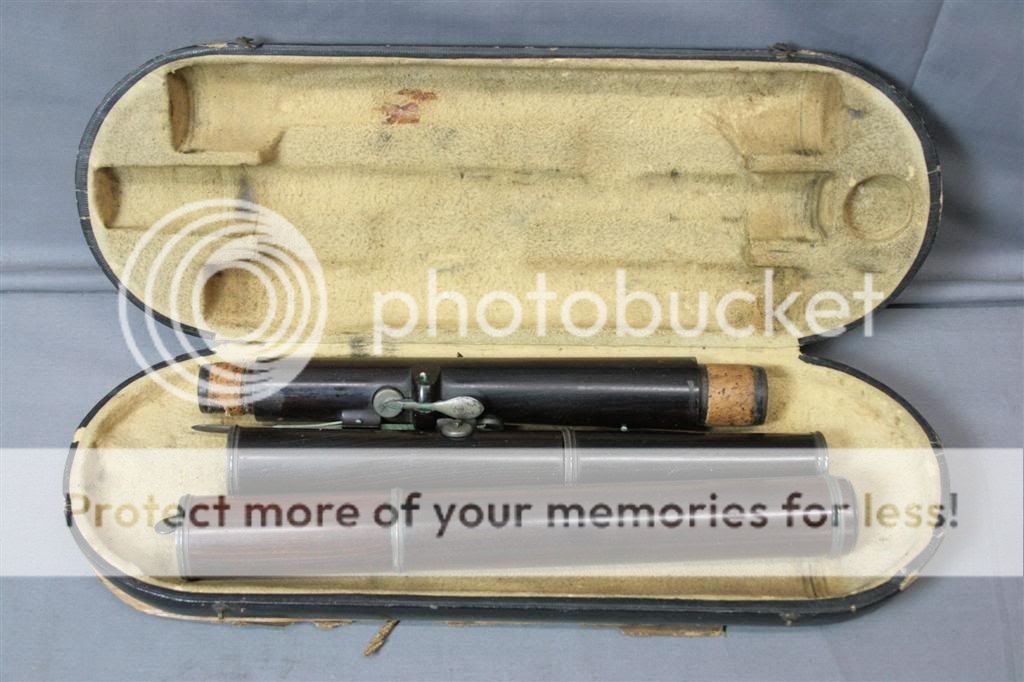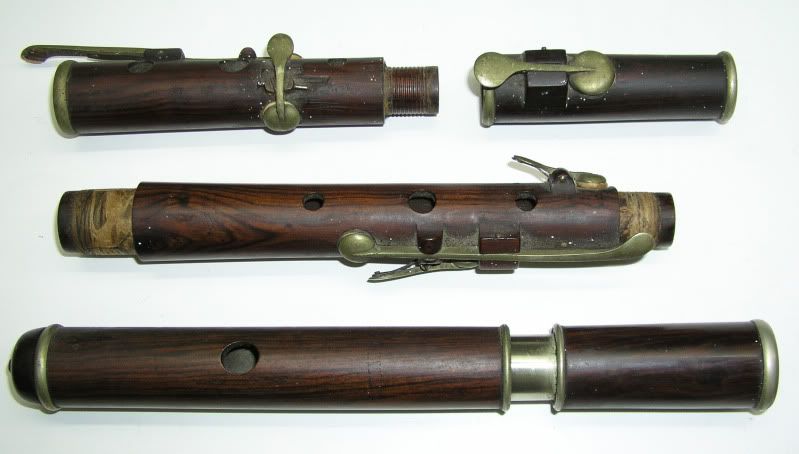
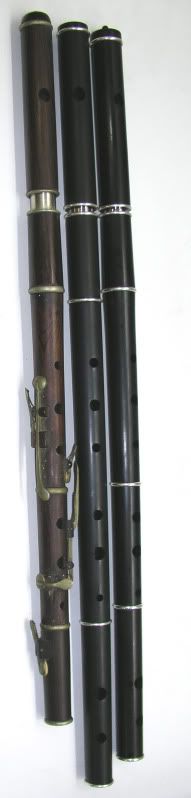
Well I’ve finally taken the plunge and, after many heated battles, been successful in an e-bay purchase of a “fixer-upper” flute. It has just arrived in my hot little hands, thank you UK postal strike, and I’m very excited to get my hands dirty working on it. This one appears to be a mid 19th century, block mounted, 6-key, Metzler with a short foot (visually looking a lot like a McGee GLP). I hope it plays in A440, but will not be able to tell until some repairs are made. When I get a chance I’ll measure the hole separation and compare it to those listed on Terry’s site and with my blackwood Ward and delrin Seery unkeyed flutes.
On the positive side the partially lined head joint is intact, with a nice clean oval embouchure hole and threaded wooden crown stopper assemblage. All keys are also intact, the slide functions nicely, and the wood is a nicely figured cocus (I think). On the other hand there is the typical, thru and thru barrel crack, two posts that need replacement, sticky springs, a foot joint that rotates, but will not separate, a frozen cork, and a complete repadding and tenon threading in my future.

I’m pretty handy, so none of this scares me, but I’d love to get some feedback from the experts here on my planned strategy. I first plan to remove all the keys, clean them up and replace the pads with clarinet, oboe or bassoon pads as described elsewhere in this forum. Then I’ll press out the cork and either modify or replace it with a new one that seals, but moves more freely. If possible I’ll just clean off the brass leaf springs and bend them to increase the pressure on the pad face. I may insert small sections of thin sheet stainless on the spring strike location as well to reduce friction at those locations.
Then the more challenging repairs are left: crack repair, stuck foot and the posts. The barrel joint crack is clearly thru the body of the partially lined barrel, right in line with the grain in the section where it is not lined, all the way to the socket. It looks like it may be able to be squeezed back together with hose clamps, and glued with thin cyanoacrylate, but I am concerned about later stress cracks popping it back open. I know that Terry advises total removal of the slide, gluing and reboring the barrel, and restoration of the assemblage. While I’m sure this is the optimal method, I don’t have an arbor press and would be very concerned about removal without further damaging the wood or slide. I may go for an internal milling and repair, again per Terry’s recommendations, but am not sure my vintage Unimat is up to the task.

Right now I’m slowly humidifying the flute and hoping that the consequent expansion will help close up the crack and, possibly, free up the foot joint. If I get lucky I’ll just glue it up and hope for the best. That socket is a major stress location due to the three point “Rockstro” grip I use, so the milling and turning option would probably be the best. At least it has the typical simple silver rings to reinforce.
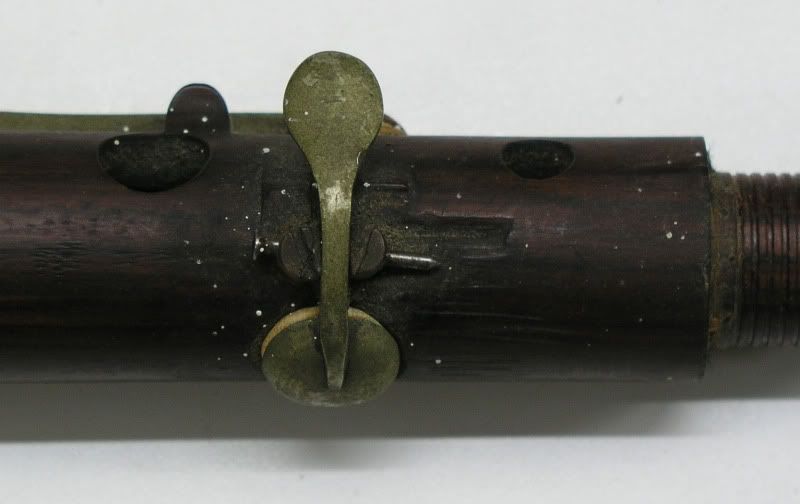
As far as the two posts that need repair, I’m kind of on the fence there. Once I get a chance to post photos (not sure how to do that), it should be more clear what I’m dealing with. At one location, half of the post had split and been replaced with a bent steel wire pressed into what was left of the post. This actually seems to work pretty well for holding the key in place, but until I replace the pads and fix the springs it is not possible to tell whether it functions properly. Of course I’d like to restore the flute to its previous glory, so I may just yank out the wire, file the section flat, and glue on a replacement post. With the other half of the post still intact to use as a guide, it shouldn’t be that hard to drill out the hinge pin hole in the new section. I was thinking of using “Gorilla Glue” for this portion of the repair and wondered if anyone has used it on posts. I will probably pre-shape the post to match the existing half before gluing on to the body to avoid slipups.
The other problem post looks as though it had been broken in half and redrilled at some time in the past with a brad used in place of the old hinge pin. Here a picture would really help as it is a bit tough to describe. I think this will be a candidate for full replacement, but am worried as I have no original pattern to work from. I guess if it works I could just replace the hinge pin and leave well enough alone.
As mentioned above I’d love to hear back from any of you experienced repairers with suggestions, including anything on lubrication or bushings/washers for the key hinges. Sorry about the long post, but I guess I’m pretty excited with this new project.
Thanks
 , but the short F wasn’t exactly moving smoothly.