Sorry, I don’t know what “poststructural” means but I can’t find a category for flute making. I have two questions. This will be a transverse flute in F, from 3/4" cpvc.
Regarding the sharpness of the embouchure hole. I understand that you start sharp and sand it down a little . Very subjective/vague. Does anyone have a suggestion for an actual radius in mm? 0.1 mm? Anyone?
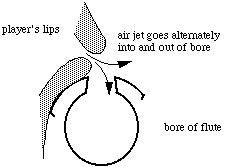
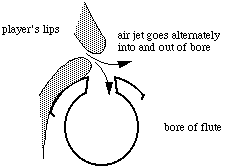
I will thicken the embouchure plate to the correct depth, but what of the undercut? I’ve heard 7 degrees all around and some say the sides and back should be straight? Any opinions?
I will put a tiny chamfer around each finger hole to improve closing, but what about undercutting the finger holes? All around symmetrical? 7 degrees?
Regarding the sharpness of the embouchure hole. I understand that you start sharp and sand it down a little . Very subjective/vague. Does anyone have a suggestion for an actual radius in mm? 0.1 mm? Anyone?
I find it very hard to imagine how you would measure a 0.1mm radius. I reckon cut the embouchure hole as well as you can. Then play it, listening to the tone. Is it clean, or is there a hissy or edgy sound superimposed. If that, slightly soften the sharp edge by rubbing some very fine steel wool along the edge. Listen again. Still hissy or edgy? A few more strokes. Etc, etc, until you are getting a nice clean sound.
I will thicken the embouchure plate to the correct depth, but what of the undercut? I’ve heard 7 degrees all around and some say the sides and back should be straight? Any opinions?
I do 7 degrees under the far edge, 10 degrees on the close side. Not sure where I got those figures, it might have been from Boehm! I leave the sides straight apart from rounding the tops and bottoms of the sides to smooth the airflow. I do not round the bottoms of front or back, apart from slightly smoothing the tops with the fine steel wool as mentioned above.
I will put a tiny chamfer around each finger hole to improve closing, but what about undercutting the finger holes? All around symmetrical? 7 degrees?
I mostly make D flutes, which means the holes should be further apart than humans can comfortably reach. So in most of my models, I undercut the 1st and 4th hole upwards, the 3rd and 6th hole downwards, to make them seem like they are further apart. And undercut the 2nd and 5th hole all round, as needed to tune them.
Hope some of that makes sense.
And going back to your query about where to pose questions relating to flute making, I would have thought the flute section. Perhaps some guidance needed here from our host?
Oh, and I should add this. When cutting embouchure holes, I reckon it’s really important that there are no bulges under the playing edge. They seem to confuse the airjet.
I’ve come across old flutes where some amateurish hand has tried to modify the embouchure and introduced some convex furniture under the edge. Probably thinking to smooth the airflow. But it can really need with the jet-switching action the flute depends on for efficiency.
Is that 7 degrees from the vertical as left by the drill, with the cutting edge itself sharper than that due to the tube curvature? So the tube wall thickness and presence or absence of a lip plate would alter it? Possibly being a bit fussy, but the difference between 7 and 10 degrees is in the same sort of region.
Having worked out how to get a clean cut I’m just about to attempt a ‘soprano’ C flute in 16mm OD PVC. With a 10mm diameter embouchure hole I can vary the overall angle at the important edge by offsetting the drill from the mid-line.
I had trail and error in mind but what the best guess at where to start?
I don’t see that any change in OD would change angles.
Agreed. But keep in mind, one is forward, one is backward.
Offsetting would realise the 7 degrees offset needed for the edge. But it would leave the underlip slope as +7 degrees rather than -10 degrees (if you accept my +7 / -10 degrees embouchure approach).
Always the question with flute making! Was there ever a field where we had to find out own way?
Looking that the UNSW sketch if we imagine the bore about 50% smaller relative to the hole (as it would be for my 16mm tube) the edge is further round the circumference so the drill makes a higher angle with the circumference. Likewise adding a lip plate reduces edge angle. Pete Kosel of the ‘original Flutomat’ suggests aiming for about 45 degrees between the drilled hole and the circumference.
I was thinking the backward and sideways edges were more to do with acoustics than fluid dynamics so less critical to the sound and could be done by hand. Controlling the forward angle by offsetting the drill should be more repeatable, and predictable with some basic trigonometry.
I agree with most of what has been said, but would add that generally the embouchure hole on small flutes with narrower bores will be smaller. I think this speaks to one question david_h asked.
Regarding asymmetry between front and back wall undercut angles, bear in mind that this effectively imposes a handedness on a keyless flute that is otherwise unnecessary. There are more left handed flute players out there than statistics for the general population would suggest. Not sure why that is.
Making sure that there is nothing convex on the embouchure wall that the player is blowing against is critical. For this reason, that wall should be scraped ( using a sharp, straight edged scraper) not filed or sanded, in finishing.
The cylindrical high D, C and Bb flutes I have to hand have embouchure holes of about 10mm diameter. Doug Tipple’s G and F are a shade under 10mm. They all work for me and that covers OD between 16mm and 26.8mm
Mirroring their tin whistle teacher maybe? Less likely practicing in front of a mirror with a tutor book propped up. A friend who is used to mirroring as a dance teacher or student found the teacher not mirroring at a beginners whistle class made it hard work!
I have been studying renaissance flutes recently, and discovered that most of the early paintings depicting renaissance flute players show left handed players. Again, quite puzzling. Perhaps it is mirroring.
Regardless of the cause, it’s probably a good idea to cut your embouchures symmetrically, if you have time.
I was in the habit of only voicing mine for right handed players by default, mostly because I am right handed myself. Recently I handed one of my flutes to Laurence Nugent to try out after a concert, and being left handed, he immediately switched it around and played it backwards. The limitations of my approach immediately struck me, but fortunately, he seemed to like it anyway, which was a bit of a surprise since I hadn’t done anything to voice the back wall of the embouchure hole that he was playing against. He could probably play anything and make it sound good though!