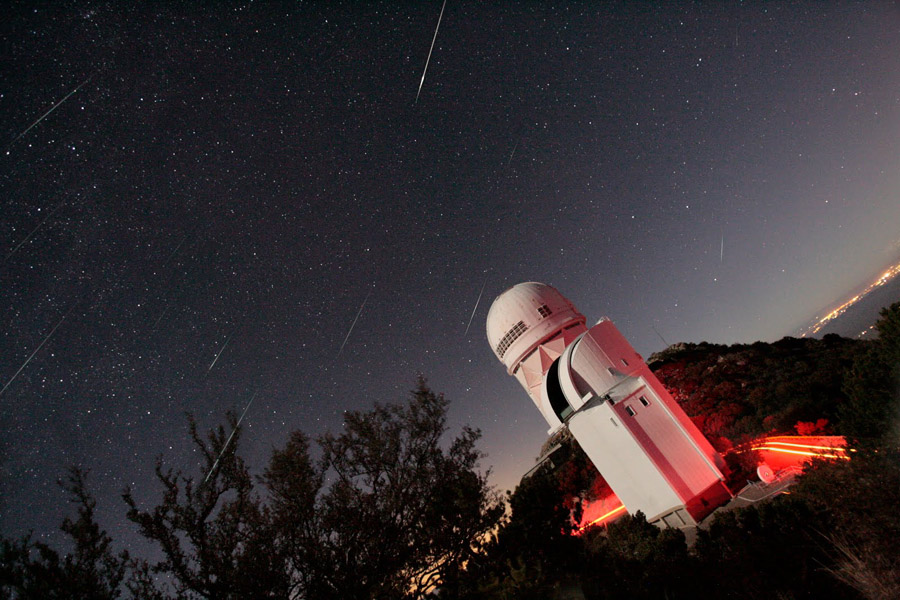
As an employee of Kitt Peak National Observatory, of course, I was on the mountain many times. Now residing in my home state of Indiana, I have to say that I miss the Arizona desert and the brilliant nighttime stellar displays overhead. Maybe I will find my way back there someday. Unfortunately, a lot of other people are having the same thought, driving up home prices and causing a serious overload to the water supply. The sky will remain the same, regardless.
Also adding to light pollution, reducing clear views of the skies.
There is no way to eliminate light pollution with increasing population, but there is a city/county ordinance with regard to street/highway lighting. The light from the approved bulbs emits a frequency spectrum that is less harmful to astronomical observation. Also, if I am not mistaken, not much observation is done in the visible spectrum anyway.
Us amateurs are usually observing with simpler optical equipment, it’s especially bad when attempting solar observations during the day. 
I was not fully correct in my statement that the sky will not change. When they first built the observatories on Kitt Peak, about 50 miles from Tucson, Tucson was a small city, and there wasn’t much in between in terms of light pollution. Now there are also world-class telescopes on Mt. Hopkins in the Santa Rita Mountains, just south of Tucson. Obviously, with all of the light pollution our view of the nighttime sky has changed considerably. I guess I was thinking about the actual stars and their placement in the sky when I mentioned that that was a constant, but I wasn’t correct on that one either.