You’ve probably heard of Healy’s fully chromatic keyless 10-hole flute, or even had the privilege of playing one. I find this flute wonderful, but the price tag ($1500) is less wonderful. Is anyone aware of a cheaper flute based on the 10-hole fife, preferably made of plastic?
daniel
you may see my post in the “what am i doing” thread re: chromatic.
I know of no other flute maker who uses the 10-hole type idea for flutes. Remember, Skip’s background is fifing, so by extension it makes sense.
Iplayed the F flute multi-hole model. As someone who grew up on McDonagh model fifes and mastered the 11-hole fife, I preferred it. However, my hands could not accommodate the reach on a consistent basis. That was the F flute. I can’t even imagine the D.
Too…you’d find difficulty with some ornaments (assuming you’ll want to use them) with the multi-hole, notably the low-E rolls (if the flute uses the same principle of fife…which is to keep that pinkey down) and the A rolls (where the ring and pinkey fingers must move simultaneously). Not impossible, just difficult and needing practice.
my 2cents
oh…and $1500 is not too much seeing as many 6-hole keyless flutes are in the $1200-$1400 average range now.
There’s a lovely Russian instrument called a Sopelka.
It has 10 holes and sounds really nice.
But if you’re going to want a hand made instrument with different design features, $1500 is not expensive one bit.
If you think it is, buy a plastic recorder.
$1500 is not expensive? On what planet do you guys live? Traditional flute music has always been about accessibility and affordability. I doubt many regular working-class people have $1500 to put into a hand-made instrument. It’s kind of ironic that it’s more expensive to play traditional music than classical. If I want a bunch of keys, I’ll just buy a nice student boehm and pay a lot less. You’ll say: it’s hand made, man! Well, I bet most of you don’t sound any better on a hand-made instrument than on a a flute made in factory. Conclusion: there should be more cheap factory-made traditional flutes.
There’s not a big enough market for mass produced Irish flutes. The ones out there now are hand made by professional craftsmen, and if you understood the time and dedication involved in making one single flute, you’d probably understand it all better.
Still there are great, inexpensive polymer flutes out there that goes around the issue of seasoning wood and let it rest for many weeks in between the different stages of reaming. Great quality flutes are available in the $350 range.
Keys are often hand made as well, from sterling silver which is not the cheapest material.
I’d agree that $1500 is pretty high for a keyless, but it’s not outrageous. It’s probably a lot more work to make a 10 holed chromatic flute than a standard 6-holed.
You can’t compair a normal Irish flute with a student Boehm flute. You should compair the standard Irish flute with a hand made Boehm flute, and you’ll quickly see that Irish flutes are very affordable.
Very true… The flute players who initiated the irish flute playing more than a century ago used the wooden simple system instruments partly because at that time they were less expensive than the Boehm.
There are still some inexpensive possibilities for playing irish flute: PVC and Delrin, sometimes young makers’ flutes are not too pricey, too.
Another idea I don’t see here very often can be quite fun: it’s sometimes possible to find on ebay a wrecked english or german flute from the 1880s for a few $, remove the keys and plug their holes, superglue the inevitable head crack and use it as a keyless. I did that, and the resulting stick is actually not that bad, though high pitch.
It’s like the debate between high-end and 20$ whistles. Copeland or Generation…
I think the problem is that a ten holed flute has a relatively small market. Most music is played fine on a six holed instrument and few people want to be bothered with the extra finger holes if they are not needed. Keyed instruments are much more common and can be found (used) for much less than what you would find a Healy ten holed flute. The six holed flute is in higher demand so there is more competition for them and less expensive flutes exist.
Not to start a flame war, but do you mean “traditional music” or “traditional flute music”? It seems that from the above statements that the flute only was introduced when it became affordable and the music is not necessarily “traditional flute music”.
Sadly there aren’t. However, certain manufacturers in Pakistan agree with your conclusion and are churning out their inexpensive wares even as I type. They don’t seem to offer a ten-hole keyless though, and I think they’re still hand-made (although possibly on a line basis).
Nice post, Henke.
I think the only ‘factory made traditional flutes’ I’m aware of are the Eb 8-key ebonite flutes from EmpireBrass in India. You’d lose your bet.
In the grand scheme of things even the priciest “Irish” flutes are cheap. Look at the prices any pro-level violin or cello, or even mandolin will fetch and then breathe a sigh of relief.
I think Loren, many moons ago, posted about the number of tools involved in constructing a good flute, and the labor involved. It’s a good read.
$1500 is not expensive? On what planet do you guys live? Traditional flute music has always been about accessibility and affordability. I doubt many regular working-class people have $1500 to put into a hand-made instrument. It’s kind of ironic that it’s more expensive to play traditional music than classical. If I want a bunch of keys, I’ll just buy a nice student boehm and pay a lot less. You’ll say: it’s hand made, man! Well, I bet most of you don’t sound any better on a hand-made instrument than on a a flute made in factory. > Conclusion: there should be more cheap factory-made traditional flutes.
[my emphasis]
Nothing personal meant by the following: I find the bolded statement more or less abhorrent.
As noted above, there is simply not enough demand to justify the investment in automated assembly-line style “Irish” flute production. And that’s a great thing, really. I for one very much appreciate the individuality available in different makers’ offerings. Were flute production “Walmartized,” we’d have Walmart brand, Matt Molloy-licensed Chinese made flutes available in large and small hole models and little else. Very little room would be left for the true craftsmen. Is that something we really want?
For the record, I play a “cheapie” poly flute and not a “top-level” brand or an antique. Also, anybody with a brain, an internet connection, and <$100 of plumbing supplies can make a very good sounding flute with a little practice.
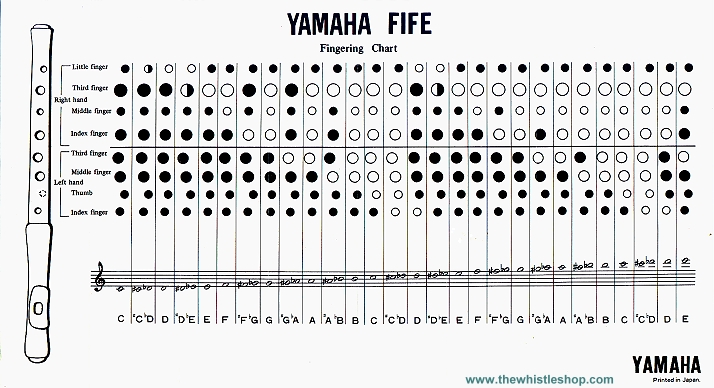
Fifing is even a smaller market and yet Yamaha makes an eight holed fife out of plastic for under $10. It is in the key of C (rare for fifing), fully chromatic for 2+ octaves, tapered bore and comes with it’s own soft case. I think that with the popularity of ITM, it is about time that they mass produce a flute.
I always wondered who buys these strange things. They’re actually a blend of recorder and fife, I don’t know in what type of music they could be used.
But I keep seeing ones regularly in a lot of music shops, so I guess there is a market for such an instrument.
Does anybody on the board use a yamaha fife?
I agree… There was a plastic traverso made by Aulos, why not an irish flute?
I purchased one for fun. I owned it while I was still working on the third octave (my embouchure was not all that great) but I should have had no problem with this fife. I found it more difficult to blow than my normal fife and even harder than my old MelBay brass fife. It had a rectangular embouchure so it should have been an easy sweet spot to find. I cannot even attribute it to the fact that it is higher pitched than a normal fife because I have a Sweet D folk fife that I had no problem with. I wonder what an accomplished player would think about its playability.
I think that the main use for these “fifes” is for elementary school music education.