Hi everyone,
I picked up a Tipple 3-piece in D, oval embouchure and no lip plate, and I’m really pleased with the sound. However, I’m finding the embouchure to be a little tricky compared to a few flutes I tried at my Celtic teacher’s house. Generally, the Tipple doesn’t seem to like being pushed, and seems to require much more specific and focused embouchure than the wooden flutes. Is this just a virtue of being made of PVC? The embouchure hole is pretty sharp, I notice, with a steeper undercut than the wooden flutes. Does this require more/less breath, or a tighter embouchure? If you have a wood flute and a Tipple, do you notice a difference in how you adjust to each flute? I’d welcome any suggestions you have. I realize I am a relative beginner, but I didn’t seem to encounter the problem so much on other flutes.
I’m aware of the concept, but that’s not really helpful in improving my playing of said flute, as the chimney height is most understandably not adjustable.
I’ll shoot Doug an e-mail in that case. Mute- believe me, if I had the money to play a lot of different flutes consistently, I would. I guess I was hoping someone would say, “Oh, yeah, Tipples need to be blown down much more than other flutes,” or “the larger hole needs a wider airstream.” But if it ain’t so, it ain’t so.
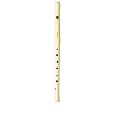
A yamaha not-really-a-fife can be had at amazon.com for $8. They’re great for boating or leaving in the car. They’ll tighten an embouchure. I’ve come across some other inexpensive flute type things that sound good.
No, but it’s close enough. It has a back hole. And there is something else going on with the scale too. I have done my best to play this instrument by ear and not figure out what the actual notes are. There is something going on around the B. Maybe it’s a Bb, I don’t know. But it does half hole really nicely. I would never just jump on a stage and perform a song cold without double checking first if that note is a B or a Bb. (There is also the possibility that I am completely wrong.)
The Yamaha is a neat little toot. The one I have is in ‘C’. It does, however, have a ‘Reform’ embouchure-lip-plate, which I find a little distracting whenever I pick it up.
Talking about embouchure (lip) is difficult. Demonstrating it a little easier. Easiest, just ‘mooching’ about trying all sorts of different approaches. Hence the advice to ‘Practice,Practice,Practice’. What works for me may not work as well for you. . .we’re all built a little differently (duh).
The Tipple without a lip-plate is closer to a Bansuri than the favored wooden concert flute in these parts. You can get many fantastic effects from these bamboo style flutes, but it is harder to get the ‘hard,dark tone’ favored by ITM enthusiasts. That was why Denny pointed out the chimney depth (or contrariwise:height).
Mumble years ago when I first tackled the silver flute as an 8 year old, my teacher taught me to ‘call the cows’ with only the head joint. . .and encouraged me to attempt a tone on almost anything that remotely resembled a blowhole. I tried lip-stick caps, pop bottles, disassembled ball point pens, ,milk bottles, A&W Root Beer half gallons, you name it. A professionally cut embouchure will be easier. . .and with more predictable results.
I just returned after being away on a vacation, and I see this question has been discussed for a few days. I agree with Bob that my large bore pvc flutes without the lip plate, because of the large bore and thinner embouchure chimney depth, play more like a bansuri than a traditional wooden conical-bore Irish flute, although you can make them sound Irish with the right embouchure. I think that my lip plate flutes with the deeper embouchure chimney play more like a traditional Irish flute, although I think that they are a little less fluid in the second octave, so there is some tradeoff, and I like both flutes.
I cut the the fairly steeply-cut embouchure front edge because I think that the flute has more volume and more potential with this embouchure design. A flatter front wall just doesn’t do it for me with the large cylindrical-bore flute like my flutes, although it does work quite well for a smaller-bore conical flute like the wooden Irish flute. That being said, I think that the steeper cut embouchure requires a good personal embouchure on the part of the player, as it is easy to run into air-management issues without it.
I have a discussion from veteran players about this topic on the FAQ page (question three) at my website. I think that Jem Hammond (Jemtheflute) and Michael Eskin give a fair analysis of my flutes. I also give my opinion at the end of their discussion. http://tippleflutes.com/frequently-asked-questions/
Now that classes are wrapping up I had the chance to play for a while today, and I think I’ve solved the problem. To get that good Celtic edge to it, I used a much tighter embouchure than usual and aimed the airstream further down. The upper octave remains of course fantastic. Great work Doug, I forgot to tell you what an excellent starter flute this was for me. I love having waterproof instruments I can take mountain climbing!
I’m new to this flute world and in February got my first flute, Doug Tipple’s in D, with lip plate and wedge. I played many years stringed instruments and used to say “It don’t mean a thing if it ain’t got them strings”.
But I’m real happy with the Tipple flute and am getting good (?) tone through the first octave with plenty of volume. The second octave was giving me a problem, but I recently got over the hump on that and figured out an embouchure that works for second octave almost every time. Still have a long way to go, but enjoying the journey.
Frank
@Madman - I agree about the waterproof, low-maintenance aspect of this flute. No worries about cracks and humidity and taking it in the car, etc.
Also, I think I may pick up one of those Yamaha fifes to work on embouchure.
Looking at the fingering chart, it is capable of playing chromatic. that’s very cool. Does yamaha have something similar in a flute that can play chromatically?
It pleases me to say that I am not aware of any low-cost injection molded larger flutes like the Yamaha piccolo, either diatonic or chromatic. Of course, Yamaha could easily make them, but so far the market for such flutes is not perceived to be that robust.