On some of the cylindrical flutes I’ve made (PVC and bamboo), I’ve been noticing that the 2nd octave top note (L1 covered, overblown) tends to crack to the next harmonic unless R3 is covered.
In other words, the fingering for the top note of the second octave that works is XOO OOX instead of the typical XOO OOO. This is probably a consequence of a cylindrical bore and that there’s some kind of mode competition going on with the impedance being low for both the intended note and the harmonic.
I even tested it with an identical head joint and just changing the body with different tone hole configuration and I’ve confirmed that the tone hole placement has a lot to do with it.
What I don’t understand yet is which exact placement creates it. The math to compute the standing waves and register nodes and such is currently still beyond me.
Another interesting thing is that unlike a typical cross fingering that flattens the note, XOO OOX sharpens that note on the 2nd octave so that it’s actually in tune.
Currently I’m doing it empiricially by adjusting the hole sizes and placements incrementally to find out which one works without the special fingering.
But just asking here to see if anyone else has had this experience.
Thanks
Bottom hand holes sharpening that note is a ‘known thing’. For example X00XXX is one of the alternatives to XOOOOO given by http://www.oldflutes.com/charts/onekey/index.htm
The comments for the alternative fingerings above second octave G in the fingering charts on that site may shed some light on odd things that happen with harmonics.
1 Like
I had never noticed that because on flute I have always used my bottom-hand ring-finger as an “anchor” finger while playing A, B, and C.
But when I switched from flute to Low D Whistle I discovered that having my bottom-hand ring-finger down made High B more difficult to sound, and on some Low D’s gave High B a harsh under-tone.
Measure the distance from the middle of the embouchure to the middle of the second (L2) hole. The wavelength for second-octave XOOOOO is a bit longer than this. Divide by 4 to estimate the quarter wavelength. I’m going to guess that, for one thing, you don’t want the distance from the end of the flute to the middle of the bottom (R3) hole to be close to the quarter wavelength. There may be other correspondences we don’t want, but that’s the one that comes to mind.
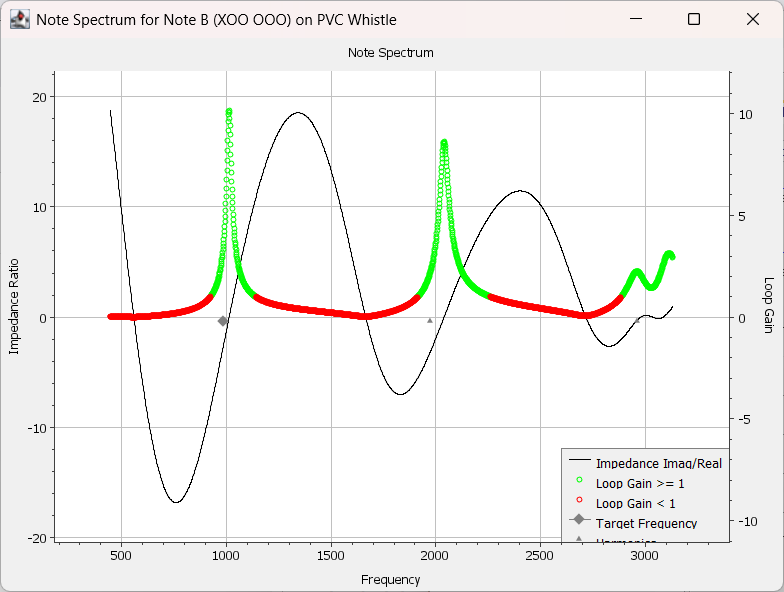
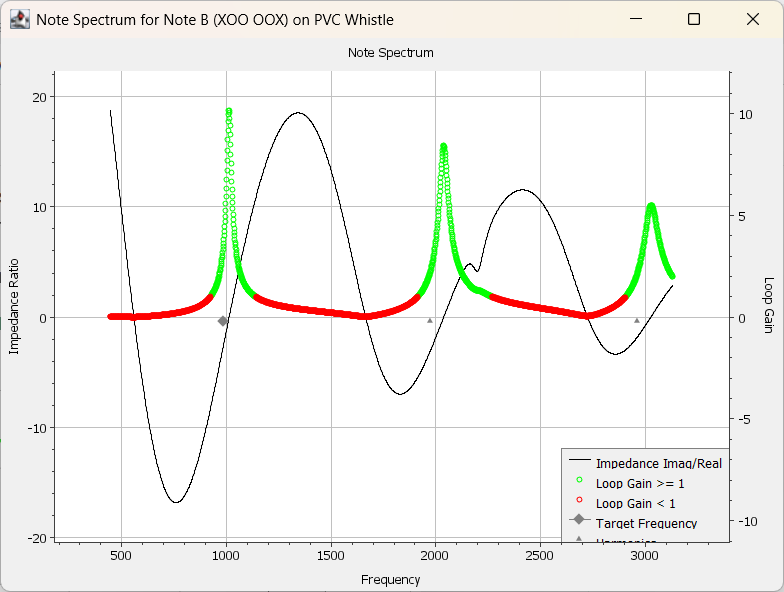
WIDesigner ( Home · edwardkort/WWIDesigner Wiki · GitHub ) has a tool to display the impedance spectrum for a specific fingering ( Reading the Note Spectrum Graph · edwardkort/WWIDesigner Wiki · GitHub ). By comparing the spectrum of a flute where XOOOOO works, to a flute where you have to use XOOOOX, you may get a clue what looks “wrong” in the spectrum.
For example, for a whistle where the R3-to-end length is close to a quarter-wavelength, here is the spectrum for XOOOOO. Second octave B is just shy of 2000 Hz on the horizontal axis. I’m suspicious that the wobble around the third harmonic just below 3000 Hz is related to your problem.
And here is the spectrum for XOOOOX. No wobble at the third harmonic.
If we move R3 higher up the tube (and make it smaller) where it belongs, the spectrum for XOOOOO looks more like the second graph than the first.
Thank you for this @Tunborough. This is exactly the information that can help guide my experimentation so I’m not doing it blindly.
I’ve done some more experiments and found that increasing the size of R1 and R2 and moving the cork 1mm or 2mm farther help prevent this problem.
I think this is why R1 and R2 are big on the Tipple flute: it’s not just for power, but to prevent cracking at the top end.