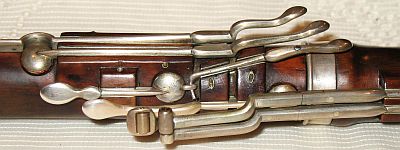
This is a flute that a friend of mine’s father has in his collection. Currently not playable, but with a quite remarkable set of foot (and other) keys - has anyone played a flute with a foot like this in working condition?
How are you meant to use the keys on the outside of the top joint anyway? (The ones above the G# key…) And what does the very top hole achieve? Is it a C trill like on Boehm flutes?
Also, does anyone know anything about M Kneer in Münster (I have tried googling “M Kneer Instrumentenbau Münster” with little sucess.)
And I would be glad to hear any other comments that the pictures might inspire.
Does anyone have a vague idea of value and whether the restoration would be worth it. I doubt that it would make a viable session flute though (pitch, balance, smallish holes, etc.). The visible damage is a split in the back of the headjoint, recorking and repairs to the keywork - all the original bits of the long keys seem to be present, though. And a couple of blocks were split off (visible in the pictures, including the long F and some of the low foot keys.). Almost certainly not worth repairing unless someone particularly wants to play it though - and that probably won’t be me - I have enough to do with my other flutes. The owner might want to repair it just for the sake of having a playable item in his collection. (Mostly he has clarinets and saxophones. And lots of other stuff…)
I also presume the white bits are ivory, though I am not sure.
I’m with Dunnp, the flute looks very Viennese/Austrian, though Münster is much further north near the Netherlands.
I would say that this flute is a valuable example of a transitional keyed flute from the early 1800’s (before most makers settled upon the typical 8-key configuration). It is probably a sweet voiced flute, but its value as a player is dubious.
If the owner desires to play the flute, then it might be worth restoring. If he is just a collector, I would let the flute rest and allow someone else to restore it.
Did the Viennese ever do block mounts? I’m not sure I’ve ever seen a German or Viennese flute with block mounts.
The label looks like a dealer’s label to me…they sell clarinets, flutes and bassoons and something that looks like Hoboen? I’m clueless on that last word.
Any name on the flute itself? Could it really be some odd English made flute for the German market?
The F shaped key on the upper section appears to be placed right for a trill key, but I can’t imagine how such a critter would be used. Maybe I’m way off base, though.
Flute is stamped as well. Its made in Munster presumably. Shares more features with flutes on the Viennese and Italian page on Rick Wilson’s site than any other page.
And yes German flutes were block mounted before pin mounted same as English the difference being perhaps that they adopted pin mounts on a wider scale before English makers did?
I have seen a lot of earlier German made flutes in boxwood with horn mounts, brass keys, block mounts.
M. Kneer was a music dealer in Münster (where I live). So they probably didn’t make the flute, but had someone make it and put their stamp on it. Anyway, the flute must have been sold just minutes from here…about 200 years ago! That’s quite cool. I’d love to restore it to playing order.
The owner is a retired doctor who collects many things, amongst them old instruments. He mainly has clarinets and saxophones (which he can play) but he also has a lot of odd items that have ended up in his hands - this flute was inherited from a patient many years ago. They are near the Ammersee, southish of München, so that is presumably roughly where the flute spent its’ last century. I doubt (given the state of the flute) that the previous owner played it much, though he might have when he/she was younger?
The owner offered it to me if I wanted to restore it and play it, but I am not sure - I have a few other flutes that need my care and attention… The owner does not play the flute himself. Another friend of mine has several of his clarinets on long term loan/donation, so I know that the offer of the flute is probably seriously meant - I think he’d like to hear what it sounds like:-)
Restoration with an eye to resale is probably not an option.
And, counting the keys, it appears to go down to low A.
If anyone can tell me what the extra keys on the top joint are for then I’d be grateful for the info. Some of them I can work out as being duplicates of the standard tone holes - presumably to allow different fingerings.
The last word on the label is Fagott - Bassoon in German.
And am I right in understanding that such flutes usually pre-date the mainstream 8-key system? And does that put it around 1810/30? And, if not Viennese, then likely to have been inspired by Viennese makers? (I’m looking for a potted history that I can tell the owner here…) It lacks the ornate metalwork of the Ziegler and Koch flutes on the old-flutes page, and the well-known makers would probably have insisted on their own maker’s stamps?
Interesting…I guess in the US, at least in the midwest, block mounted German and Austrian flutes were not sold via Sears.
However, I was correct that it was a dealers label…my German is rusty, but reading it really made it sound like a dealer.
Bassoon was one word I was able to translate myself…it’s the word before bassoon. Being more awake this morning…is it Oboe?
The word seems to be Hoboen - I presume it means Oboen and that the H is either an artistic wiggle or an historical spelling? I make the complete text to be:
“M.Kneer in Münster
verfertigt alle gattungen Flöten, Clarinetten, Hoboen und Fagotten.”
Which I translate to:
“M. Kneer of Münster.
Fabricator of all types of Flutes, Clarinets, Oboes and Bassoons.”
Interestingly the modern German spelling for Clarinet is Klarinette (as I understand it), but here it gets a C instead… I don’t know if that is a product of the recent Rechtschreibreform or an earlier change?
I found the spellings interesting as well and they clearly show the age of the instrument and how fluid spelling was back then.
The words in images were hard to read on my phone…seeing them written out it clearly indictes they were the makers.
I wonder what year it was made…the makers sure were producing a wide variety of instruments which I, perhaps incorrectly, think of as a more modern development but the spelling makes me think it is no later than mid 1800s.
Here’s an image of a completely restored Max Kneer flute:
It’s from the site http://www.feinwerkstatt.net/restaurierung/
They don’t provide any information about the background of the instrument (just about what was broken and how they restored it); but apparently they had a similar Kneer flute for comparison, which is in the Museum of Musical Instruments in Leipzig. You might ask them, if somebody can give you more detailed information, then they can, I guess.
Regarding the extra keys, I’d say we have a duplicate C (the one that looks like the G# key, just reversed), between them is a duplicate Bb (that looks like a short F). I can’t see if there is a double lever or third key for the regular Bb key - what I see is a RH1 operated Bb. Then the normal eight keys we know, plus low B, Bb and A. The upmost key is probably some sort of trill helper key, but I’m not sure.
Beautiful flutes. I have a pin mounted anon flute with B foot, ivory head, and 2 keys for every semitone outside of D#; I guess it’s Viennese or Italian, based on the info Rick Wilson provides. Seems like these makers wanted the player to always have an optional fingering ready.
The trill key on the front of these Kneer flutes is unique to this firm, I think. Nothing like it on the Viennese or German pages at Rick’s site, anyway. Maybe it was meant to provide d’’ or d#‘’? You’d think the long body of these flutes might change the fingering for d’‘’ but you see the usual long trill key on the oversized flutes at Rick’s site. Perhaps it was intended as a key to trill on c’‘’ or c#‘’', with the LH index finger up to strike the key?
That pin mounted job underneath the big Kneer looks intriguing, too. Some Schwedler type ax?
Yup, it is a bass clarinet in the background, - or on second thoughts, maybe it was actually something unusual like a tenor? If I remember, it was smaller than a bass. Though the last time I played a bass clarinet, I was in a school archestra and 14 years old, so I may remember them as being bigger than they are…