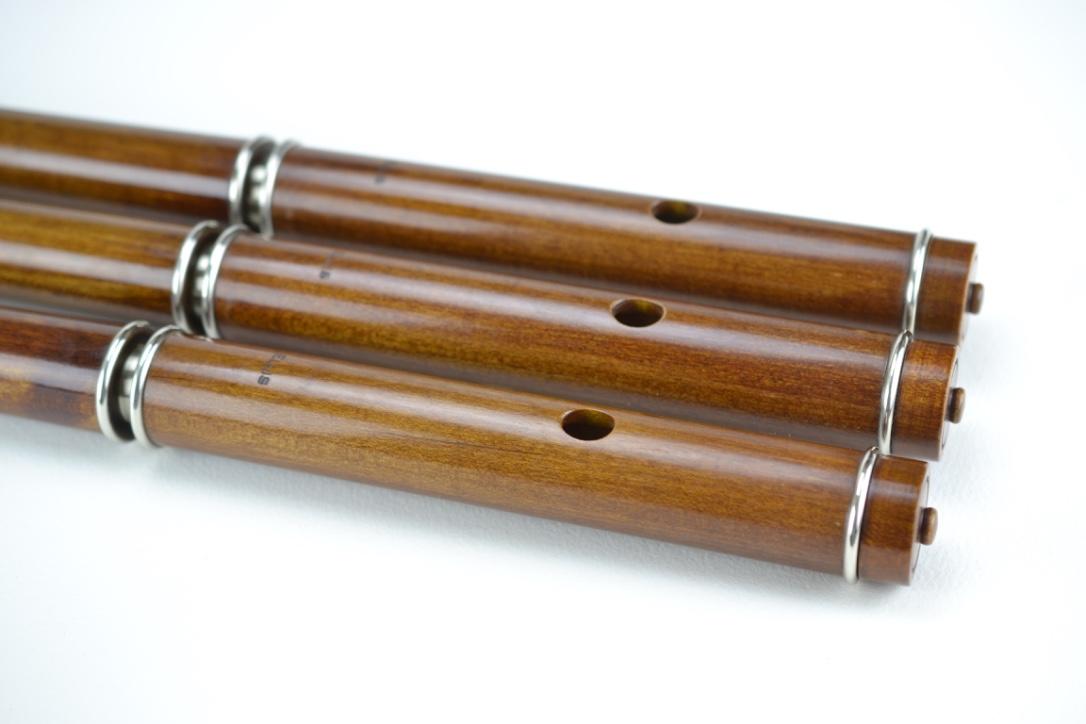
For some time now I’ve been trying to create an ideal flute for ITM. Obviously this is a personal and subjective goal because there is no such thing Of course individual players want different things, but what I really mean is that I’m trying to take note of the qualities that players value the most and blend them into a flute design that is affordable.
The feedback that I’ve received on my Pratten flutes over the last couple of years has been most gratifying, but my more contemporary design has not been to everyone’s taste and it wasn’t the most efficient in terms of my being able to produce them in a price range that is attractive. I set out to remedy that and I’m pleased to share the result of my efforts.
These are still very much the Pratten design. Powerful, clear voice that is great for session play. They are made from resin-stabilized hard maple that I have dyed to achieve an “old-timey boxwood” look. Nickel silver bore rings and integrated foot. The resin treatment makes for a flute with the density of African blackwood.
The unusual feature is the combination joint/tuning slide. I wanted to make a simple, two piece flute that was tunable. So I eliminated the barrel and I created a joint that is made from a nickel silver tenon that fits into a Delrin lined socket. This avoids having a metal-on-metal slide which would probably experience a lot of wear if the player were to take it apart every time they played. It is a precision fit so it acts as a very solid joint and a very functional tuning slide with the same minimized disruption that one gets from a fully metal slide. The only difference is that due to design requirements the metal tenon is in the flute body and the socket is in the head joint. This design does mean that the travel of the slide is somewhat limited, so really radical tuning adjustments are not possible. However, the player can comfortably get about 8mm of travel in either direction to sharp or flat the pitch, which should be plenty for most occasions. The metal and Delrin get along very well with one another, but the player does need to apply cork grease each time they assemble the flute but I’m guessing most of you are used to that.
The inside of the head and body are sealed with a clear coat marine epoxy so they are completely waterproof and require no oiling at all. Plus the bore is as smooth as glass and gives the flute superb response.
Okay, that seems like enough for the sales pitch Here are some photos!
By the way, does anyone recommend any type of host for photos so that they can be embedded into forum posts? I’ve used Dropbox for some years and once upon a time I could embed the photos in my public dropbox folder directly into a post like the one above. They have discontinued that option so now I can only put up links that take the viewer away from the forum.
I’d love to have the ability to embed photos directly. Suggestions?
I just uploaded my photos to a different host and was able to embed some thumbnails.
I was told that Dropbox discontinued the public folder that allows me to embed images and I couldn’t figure out how to workaround that. If they still have that function they’ve hidden it well or they only have it for their paid service.
However, I found a free host that let me embed the above thumbnails. But they still take you away from the forum if you want to get a closer look.
Yes, I had done that initially. Dropbox provided me with a link for sharing purposes, and when I put it in after the usual fashion (I’ve embedded images from Dropbox in the past) it didn’t work. Odd.
These look very pretty, and $550 is a great price-point. Can you tell me the weight? I’d be very interested in one of these as a backpacking flute. Any idea when they might be available for order?
I see you have moved away from the delrin insert for the embouchure wind-hole. That seemed in theory a very flexible system in that changes and adjustments could be made in a relatively non-destructive way - and was a good idea. In practice were there problems?
I’m actually taking orders right now and have a short waiting list at the present. The first batch should be available in the second half of May.
I’m hoping to get some recordings online before long.
They weigh about 10 oz. according to my scale, which I think is reasonably accurate.
Yes, the Delrin inserts for the embouchure hole had some neat aesthetic qualities, and it was rather nice to cut a material that was so consistent, but apart from that there was no great advantage, really. It’s not as if you can remove the insert very easily if something went wrong because it was glued to the metal liner as well as the wood around it I used them primarily because I was going for a “look” and wanted it to highlight the Delrin bore rings. And while it made for pretty flutes I do think that the look was a bit too contemporary. My friend Jon (aka paddler on these forums) made a flute that had this same sort of old-school look and when I saw it I thought it was so attractive that it made me want to change the look of my own flutes. His flute looked like it came straight from the early 19th century and was super handsome. I was converted
The previous versions that had the classic design (tuning slide, barrel, foot joint, etc.) were more involved to manufacture and therefore more costly. Additionally I’ve been having to pick my battles lately and limit different flute designs that I offer. I make many other types of flutes apart from Irish flutes and since I work solo it’s easy to get scattered in too many directions So I wanted to make a solid, single style for ITM that would have wider appeal. I might offer a black colored version of this same flute made from “ebonized” maple as well for another classic look. But these are probably the only options I’ll have for Irish flutes. Otherwise I might go slightly mad!
Am going to try the Acrylic Impregnation method myself. I just sent off a pair of Curly European Maple flute sets to a service that does this, wood rounded and pilot bored. I am eager to see what this does in terms of adding mass to this wood. The maple is highly figured and these should make for a pretty pair of instruments. Am hoping that the other qualities such as reaming etc. remain similar to working wood rather than Delrin. The descriptions here of Delrin suddenly seizing the tools was enough for me to remember how it does that and stay away from it. This will be an interesting experiment!
You’ll get mass alright! Also, commercial wood stabilizing is likely to actually achieve a higher percentage of impregnation, at least based on what I’ve read. It depends upon their set up, but some of them combine vacuum infusion alternating with pressure and claim this gets more resin in. I’m a trifle skeptical about the pressure aspect because I’ve done it. I have a vacuum chamber and a pretty big pressure chamber and I did a two part process (in theory similar to that of the commercial stabilizing outfits). My experience was that any extra absorption as a result of pressure was tiny and not worth the huge trouble and mess that was involved. It seemed that woods that are going to drink up the resin will do so under vacuum. One of the tests happens when you move the wood from the vacuum resin bath to the pressure tank. My pieces of maple were already so saturated that they sank! Some other pieces of cherry and walnut bobbed up like corks and had to be held down with weights. After the pressure treatment, the maple was still submerged, but when I took the weights off the other woods they still bobbed up like corks. So that decided me. However, I won’t presume that my set up was the same as a commercial one. I was using about 65 psi for about 12 hours. They might use more pressure and longer times.
I think that the resin infused woods ream better. Meaning better than regular wood. And the resin also makes the wood behave like a more oily wood when it comes to cutting it. Cuts smoother, less prone to tear out, etc.
Wear dust protection!!! I’m sure you already do, but if wood dust is bad I’m guessing wood dust saturated with cured resin is worse
 Of course individual players want different things, but what I really mean is that I’m trying to take note of the qualities that players value the most and blend them into a flute design that is affordable.