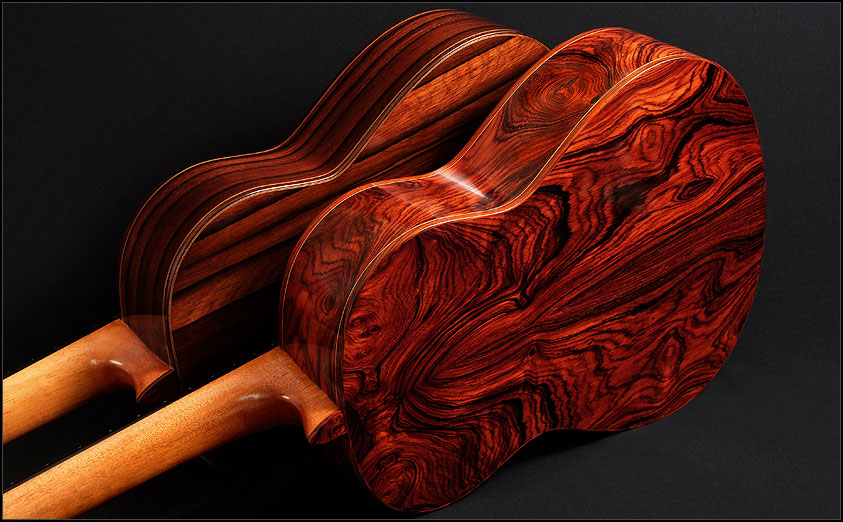
I was wondering if any of you have tried the 1 piece cocobolo flute that Erik The Flutemaker is offering? Being less than than $200 USD, it sure is tempting. It also looks very unique. I like the minimalistic “pretty broomstick with holes” look. It really shows of the grain of the wood. He used to only offer ones in bamboo, but the cocobolo ones look much more promising. Take a look at the photo below.
How does it play? Is it well in tune? Concert pitch? How is the tone? Let us know if you’ve tried it out!
Yes, the trick is not to use an oil finish (which just blends with the natural oils of the wood) but to use layers of some type of polymer or lacquer to create a barrier between the player and the wood.
I use cocobolo for the same sort of flutes, but they have marine epoxy in the bore, then CA glue on the outside (in several layers) followed by lacquer and then wax. Plus they have a lip plate of blackwood to keep the players mouth off the flute body. So far no problems, but I wouldn’t do something like linseed oil, for example.
It varies from person to person quite a bit. I’ve worked with cocobolo for many years and have zero reaction to it. Other people get a bit of dust on them and break out in hives.
If you tend to be strongly reactive to things like poison oak or poison ivy, or have any tendency toward allergic reactions in general I’d stay away from it. Unless of course it is part of a guitar that is encased in acrylic
Well, I have not encountered any allergic reactions to the many exotic hardwoods that I have come across although, I have had no experience with poison ivy or oak living in the middle of a very urbanized tropical city.
Thank you for the insight! I still might risk it if I hear any good news regarding the flute’s playability. Should I break out in to an inflamed mess of hives, I could gift it to a hopefully non allergic friend
A reaction to cocobolo might not be a temporary condition. Sensitivity can result in a prolonged or lifetime acquired allergy to blackwood (a common flute wood), or members of the rosewood family. It’s also not limited to lip sensitivity (which can be mitigated by a lip plate), but some individuals will react where their fingers handle the instrument as well.
It wouldn’t necessarily be that desperate Flutes can be made from lots of woods that are not rosewood, but if you had a serious rosewood sensitivity it might limit your choices.
As a maker I’ve been exploring a lot of alternatives to tropical hardwoods for flute making. I love using rosewoods (who doesn’t?) but sourcing them might prove difficult in the long run. Cocobolo has made the CITIES list and other woods may follow. Finding more common (and less potentially allergenic) hardwoods for flute making is a good idea. A friend set me up with some dogwood and some pieces of hawthorne. Both have excellent qualities for woodwinds (I especially like the hawthorne). Very boxwood-esque.
OK, I’ll weigh in with my opinion. I’ve played a number of Erik the Flutemaker’s flutes over the years. I used to run into him at one or another Ren Faire or other festivals. Most I’ve played were cane flutes but some were his timber model. I don’t really remember if they were cocobolo or not but they may have been. I do not recall there being any finish on the wood at all. (Many exotics really don’t need a finish for aesthetic reasons since they polish so nicely without any coatings.) I do not think that ETF’s flutes are anything special or a good value IMO. That’s just my impression. You can get better sounding and playing flutes for similar or a little more money and they will not be a one piece design, should be tunable, will have good chimney depth, stronger tone, better octave balance, etc.
One of Geoffrey’s flutes would be a better choice IMO. Yes, these are one piece flutes too.
That’s not such a bad thing, especially if it becomes our reality due to CITES and other factors. There’s a place for polymer flutes in the world I think. I’d offer that a Tipple PVC flute is a better choice than ETF’s cocobolo flute. Cocobolo is certainly nicer looking. Delrin can be used to make a flute that will stand up in any climate, even tropical heat and humidity, that’s the equal of many a timber flute. Wood is a composite fiber/resin material in its natural form anyway. Cellulose is a major component of wood’s structure, so it is substantially a polymer material when you think about it.
Geoffrey, how’s the vacuum infusion process going? I’ve gotten my chamber working for whistle blanks recently.
Actually, lots of woods are potentially toxic. Cocobolo just happens to be one of those I’ve seen reported most often, and, anecdotally causing prolonged sensitivity when one is normally NOT generally sensitive already to other woods. Still, there’s a long list, many having similar effect, though perhaps hopefully not to the same degree.
Following are quotes from the Wood Database (boldface mine):
Many of the rosewoods are categorized in the same manner as above. An individual might have a reaction, but severe ones are uncommon. There also seems to be more risk to woodworkers from inhaling/ingesting dust (and some skin contact) while working with the woods, than in general handling of a finished product.
I must be one of the lucky ones. I’ve got a Brazilian rosewood flute I’ve owned and played for decades with no problem. But then I’m aware of the risks of a lot of woods and don’t take many chances beyond Rosewood, Blackwood, and Boxwood.
Maybe not. Brazilian rosewood is not a particularly common instigator of wood allergies. But once sensitized, usually through working with other species, I am sure one might react to contact with Brazilian as well.
Vacuum infusion is in full swing So far it has delivered on its promise of adding density and stability to domestic hardwoods.
In the attached photo you can see a selection of Pratten flutes, and all of the wood (except the bottom flute, which is delrin) has been through the vacuum resin infusion process. The topmost flute is grenadillo (Platymiscium pinnatum), a popular substitute for cocobolo. It is quite oily and does not absorb much resin, but the domestic woods below it (curly maple, curly cherry and curly black walnut) take on quite a bit. Walnut and cherry experience about a 30% gain in density and maple about 50%, making it about as heavy as blackwood. The second flute from the bottom is Bubinga. It does not take up much resin either (it is already hard and dense, but without being oily), but all of the woods benefit in terms of stability, simply from having the air and moisture vacuumed out and some resin absorbed. I finish the bores with marine epoxy, making them waterproof inside, so no oiling is ever needed.
The bottom flute is delrin that I decorated with sandblast etching, adding a Celtic knotwork design. Sort of dresses it up. Delrin makes great flutes and has a lot of decorative potential as well.
I’ve attached another couple of photos of a delrin xiao that I made and etched as well.
What you describe matches my meager experiments as well. I’m having best results with maple, cherry, walnut and a few other domestic varieties. The polymer certainly increases density in those woods. The wall thickness of my turned whistle blanks is considerably thinner than that of a typical flute. So I’m still experimenting with how the finished blanks hold up structurally.
I know clarinet and oboe makers rough bore blanks at some point in the middle of the seasoning process. This is supposed to decrease warpage after manufacture. Is anything like this done with niche whistle and flute makers? Would this allow the resins to penetrate deeper than otherwise or is the resin process done after final machining?