Someone asked, “Why doesn’t he just design his own whistles?”
Sigh. The question does come up now and then, though it reflects a pretty complete lack of understanding of what I do.
I replied:
What eventually became the standard “chassis” for every plastic mouthpiece whistle (Generation, Feadog, Waltons, Oak, Clare, etc.) first appeared around 1953 when Generation converted from an all metal design. Those original Generation mouthpieces changed in the early 1980’s when Generation updated their injection molding tooling.
As it happens, the old, “classic” Generations tended to be better than the newer versions that replaced them, although there was, just as now, quite a lot of variation, one to the next. Players would search for that great, “keeper” whistle they would play for years and decades until it finally broke beyond repair.
You can look at the evolution of Feadog’s whistlehead design and see the stages they went through over several years before eventually settling on the Generation model. The original Feadog mouthpiece (some refer to it as Feadog Mark I) had squarish block at the top of the soundblade ramp and an odd soundblade placement, far above the windway floor, almost in line with the outside wall of the tube.
Those were great whistles btw, and they’re sought after now. They have a clean, velvety tone that’s different from any whistles being manufactured now.
For reasons unknown, Feadog abandoned that design. What followed (“Mark II” and “Mark III”) were two very similar whistleheads, both of which had a bump on the soundblade ramp. I assume they tried a bump because Generations have a bump. (In my experience, the bump makes no difference.)
Finally, they came out with the whistlehead (with no bump) they’re using now. Although it looks different outside, it’s nearly identical to a Generation whistlehead in its inside geometry. If you measure, you’ll find the differences are only a few thousandths of an inch here and there, as is also true with Waltons, Oak, Clare, etc. Across all those brands, the whistleheads are essentially the same.
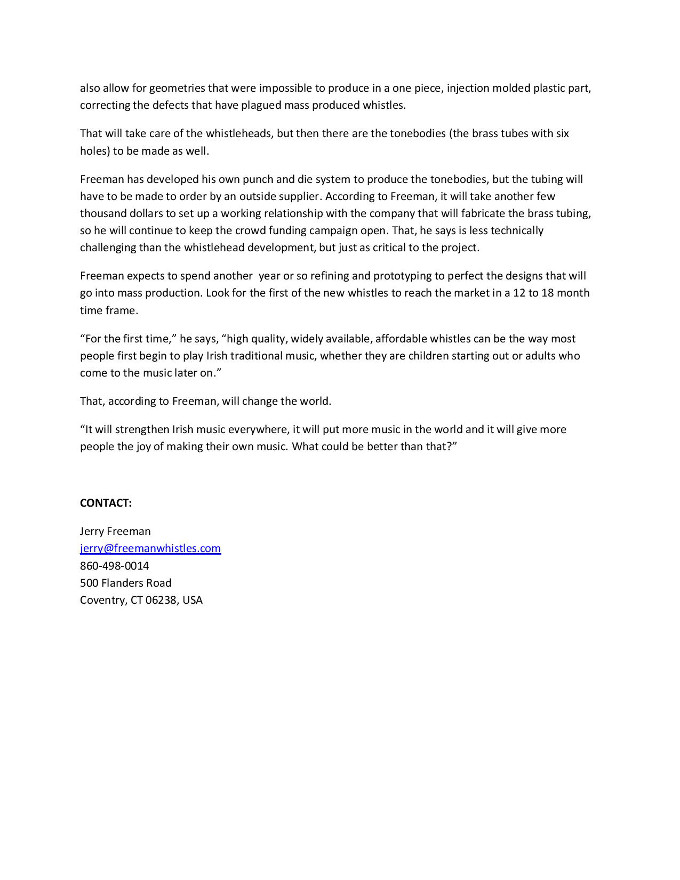
Also, the tooling used to make the whistleheads was copied from one maker to the next. It’s a rather complicated tool, with a slender spike in the “A” mold cavity that forms the inside of the windway, an opposite “B” cavity spike that makes the socket and inside geometry, and a moving side action that locks with the other two parts when the mold closes to make the cavity the plastic flows into.
That’s an inherently problematic tooling design.
Some of the problems with these whistleheads are because of compromises in the geometry so they could be mass produced as a one-piece, injection molded plastic part. Other problems are due to the flexibility of that slender “A” cavity spike that forms the windway. Because it doesn’t align exactly the same every time, parts produced vary considerably in how the windway and soundblade line up inside the whistlehead. Even a few thousandths variation there is a big problem.
So that’s an overview.
As I said, the standard “chassis” for a mass produced plastic top whistle is pretty much a settled affair.
As you can see, there’s been an evolution in the design that eventually stabilized into the whistles that are now being made. Because of the limitations of the production methods, that design’s gone about as far as it can go. Doing it the same way, you can’t make a significantly better whistle than the ones being made now.
Which brings us to tweaking.
Over these twelve or so years I’ve been doing this, I’ve been able to map out the details for a whistlehead that works as it is supposed to, without the drawbacks of the mass produced whistles.
I mentioned the near identical geometry among the various brands of whistles. Even though built on the “standard chassis,” my tweaked whistleheads are far more different from factory run Generations, Feadogs, Waltons, etc., than any of those are from each other. Because of those differences, my designs would be impossible to produce as a one piece, injection molded plastic part.
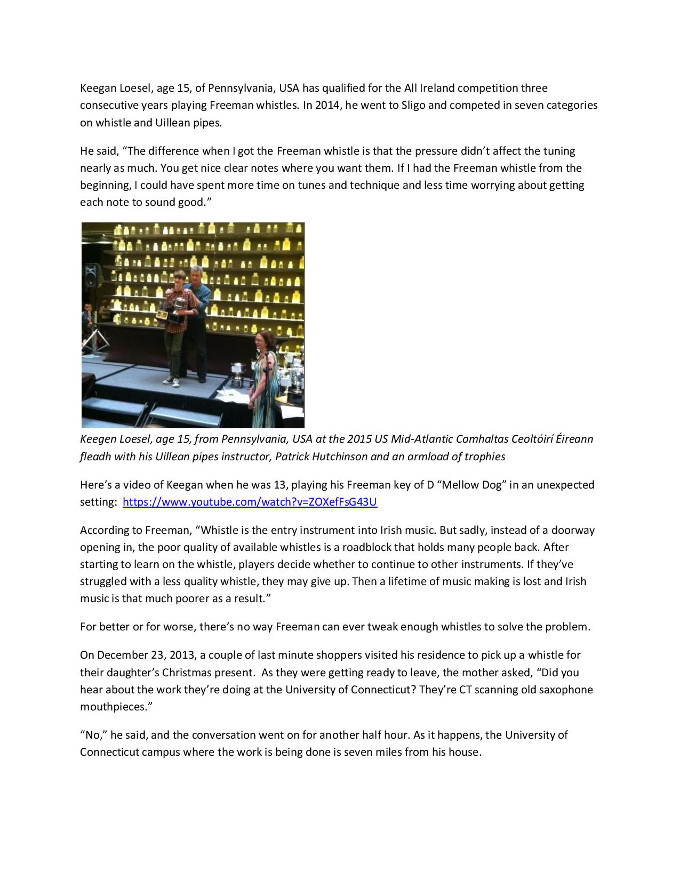
At present, I offer four different whistles in D (Blackbirds, Bluebirds, Mellow Dogs and tweaked Generations), with four distinct voicings and different playing characteristics. In all, including the various voicings and keys, I offer 16 different whistles. (It bears mention, the 2014 All Ireland under 12 whistle champion played a Freeman Bluebird in the competition. The adjudicators commented how sweet the whistle sounded.)
The voicings are distinct from other currently available Generation-type whistles (sweeter in varying degrees, and also more versatile to play). My tweaked Generations are voiced as closely as possible to the classic, pre-1980’s Generations, different from the Generations being manufactured today.